


Production Blog
Farmers Urged to Scout for Tar Spot as More Cases Detected
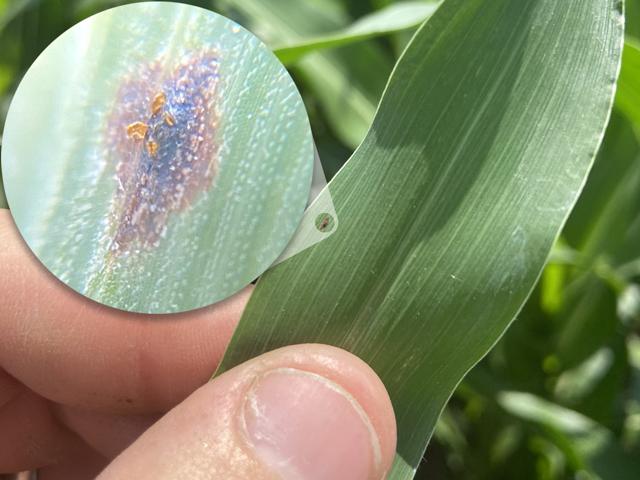
This week Kansas, Nebraska and Iowa have joined Indiana in positive tar spot detections in corn. Farmers are encouraged to check the lower canopy of the corn crop for first signs of the characteristic black spots and continue to monitor as the season progresses.
University of Nebraska Extension Plant Pathologist Tamra Jackson-Ziems told DTN via email that the first detections she's aware of in that state have come in pivot-irrigated fields.
"It's right on time according to growth stages -- V6 to V8 in all the reported fields so far," she observed. The Nebraska counties of Adams, Antelope, Boone, Clay, Greeley, Hamilton, Pierce and York have reported tar spot.
In Iowa, the first positive detections were reported in Madison, Jaspar and Calhoun counties in the June 13-15 time frame. Iowa State University plant pathologist Alison Robertson said the disease is present at very low incidence (one to few plants per field) and low severity (one spot on a leaf).
"We've been cool with wet periods," Robertson told DTN via email. "When scouting for tar spot (this time of year) look on the bottom 1 to 3 leaves of the crop. Focus on fields with a history of tar spot and hybrids that may be more susceptible to the disease."
P[L1] D[0x0] M[300x250] OOP[F] ADUNIT[] T[]
Brown and Republic counties in Kansas have reported the disease. Indiana was the first state to officially detect tar spot in 2026. So far, Randolph and Rush counties have been recorded with positive tar spot samples in that state.
The key environmental factors favoring tar spot are moderate temperatures, high humidity and prolonged leaf wetness, particularly in areas with a history of the disease and a presence of corn residue.
Tar spot appears as small, raised black spots scattered across the upper and lower leaf surfaces. The fingernail test is recommended as the best way to sort tar spot from insect frass or other disease symptoms. Tar spot lesions are raised and feel bumpy on the leaf surface and often are surrounded by a small brown or tan halo and will not scratch off the leaf. Insect frass will not have a halo or margin surrounding the lesion, and should wash off with water.
For a map that tracks tar spot go to: https://cropprotectionnetwork.org/… Counties, provinces or parishes that are highlighted in yellow on the map have had tar spot confirmed by University extension personnel and/or diagnostic laboratories in this current growing season.
A confirmation of tar spot does not mean the disease is severe or a fungicide application is needed. For more information about management of tar spot go to: https://cropprotectionnetwork.org/…. Also available is a table to sort the benefits from applying fungicides based on first detection and environmental conditions that favor further development. Find a fungicide efficacy tool here: https://cropprotectionnetwork.org/…
A risk assessment tool from the Crop Protection Network can be found here: https://cropprotectionnetwork.org/… or here: https://connect.doit.wisc.edu/…
A DTN feature with Purdue University plant pathologist Darcy Telenko recommends 10 important steps when scouting for tar spot, including early scouting tips: https://www.dtnpf.com/…
Find the latest release on tar spot from Iowa State University here: https://crops.extension.iastate.edu/…
Pamela Smith can be reached at pamela.smith@dtn.com
Follow her on social platform X @PamSmithDTN
(c) Copyright 2026 DTN, LLC. All rights reserved.
Comments
To comment, please Log In or Join our Community .