

Livestock and Rodeo Featured on Capitol Hill
Great American State Fair Brings Livestock Showmanship, Rodeo and Agriculture Education to Nation's Capital
WASHINGTON (DTN) -- Between the U.S. Capitol and the Washington Monument, cattle, goats and rodeo have taken over the National Mall as part of the 16-day Great American State Fair.
Held as part of the nation's 250th anniversary celebration, the fair features daily livestock exhibitions, evening rodeos and state pavilions showcasing American agriculture, agribusiness and rural life in the heart of Washington, D.C.
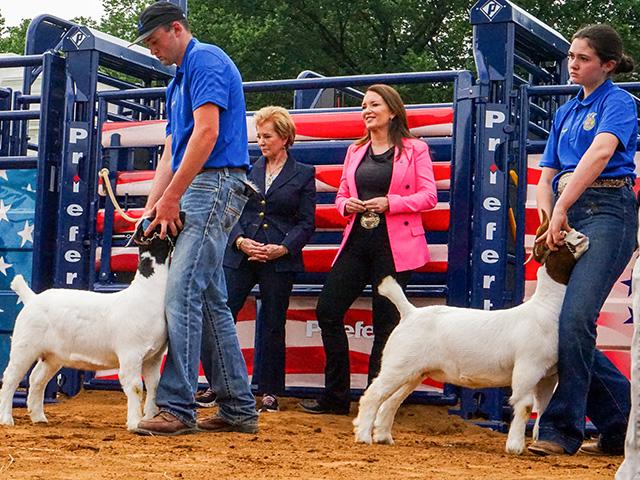
Each morning, members of FFA chapters, 4-H clubs and farm families step into a show ring, introducing their livestock to visitors who may have never seen a live steer or market goat up close.
"I filled out the application, not really thinking that we would ever get invited to come, and we did. So we're here," said Caitlin Grantham, agriculture instructor at Washington High School in Charles Town, West Virginia.
Grantham brought students representing three farms to exhibit cattle and market goats. Led by rodeo announcer Justin McKee, exhibitors introduced their animals, explained their projects and answered questions from judges and spectators.
Among those judging in the ring were U.S. Agriculture Secretary Brooke Rollins and Education Secretary Linda McMahon.
"For the first time, in at least 100 years, we have real livestock and FFAers and 4-Hers here at the National Mall to celebrate our great American history," Rollins said.
Rollins spent time talking with students in the ring as well as cattle producers gathered along the fence, many of whom had attended President Donald Trump's dinner the previous evening. One of the cattle exhibited traced its genetics to the herd of renowned Texas cattleman R.A. Brown, whose family was represented at the event.
"We have had county fairs since before the Revolution, and state fairs began shortly after 1830," Rollins said.
THE NATION'S MOST SECURE LIVESTOCK
Bringing livestock into the nation's capital required far more paperwork than a typical county fair.
P[L1] D[0x0] M[300x250] OOP[F] ADUNIT[] T[]
Grantham said every animal needed current vaccinations, rabies documentation was required, certificates of veterinary inspection (CVIs), RFID identification tags and permits issued through D.C. Health before entering the National Mall.
"We fortunately have some great veterinarians that we work with on a regular basis and they were able to get that done in the short period of time that we had," Grantham said.
Once on the grounds, exhibitors shared the Mall with one unusual audience -- Secret Service agents who patrolled the show ring throughout the event.
AGRICULTURE ON DISPLAY
Beyond the livestock arena, the fair features exhibits from some states highlighting local agriculture, food production and rural economies.
The USDA pavilion distributes free fresh fruit to visitors, while state exhibits showcase departments of agriculture and agribusinesses central to the state's success. Educational panels featuring farmers, ranchers and agricultural leaders accompany culinary demonstrations, like Extension educators would do at county fairs.
The Kansas booth features interactive crop displays, North Dakota highlights its sunflower industry, Wyoming let kids practice their lasso skills and Nebraska showcases irrigation technology from Valmont Industries.
Wayne Connley, curator for the USDA Historical Society & Museum, researched the 1926 Sesqui-Centennial International Exposition, a predecessor to the celebration taking place on the National Mall today.
Hosted in South Philadelphia, the exposition featured the Palace of Agriculture, which taught fairgoers how the United States transformed "a wilderness into a food-producing powerhouse supporting 120 million people," he told DTN.
The Sesqui, as it was known, covered 450 acres of former marshland in what is now FDR Park and the South Philadelphia Sports Complex. Organizers built five massive "palaces" in an Aztec-Mayan style, an 80-foot illuminated Liberty Bell replica, a recreated colonial High Street and a new 100,000-seat stadium.
Heavy rains, unfinished construction and muddy grounds turned the event into what many called "America's Greatest Flop," drawing about 6 million to 7 million visitors instead of the expected 40 million to 50 million -- mirroring discourse over the fair's current state in 2026.
During her ringside remarks, Rollins said, "To have every state represented here on the National Mall is really incredible."
However, national coverage of empty booths suggested otherwise. Trump redirected America 250 funds -- managed by a nonpartisan organizing committee -- into a separate "Freedom 250" celebration. In protest and due to cost concerns, several states, including Connecticut, Illinois, Maine, Massachusetts, North Carolina, Oregon, Pennsylvania, Rhode Island, Vermont and Washington, did not send official delegations. As a result, some booths sat empty, marked only by state backdrops and chairs.
But a few found solutions. Sen. John Fetterman's, D-Pa., office organized a last-minute design effort and one woman from Massachusetts organized maple syrup and pamphlets for her state's booth, NOTUS reported. Other companies sponsored the booth in coordination with Freedom 250 organizers.
Farm groups, including Farm Bureau, were approached about a month before the event and asked to sponsor individual state exhibits, but with limited lead time, all declined, one source familiar told DTN.
USDA employees from across the department's Washington mission areas were assigned to staff the event, where Rollins has made nearly daily appearances.
One Ohio booth organizer in the governor's office said roughly $750,000 dollars had been set aside for participation, though not all of it had been spent at the time of the event.
The Great American State Fair ranks among the nation's longest-running fairs. At 16 days, it trails only events such as the Arizona State Fair (32 days), the State Fair of Texas (24 days) while exceeding the Indiana State Fair (15 days) and the New York State Fair (14 days).
Livestock demonstrations are held daily from 10 to 11:30 a.m., with rodeo performances each evening.
The Great American State Fair runs through July 10 on the National Mall.
Learn about the event: https://freedom250.org/….
Jake Zajkowski can be reached at jake.zajkowski@dtn.com
Follow him on social platform X @jzajkow
(c) Copyright 2026 DTN, LLC. All rights reserved.