

Sort & Cull
The Cattle Complex Seems To Be Asking: Now What?
Now that the first full week of 2026 has passed, and cattlemen and traders alike are back into the normal cadence of business following the holiday run, everyone seems to be asking the same question: Now what?
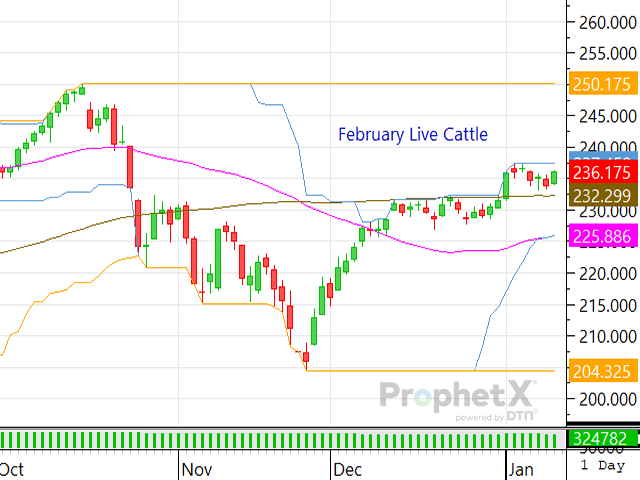
Since the beginning of December, the cattle complex has seen a sizeable rally. Both live cattle and feeder cattle contracts have trended higher, and the fed cash cattle market has seen prices trade mostly higher.
P[L1] D[0x0] M[300x250] OOP[F] ADUNIT[] T[]
But after recently conquering the market's 100-day moving average in both the live cattle and feeder cattle contracts, the market has almost adopted a new cautious tone. Traders don't seem interested in supporting the contracts much more unless they are likely to see a sizeable fundamental advancement. But when you look at the market from a fundamental standpoint, all-in-all, things look fairly strong.
Just last week the fed cash cattle market again traded higher as Northern dressed cattle were marked at mostly $365, which is $5 higher than the previous week's weighted average. Southern live cattle traded at mostly $232, which is $1 higher than the previous week's weighted average. As seasonally expected, boxed beef prices traded higher last week, too. Last week boxed beef prices saw an uptick as choice cuts throughout the week averaged $354.33 (up $5.59 from the previous week) and select cuts averaged $351.22 (up $6.70 from the previous week) with a movement of 707 loads. It's not unusual to see a beef rally in January as retailers are restocking following the holiday run. But the market also expects to see somewhat of a stale period from February until the middle of April as consumers haven't historically purchased aggressively again until the spring weather warms up around the later part of April or first part of May.
But for some time now, packers have religiously managed throughput to minimize their need of the fed cash cattle market. They will likely do so all the way through the second quarter of 2026 when supplies are expected to be the thinnest.
There's plenty of bullish factors supporting the marketplace right now. At the same time, packers know fed cash cattle supplies are going to be thinnest through the first half of the year, and they are trying to keep the fed cash cattle market from getting too far ahead of them. So, while some things change from year to year, some things also just stay the same. And the battle between packers and the grassroot sector of the industry carries into 2026, just like it has in past years.
ShayLe Stewart can be reached at ShayLe.Stewart@dtn.com
(c) Copyright 2026 DTN, LLC. All rights reserved.
Comments
To comment, please Log In or Join our Community .