



Spring Crop Insurance Prices Set
Crop Insurance Price Falls to $4.62 for Corn, Soybeans Bump Up to $11.09
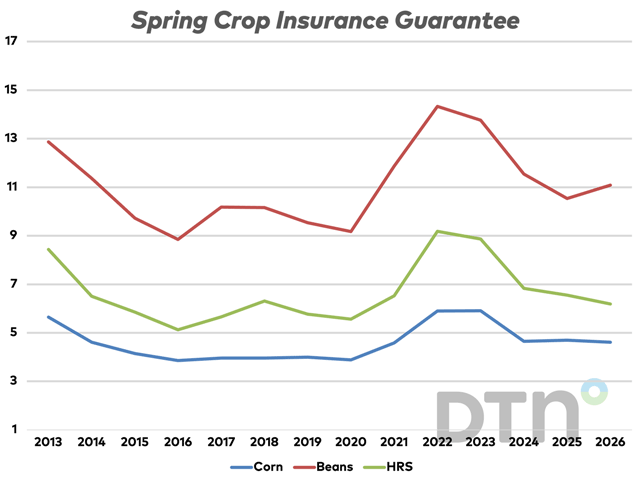
SAN ANTONIO (DTN) -- Farmers will go into spring planting with a little weaker price protection for corn and spring wheat, but will see a little stronger price protection for soybeans.
The spring projected price used for crop insurance revenue policies for the 2026-27 corn crop on Friday ended the February price discovery period at $4.62 a bushel, down 8 cents from a year ago. The soybean projected price came in at $11.09, up 55 cents from last year's price. Projected prices for spring wheat are $6.19 a bushel, which is down 36 cents from last year.
The spring projected prices are computed using the average daily close of the November soybean and December corn futures contracts during February. The prices become a key component of revenue protection crop insurance, the type of policy purchased by most commercial row-crop farmers.
Farmers now have until March 15 to buy their policies for the crop year.
Farmers purchase a range of coverage, usually between 70% and 85%. Along with their farm's actual production history (APH) yield, the projected price and coverage level are used to determine a revenue guarantee.
Changes in the One Big Beautiful Bill Act (OBBBA) could also lower premiums for farmers under some of the policy changes. Congress also increased protection levels and premium subsidies for area add-on policies such as Enhanced Coverage Option and Supplemental Coverage Option (ECO and SCO) that could make those policies more attractive to add to a base policy. USDA officials said changes in the OBBBA should save farmers about $400 million in premiums this year.
P[L1] D[0x0] M[300x250] OOP[F] ADUNIT[] T[]
Looking at the insurance prices, DTN Lead Analyst Rhett Montgomery said, "Soybeans stand out as the beneficiary of an impressive rally through the discovery month of February."
In their initial outlook for the 2026-27 crops, USDA economists last week forecast farmers will plant 94 million acres of corn and 85 million acres of soybeans. Spring wheat and durum plantings are projected at about 12 million acres.
However, looking at the per-acre profitability projections (based on USDA cost of production forecasts and 10-year average yields), corn still offers a per-acre edge, albeit both are projected to be negative returns in 2026 based on February's insurance prices, Montgomery said.
"This leads me to believe a normal 'mean reversion' in acreage -- such as the one outlined in the Ag Outlook Forum -- is reasonable, but I don't see an extreme financial incentive for producers to pivot drastically to soybeans, such as we saw with corn area in 2025 for example," he said. "Time will tell on this, but these are just my very early thoughts."
Overall, crop insurance is still a wise investment given the protection on two fronts: easing production risk and price risk. In terms of 85% coverage, soybeans are protected at a $9.43 floor, corn at a $3.93 floor, and spring wheat at a $5.26 floor.
In the case of an 80% coverage policy, indemnities would begin to pay without yield losses when corn prices hit $3.70 or soybean prices dip below $8.87 per bushel.
There are pricing opportunities to improve these floors via the use of put options, as one example, Montgomery said.
"Otherwise, from a marketing standpoint, my best advice is to remain observant through the typical seasonal high window later this spring and early summer," he said. "February carries a relatively low chance of being the calendar-year high for the new-crop futures boards."
Going back to 1994, the price high has occurred only once in February for either the November soybean board or the December corn board.
"For corn, unfortunately, 2025 was that one year, which proves that anything is a possibility when operating within the grain markets," Montgomery said. "That being said, with November soybean prices returning to late 2025 highs this week, that looks like a decent opportunity for those completely unsold to test the waters with some small-percentage, risk-off sales for new-crop 2026."
Chris Clayton can be reached at Chris.Clayton@dtn.com
Follow him on social platform X @ChrisClaytonDTN
(c) Copyright 2026 DTN, LLC. All rights reserved.