

Editors' Notebook
Progressive Farmer Photographer Avoids the 'Shock,' Captures the 'Awe' for Cover
JEFFERSON CITY, Mo. (DTN) -- Perspective is one of a photographer's greatest tools. Want to transform a scene from mundane to memorable? Capture it from an angle that the world is not expecting.
Sometimes this means slithering like a snake on your belly or perching like a hawk atop the highest vantage point available. Sometimes it means crawling into tight spaces and peering back out like a turtle or submerging yourself up to your eyeballs like an alligator waiting to ambush its next meal.
During a career that's now spanned a quarter century and counting, I've put myself in some pretty precarious positions to capture images. If there's a rail, you can bet I've leaned over it on my tippy-toes as far as I could go. I've hung off the fronts of moving boats and off the backs of moving trucks. I've shot from horseback and while lying flat on my back. I've even taken photographs of an airplane in flight while literally hanging out of another airplane, a parachute strapped to my back.
"If you fall out, don't panic. Just relax and pull that ripcord," the pilot told me matter-of-factly. Easy for him to say, right?
So, when the manufacturers of The Weed Zapper brand of electrical weeders invited me to come out to the field and see their machines in action last fall, my creative gears began grinding. What would be the best way to visually show this technology in action? Where would I need to position myself? How should I shoot it?
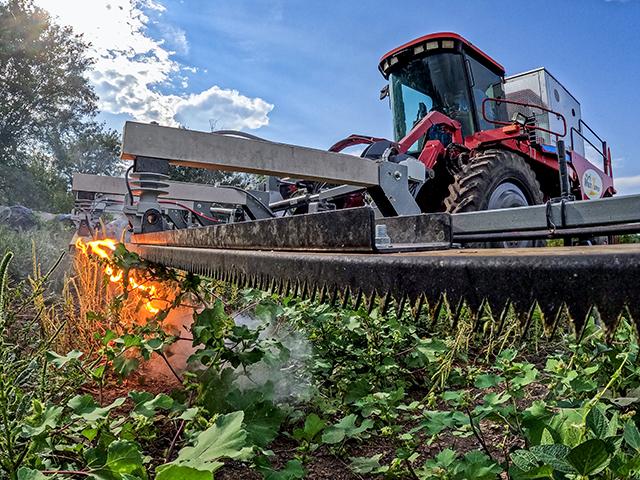
As it would turn out, I would trip the shutter on one of my most dramatic photos of the year to date, which Progressive Farmer magazine featured on the cover of its May 2026 issue, from one of the least dramatic places to do so -- sitting on the buddy seat inside the machine's air-conditioned cab.
P[L1] D[0x0] M[300x250] OOP[F] ADUNIT[] T[]
For those unfamiliar, The Weed Zapper is produced by Old School Manufacturing, a west-central Missouri company established in 2017. The company's original model consisted of an electrode boom and tractor-mounted cart containing a generator and transformer (they subsequently produced self-propelled models.) The tractor's PTO would spin the generator to create electricity, which was then stepped up through the transformer and fed as a positive charge to the electrode boom. Coulters would contact the soil and ground the machine.
When the electrode boom would touch a weed, an electric circuit was completed, and as many as 15,000 volts would travel through the plant, causing moisture in the weed to expand, rupturing cell walls and leading to plant death.
Upon hearing "DEATH" and learning that 15,000 volts was enough energy to simultaneously power five or six all-electric homes, my next questions were all about safety. How did they ensure the operator's safety? If a unit was running in a field, how close could a human (aka ambitious photographer) get without danger?
While redundant safety systems ensured that the person running the machine was protected, those outside of the machine must maintain a safe berth -- a distance of at least 50 feet. For photography purposes, this created a challenge, especially for capturing dramatic results.
For a photographer standing at that safe distance in the field, a zoom lens was required. While I could hear the "snap, crackle, pop," of weeds getting fried and even smell it (two sensory experiences I didn't expect), that vantage point produced images that weren't overly compelling from a visual sense. Even when I'd catch the split second when an electrical arc would flash from a weed to the machine like a bolt of lightning, I was standing on the ground, at a typical eye level. The perspective was not unique.
So, I launched my drone. I was no longer limited by a physical distance, but the aerial view from the drone's wide-angle lens placed too much emphasis on the machine itself and not the job it was doing. Those lightning bolts weren't as pronounced. I needed a more dramatic perspective.
Luckily, I had one more option. I reached inside my bag and pulled out my GoPro action camera, which can be controlled remotely. If I could mount it on the Weed Zapper, it might offer a perspective no photographer holding a camera could ever achieve.
After a bit of trial and error, I cobbled together a mounting arm and positioned the camera near the end of the weeder's electrode bar. The perspective was unlike any I'd seen, but would the camera operate once those 15,000 volts started flowing?
I launched the GoPro app on my phone, paired it to the camera and jumped in the Weed Zapper cab with Ben Kroeger, co-owner of Old School Manufacturing. As he fired up the generator, the moment of truth was at hand.
Eureka! It was working!
We began rolling across the field of organic soybeans and annihilating every weed that dared to stand above the crop canopy. After a little practice, I was able to anticipate when the "lightning" would strike and hit the remote shutter accordingly. The best of my efforts would eventually find its way to the cover of Progressive Farmer and help tell the story of a family-owned company.
You can read more about The Weed Zapper here: https://www.dtnpf.com/… .
Jason Jenkins can be reached at jason.jenkins@dtn.com
Follow him on social platform X @JasonJenkinsDTN
(c) Copyright 2026 DTN, LLC. All rights reserved.
Comments
To comment, please Log In or Join our Community .