

Ag Weather Forum
Ocean Network Research Cuts Leave Gaps in El Nino Analysis
The most popular topic in agricultural weather in 2026 is El Nino. The onset and related effects of a strong El Nino in the Pacific Ocean command attention every day -- not only in the food production arena, but in general news headlines as well.
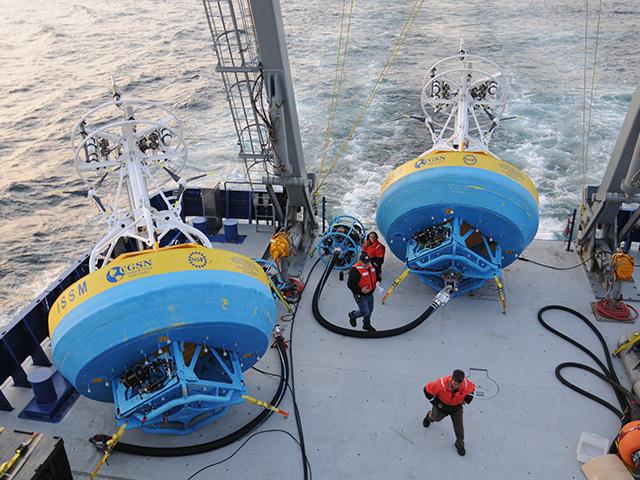
However, at a time when ocean conditions and developments are so prominent, a comprehensive network of ocean buoys, monitors, underwater gliders, and anchored surface platforms to measure and catalog deep-water developments is being taken apart. The Ocean Observatories Initiative (OOI) -- in operation since 2016 -- has started taking more than 900 deep-sea monitors out of the water. An article on the OOI's website describes this operation as a "major descoping" enacted by the OOI's administrator, the National Science Foundation (NSF).
The Ocean Observatories Initiative was built after more than 20 years of meetings and projects focused on getting better ocean measurements from the surface all the way to deep levels. The OOI was commissioned and accepted by the NSF in 2016. At that time, data from hundreds of sensors became freely available for download in near-real time online. The OOI was built at a reported cost of $368 million, The annual OOI operating budget is approximately $39 million. The federal government's proposed 2026-27 budget for the OOI has been reduced to $8 million.
Sites where monitors are being pulled out of the ocean are located in the Gulf of Alaska; the Pacific coast area of Washington and Oregon; off the New England coast in the Atlantic; and in the Irminger Sea, a portion of the North Atlantic between Greenland and Iceland.
P[L1] D[0x0] M[300x250] OOP[F] ADUNIT[] T[]
Published summaries of how these stations contributed to weather and climate knowledge show an impressive list. The stations have given information to help study the Atlantic Meridional Overturning Circulation -- a huge global temperature conveyor belt. On the Pacific coast, the stations monitored low-oxygen zones and ocean acidification in real time. And in the North Pacific, the monitors detected changes in deep subsurface conditions that eluded satellites. The monitors' information helped scientists track deep thermal patterns of deadly marine heatwaves.
But does this scaling back of the ocean monitoring network matter to producers in the Plains and Midwest? Two state climatologists said that any loss of ocean information has a negative ripple effect.
"The oceans have a HUGE influence on our weather from daily to decadal timescales," Illinois State Climatologist Trent Ford said in an email. "We only need to look to all of the coverage of the impending El Nino to know that ... ocean temperatures and salinity affect temperature and precipitation patterns in the Midwest in every season."
He noted that society may know more about deep space than it does about the deep oceans. "Dismantling this observation system would further reduce data for weather and climate forecasts, which could make these forecasts less skillful, especially seasonal forecasts like those for El Nino."
Justin Glisan, state climatologist of Iowa, emphasized that forecast model performance could be hindered by the gaps in data coverage as instruments are removed from their sites in the North Pacific and North Atlantic. After all, their contributions have gone on for the past 10 years.
"The loss of any observational network, particularly those used to monitor the climate system, will have a significant impact because a reduction of data inputs increases numerical uncertainty in climate models," Glisan said in an email.
"For example, the substantial reduction in meteorological observations from ship and airline traffic during the COVID-19 pandemic affected short-term forecasts negatively." Glisan also pointed to variable storm intensities as a feature which calls for robust information. "As precipitation becomes more variable during the growing season, for example, we need more tools in the toolbelt to help our farmers and producers better understand what will happen seasonally, but also several years out," he said.
A prominent example of intensive marine heatwave impact occurred just five years ago. In 2021, a stationary high-pressure ridge brought record heat and extensive agricultural damage to farms and ranches in the northwestern U.S. Ocean information on that heat wave was detected by the sensors in the North Pacific which are on track to be removed.
More on the forecast for the 2026 El Nino is available here: https://www.dtnpf.com/….
Bryce Anderson can be reached at bryce.anderson@dtn.com
(c) Copyright 2026 DTN, LLC. All rights reserved.
Comments
To comment, please Log In or Join our Community .