



Technically Speaking
Is That a Bear Flag Pattern on May Soybeans?
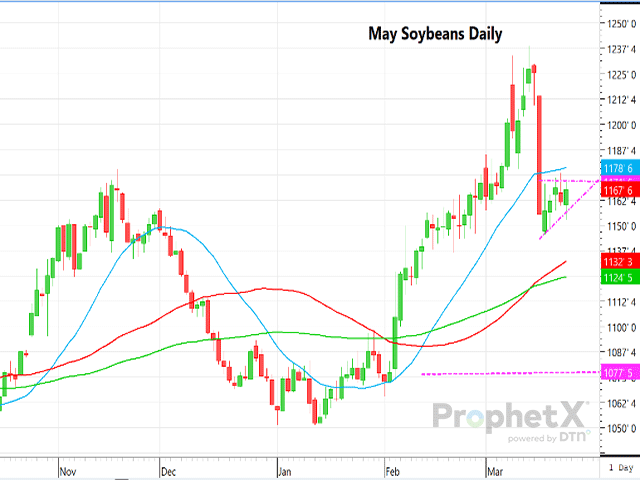
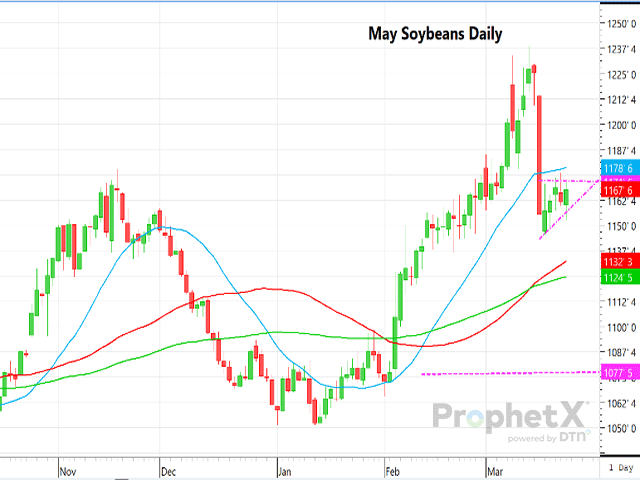
MAY 2026 SOYBEANS:
Although it is difficult and perhaps an exercise in futility talking about fundamentals and technicals when it seems each day's market action is driven by social media quotes referencing the conflict in the Middle East, one pattern stands out in spot soybean futures. As I said, it may mean little, but there is a reason why this pattern could be a hint of what might come.
That pattern is a glaring bear flag chart pattern, which began the day President Trump announced the U.S.-China summit, originally slated for April 1, was likely to be delayed by five to six weeks. That drove spot beans to limit losses of 70 cents per bushel. The summit, following President Trump's request that China buy 8 million metric tons (mmt) of old-crop U.S. soybeans, will no doubt result in a discussion of soybeans and China's plans. Multiple news sources continue to promote the idea that China is awash in soybeans right now after taking more South American beans than U.S. this year. Although the U.S. did sell roughly 12 mmt of old-crop soybeans to China, some 7 mmt of that has still not shipped. For the months of January and February, imports of U.S. beans by China fell to just 1.5 mmt from 9.1 mmt the previous year. Brazil and Argentina fulfilled the rest of that demand. China also slowed interest in shipping Brazilian beans due to contamination of weed seeds and more stringent Brazil port inspections slowed down shipments from there. The delay in the Beijing meeting has surely narrowed the window for China to satisfy Trump's desire in the old-crop slot. In the absence of such a purchase, U.S. exports are surely overstated, and ending stocks understated, which has potential to send prices lower. We also have the March 31 USDA Prospective Plantings and quarterly Grain Stocks reports ahead, which could certainly change the narrative.
P[L1] D[0x0] M[300x250] OOP[F] ADUNIT[] T[]
Technically, the chart pattern that appears to be setting up is a bear flag chart pattern, which often suggests another major move to the downside. If that should come to fruition, it would suggest prices could move into the $10.75 area. These chart patterns are not foolproof and could go either way, but are something to keep an eye on. A rally and close above the $11.80-$11.82 area would render this chart pattern moot and meaningless. It is awfully tough to rely on any fundamentals and technicals in the middle of the volatile outside forces we are seeing now, but I thought this was worthy of a mention.
DECEMBER CORN DAILY
With the all-important March 31 USDA Prospective Plantings and quarterly Grain Stocks reports scheduled for release in eight days, new-crop December corn is the one to watch. December was on an upward run that saw it rally over 50 cents per bushel as U.S. demand continues to overachieve and calls for reduced corn acres at the expense of soybeans circulated.
The conflict in the Middle East has thrown another wrench into the acreage guessing game as fertilizer, natural gas and crude oil prices soared on the heels of the Middle East war and attack on energy. Fuel, fertilizer and transportation costs are much higher than before the conflict began. No one has a clue as to which way this market may be headed. However, a couple of key areas to watch are the double top up near $4.99 and support in the $4.75-$4.80 area. A rise above or close below those areas could signal the next move. Weighing on the market will continue to be the 2.1 billion bushel (bb) ending stocks number, which some feel could climb another 200 to 300 million bushels (mb). The jury is still out on this one.
**
Comments above are for educational purposes only and are not meant as specific trade recommendations. The buying and selling of commodities, futures or options involve substantial risk and are not suitable for everyone.
Dana Mantini can be reached at Dana.Mantini@dtn.com
(c) Copyright 2026 DTN, LLC. All rights reserved.
Comments
To comment, please Log In or Join our Community .