



South America Calling
Last Month of Brazil's Wet Season Looking Drier
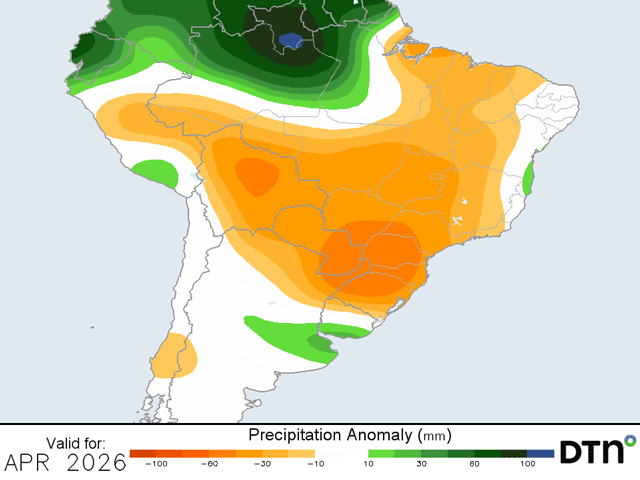
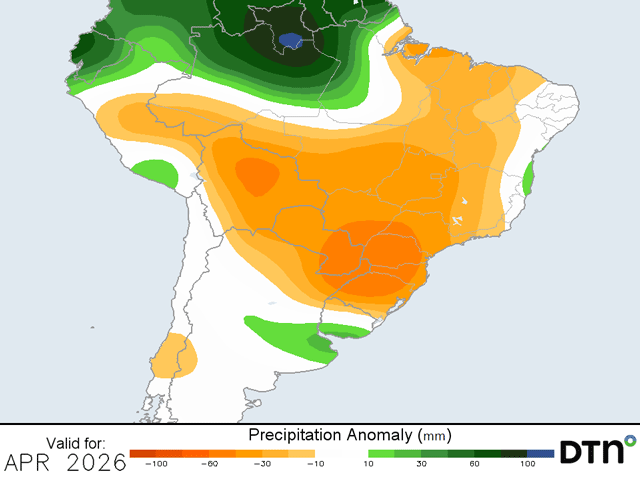
The wet season in Brazil has been an odd one this year. It started with sporadic showers that were early but came very broken by cold fronts moving through during October. Though showers became much more consistent around U.S. Thanksgiving, they have been largely falling at a below-normal pace for the entire season. Now, with the last month of the wet season left to go, it appears below-normal rainfall is likely to continue.
The lower rainfall was fine for the soybean crop that was planted in September and October. Despite some irregularity in the rainfall, there was plenty to fill pods in January and February, which seems to be resulting in a record crop this year. But the limited rainfall has meant below-normal soil moisture for the second season (safrinha) corn crop.
P[L1] D[0x0] M[300x250] OOP[F] ADUNIT[] T[]
Corn planting still is not complete but is close. Conab estimates just under 92% of the crop has been planted, with the remaining work to be done on the outskirts of the primary region as well as portions of western Parana where rainfall has been rather heavy in some areas lately.
Satellite estimates for soil moisture are showing rather large areas of central Brazil as having below-normal levels for this time of the year, necessitating the rainfall to continue to be strong and long-lasting in April and ideally into May, like it did last year. However, the forecast does not call for that. Some long-range models and DTN's forecast hint at below-normal rainfall to conclude the wet season, which may include an early end to the season. Usually, these rains start to shut down in mid-April and are fairly dry starting in early May as the last 30 millimeters (1.2 inches) falls and is almost completely dry afterward. Southern areas of Brazil may still see fronts moving through with showers in May that can be beneficial for the crop there.
Any early end to the wet season rainfall would be damaging. Producers hope to get their corn through pollination before the rains end to ensure good pollination and early grain fill. Afterward, they count on the built-up soil moisture during the wet season to carry them through the fill process. In a normal year, this can be achieved with fair amounts of success and average yields of around 100 bushels per acre. Those yields would be unfortunate here in the U.S., but are enough to make planting a second crop worthwhile.
Despite DTN's forecast and its implications, not all long-range models agree. Recent runs of the American GEFS model showcase above-normal precipitation across important states like Mato Grosso and Minas Gerais, as well as farther north in April, but still have drier conditions farther south. So, the forecast is not favorable, but it's also not a given. With the soil moisture situation still largely lacking across large areas of the country, rainfall will be more important to have continue this year.
To find more international weather conditions and your local forecast from DTN, visit https://www.dtnpf.com/….
John Baranick can be reached at john.baranick@dtn.com
(c) Copyright 2026 DTN, LLC. All rights reserved.
Comments
To comment, please Log In or Join our Community .