


Sort & Cull
External Pressure Drove Cattle Complex Lower on Monday, Despite Strong Trade in Cash Market Last Week
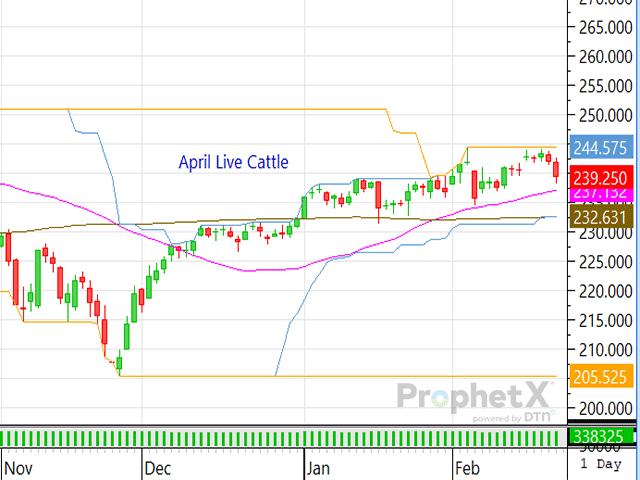
I've always been a fundamentalist at heart -- whether that's in regard to life or how I approach analyzing the markets; to me tangible fundamentals have always been the safer bet. But I remember distinctly one day on our weekly analyst team call, retired DTN Lead Analyst Todd Hultman said, "Don't ever get too confident in the fundamental windshield, because it can change right before your eyes." And truthfully, the comment made me raise my brow and pause for a second, as it challenged my beliefs. But as time has passed, Todd's comment has aged like fine wine -- and Monday's performance in the cattle complex is a perfect example of just that.
Last week's trade was truly a rallying force, as the futures complex traded higher throughout the vast majority of the week, and the fed cash cattle complex scored higher prices once again late on Friday when trade finally began to develop. Last week, Northern dressed cattle traded anywhere from $380 to $388.50, but mostly at $388, which is $7 higher than the previous week's weighted average. Southern live cattle traded mostly at $249, which is $1 higher than the previous week's weighted average. Last week's negotiated cash cattle trade totaled 74,704 head. Of that, 86% (64,460 head) were committed to the market's nearby delivery, while the remaining 14% (10,244 head) were committed to the market's deferred delivery option.
And although prices are at all-time highs in the cash sector, the market still opted to trade noticeably lower on Monday. Why is that you ask? There are a number of different factors that played into Monday's lower end. But the biggest factors were:
P[L1] D[0x0] M[300x250] OOP[F] ADUNIT[] T[]
1) The looming concern of a potential strike at the JBS plant in Greeley, Colorado.
2) Traders uncomfortable to push the contracts any higher without first seeing renewed support and interest in the fed cash cattle complex as prices are a little over $10 away from the highs established last October.
3) There again being external pressures looming geopolitically, with tensions high between the U.S. and Iran, and cartel troubles erupting in parts of Mexico.
I share all of this with you to help put into perspective what traders were grappling with on Monday when they ultimately elected to allow the contracts to scale lower. Yes, the market's fundamentals remain incredible -- supplies are tight and demand is extremely strong. But just as Todd mentioned, the windshield of the marketplace can change before your eyes.
I personally believe the market remains in a strong fundamental position, and I'm not sharing this blog with you to indicate the market's fundamentals are crumbling, but rather to help shed light on some of the other factors that are also weighing on the marketplace.
ShayLe Stewart can be reached at ShayLe.Stewart@dtn.com
(c) Copyright 2026 DTN, LLC. All rights reserved.
Comments
To comment, please Log In or Join our Community .