


Canada Markets
The First Official Look at the 2026-27 Canadian Crop

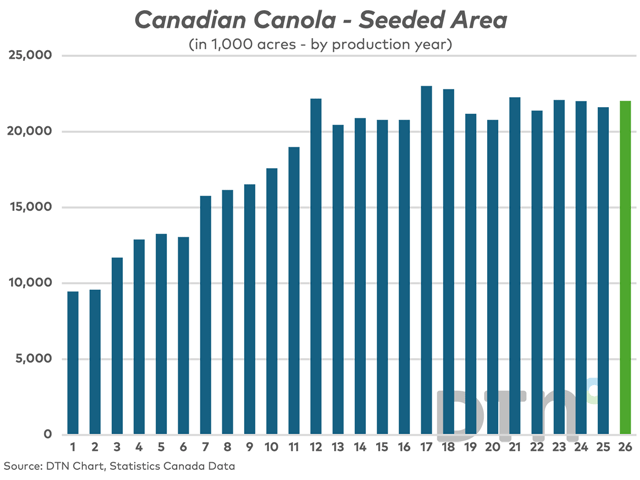
On Jan. 21, Agriculture and Agri-Food Canada (AAFC) released its first look at its 2026-27 crop year projections. The only thing for certain is the final results will be somewhat different. In the meantime, it does provide a bit of encouragement for canola producers, suggesting demand rationing will play a role in marketing the crop once again. This is even with a slight increase in seeded area projected (in green on the accompanying chart to 22.029 million acres from 21.616 million last year. This is also despite all the political risks and trade uncertainties.
Grabbing your attention right out of the gate should be the estimate that exports need to be cut by 700,000 metric tons (mt) from the current crop year's estimate of 8.2 million metric tons (mmt) (or 1.831 mmt from 2024-25 exports) just to keep ending stocks from declining further than 1.65 mmt. That level likely represents roughly minimum pipeline levels, given the expansion of the industry, and everyone maintaining minimum amounts of inventory. That would mark a 1.1 mmt decline from the current estimate of 2.75 mmt for 2025-26 ending stocks -- in part because of another 500,000 mt increase in canola crush for the new crop year.
It is worth noting that AAFC increased the 2025-26 export estimate by 200,000 mt this month (from the December outlook) and reduced its ending stocks estimate by the same amount, presumably due to the rollback of Chinese canola import tariffs. It's also worth noting that AAFC assumes yield will fall back to 2024-25 levels of 38.7 bushels per acre (bpa) from last year's 44.8 bpa.
P[L1] D[0x0] M[300x250] OOP[F] ADUNIT[] T[]
Sticking with the oilseeds, AAFC is looking for a slight increase in soybean area as well to 5.933 million acres from 5.782 million acres last year. In this case, it is looking for a rebound from the drought-damaged yields found in Eastern Canada in 2025-26, with the new crop yield pegged at 47.1 bpa, up from 43.6 bpa last year. That is expected to allow for a slight rebound in exports (to 5.5 mmt from 5.25 mmt in 2025-26) and increase in domestic crush (to 1.75 mmt from 1.7 mmt in 2025-26) while still resulting in an increase in ending stocks (to 650,000 mt from 400,000 mt in 2025-26).
The largest change on the cereal side is a jump in the barley area expected to be seeded. AAFC is looking for barley area to increase to 6.511 million acres from 6.135 million acres in 2025-26. Offsetting the extra 376,000 acres is an expectation that yields will fall back to more normal levels. The 2026-27 yield is pegged at 65.2 bpa compared to an unusual 79.4 bpa last year. That is expected to result in a slight decline in exports (to 3.04 mmt from 3.24 mmt in 2025-26) yet allow a slight increase feed use (to 5.628 mmt from 5.552 mmt in 2025-26), while resulting in a significant decrease in ending stocks (to 1 mmt from 1.7 mmt in 2025-26).
All-wheat is not expected to see significant changes to seeded area, but AAFC does expect a shift out of durum and into other wheat types. Roughly 450,000 acres are expected to be cut from durum wheat and planted to spring wheat. AAFC is looking for durum area to decrease to 6.081 million acres from 6.53 million acres in 2025-26. Wheat other than durum is expected to increase to 20.94 million acres from 20.50 million acres in 2025-26. Yields are expected to fall back to more normal levels here as well. The 2026-27 all-wheat yield is pegged at 48.5 bpa compared to an unusual 55.9 bpa last year. That is expected to result in a slight decline in exports (to 28.5 mmt from 28.55 mmt in 2025-26) and food consumption (to 3.4 mmt from 3.5 mmt in 2025-26) yet allow a slight increase feed use (to 3.928 mmt from 3.561 mmt in 2025-26), while resulting in a significant decrease in ending stocks (to 5.7 mmt from 7.5 mmt in 2025-26).
Oats are expected to see only a marginal increase in area (up 54,400 acres), with a more normal yield that is expected to result in relatively stable use and a slight decline in ending stocks (to 750,000 mt from 830,000 mt in 2025-26).
And, last but not least, corn is expected to see a slight decrease in seeded area (by 27,000 acres), with yield recovering marginally from the drought-reduced yields of 2025 (in Eastern Canada), resulting in an increase in ending stocks for 2026-27 to 1.9 mmt while imports and use basically mirror current 2025-26 projections. In the January report, AAFC did incorporate changes based on the surprisingly large U.S. corn crop and resulting increase in exports on their part. Canadian corn imports were increased 300,000 mt for 2025-26 compared to the December outlook, while (Canadian) exports were cut 200,000 mt and feed use was increased 500,000 mt, leaving 2025-26 ending stocks unchanged at 1.6 mmt.
I welcome feedback along with any suggestions for future blogs. My daily comments can be found in Plains, Prairies Opening Comments and Plains, Prairies Quick Takes on DTN products.
Mitch Miller can be reached at mitchmiller.dtn@gmail.com
Follow him on social platform X @mgreymiller
(c) Copyright 2026 DTN, LLC. All rights reserved.
Comments
To comment, please Log In or Join our Community .