



Canada Markets
A Deeper Dive Into the Recent Agreement Between China and Canada
The canola market continues to celebrate the tariff reduction deal reached between China and Canada (catching it somewhat off guard last week) that is set to restore most of the trade between the two countries. By March, China's canola seed import tariffs are going to be reduced to 15% while canola meal, peas, and seafood products will no longer be subject to tariffs. Canola oil and pork have not been mentioned with it appearing as those negotiations will be left for a later date. In exchange, Canada will allow up to 49,000 Chinese EV imports at a 6.1% tariff rate.
Considering all of misinformation that constantly floats around these days, it is worth taking note of some of the facts.
Canola seed exports are clearly the most important part of the agreement to Western Canada. China had set a record in 2024, importing 5.929 million metric tons (mmt) of Canadian canola seed and obviously taking top spot along the way. As of the end of October, they had only imported 2.033 mmt with little trade expected after that following the Aug. 14 implementation of the anti-dumping duty on Canadian canola seed.
The somewhat surprising announcement takes on added importance given managed money traders appear to have been caught offside. They had built a significant short position in the canola market ahead of meetings between the two countries thanks to their recent pessimism. As of Jan. 6, they were net-short 96,131 contracts or 1.923 mmt, their largest net-short position since early December 2024. It's worth noting that when they turned sellers at the end of June, they were net long a record 141,907 contracts or 2.838 mmt. So, if you're wondering who was primarily responsible for the roughly $100/mt lost since then, those total net sales of over 4.75 mmt can take much of the blame. But now, the buyback of those current short positions should support additional gains.
P[L1] D[0x0] M[300x250] OOP[F] ADUNIT[] T[]
Getting back to the trade deal, canola meal exports are the second most important beneficiary. China had a growing appetite for Canadian canola meal up until 2025's tariff surprise with nearly 2 mmt of imports seen in the three previous years. That total fell to only 736,000 metric tons (mt) in 2025 (as of the end of October) with most of that business being done early in the year. For comparison, the U.S. is the top destination with just under 3.5 mmt in exports being the normal over the past decade. So, a return to tariff-free trade in canola meal will certainly be welcomed by the canola crushing industry.
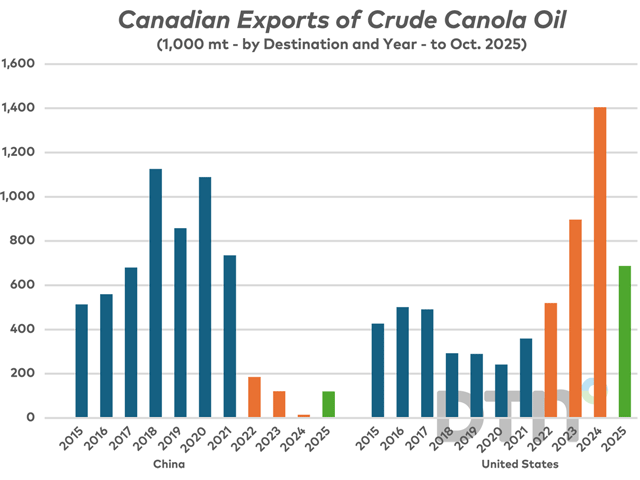
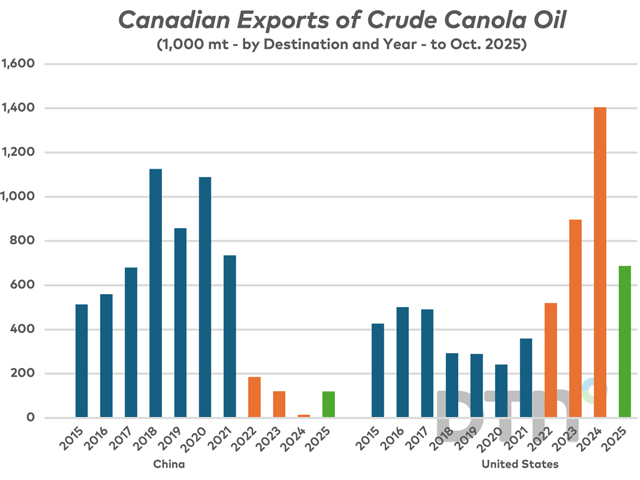
The part that might be attracting attention from the doom-and-gloom crowd is canola oil being left out. That may have been a concession given the relatively little trade there recently anyway. China has purchased almost no refined canola oil since 2021, and little prior to that. They did purchase significant quantities of crude canola oil up until 2022. In fact, they double their imports during the first trade spat over the Huawei CFO, taking as much as 1.126 mmt in 2018 when they weren't buying canola seed to crush. By 2024, that had declined to just 15,000 mt as seen on the accompanying chart. Early in 2025, imports had picked up briefly ahead of the surprise tariff announcement in March when U.S. imports had slowed.
As you can also see on the accompanying chart, the U.S. began dominating the crude canola oil import market back in 2022 when it was deemed eligible for Renewable Fuel Standard blending credits. All indications are that demand is set to only expand further if the mandatory blending obligations are finalized at anywhere close to 5.6 billion gallons in early March as expected. That compares to just 3.35 billion gallons in 2025 and 3.04 billion gallons in 2024. If so, Canadian canola oil will be needed to achieve those targets considering the limited supply of soybean oil. Suggesting there will be little to no crude canola oil available for China regardless of import tariff levels.
And finally, it is worth noting how little was at stake over the whole trade war. Canadian imports of Chinese Electric Vehicles (EV's) averaged just 4,875 units from 2020 to 2022 with that jumping to a high of 38,366 units in 2023 at the height of the EV push. The 2024 total had fallen to 25,776 units. Given the cold climate and resulting failure of the technology to be adapted, the potential for the 49,000-unit tariff rate quota to be reached seems very minimal. So those suggesting it's devastating to Canada are clearly not considering the facts.
Hopefully this helps clear the air and end a few disagreements. Now on to revising the marketing strategy.
I welcome feedback along with any suggestions for future blogs. My daily comments can be found in Plains, Prairies Opening Comments and Plains, Prairies Quick Takes on DTN products.
Mitch Miller can be reached at mitchmiller.dtn@gmail.com
Follow him on social platform X @mgreymiller
(c) Copyright 2026 DTN, LLC. All rights reserved.
Comments
To comment, please Log In or Join our Community .