



An Urban's Rural View
The Elusive Dream of Rock-Bottom Interest Rates
Sometime in the next few months, President Donald Trump will appoint a successor to Jerome Powell, whose term as Federal Reserve Board chair expires next May. It's tempting to think that a Trump-appointed chair will give farmers, ranchers and other business borrowers sharply lower interest rates.
Tempting, but very possibly wrong.
The president, to be sure, does indeed favor much lower rates. At one point he suggested the Fed's benchmark federal funds rate should be between 1% and 2%, some two percentage points lower than today. He's called Powell a "numbskull" and worse for keeping them higher.
Yet even if Trump appoints a Fed chair who shares his preferences -- even one who consults with him on interest rates, as he's demanded -- the Fed may not oblige him.
For one thing, the chair is only one of 12 voting members of the Fed's rate-setting Federal Open Market Committee. Among the other 11 are six governors who, like the chair, are appointed by the president and confirmed by the Senate. They serve 14-year terms. The president can only remove them "for cause."
The other five voters are presidents of regional Federal Reserve banks, who are appointed by those banks' directors. There are 12 such banks and all 12 presidents are members of the FOMC but only five are voting members. The voting privilege rotates among the 12 each year.
Consensus normally reins on the FOMC; most votes are unanimous. Lately, though, there have been dissents. When the committee voted to lower the fed funds rate by a quarter point on Dec. 10, the vote was 9-3.
P[L1] D[0x0] M[300x250] OOP[F] ADUNIT[] T[]
One member -- Trump appointee Stephen Miran -- wanted a half point cut. The other two dissenters wanted to leave the fed funds rate unchanged.
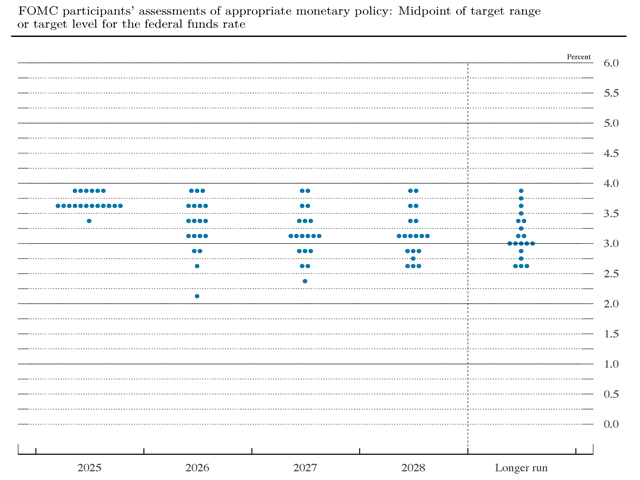
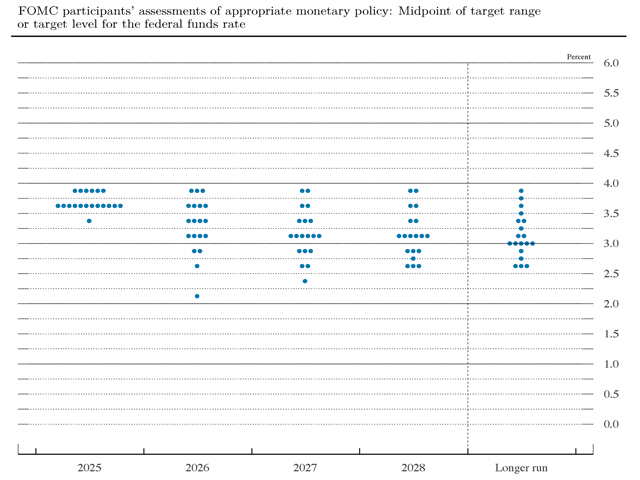
Judging from the latest "dot plot," where the 19 indicate their expectations for future interest rates, votes in the FOMC for big cuts may be hard to come by. Eleven members indicated they expect no further rate cuts next year; four expect no more than one. Read more about that here: https://www.federalreserve.gov/….
Seeing this, Trump might well try to push through legislation giving him more power to reshape the FOMC to his liking. Whether he could get Congress to go along with it is open to serious question. Nor is it clear he would succeed if he tried to reshape the committee through executive orders or lawsuits.
And if Trump is perceived as taking a wrecking ball to the Fed's independence, the bond market would get jittery and push higher the long-term rates business borrowers care about.
What the current FOMC members seem to be saying is the 1.75 percentage points in fed funds rate cuts they've made in the last 16 months are enough, or nearly so. We are, that is, at -- or pretty near -- the "neutral rate of interest."
R-star, as it's called, is the rate that neither stimulates nor restrains the economy, the equilibrium rate that's consistent with the Fed's dual mandate of maximum employment and stable prices.
R-star isn't a set number; its level is something economists debate. It can change over time. One oft-heard theory, however, puts the neutral rate at 3%. With the latest of three recent quarter-point cuts, the fed funds rate is in the 3.25% to 3.5% range.
DTN lead analyst at the time, Todd Hultman, said 15 months ago a fed funds rate below 3% would take some of the pressure off the ag economy. Read more about that here: https://www.dtnpf.com/….
Miran, the Trump appointee who will only serve until January, thinks r-star is closer to 2% than 3% and has voted for half point cuts at recent meetings. See more here: https://www.dtnpf.com/…. In the latest dot-plot (shown in the chart accompanying this article), he is thought to be the FOMC member who predicted a 2026 year-end fed funds rate between 2% and 2.25%.
The problem for the president is that Miran is a lone wolf. Only three other FOMC members saw the year-end 2026 rate below 3% and none other below 2.5%.
A new Trump-appointed chair might well favor a 2% fed fund rate. If the majority continued to think we're at or near r-star, however, the new chair would have to be very persuasive to get a vote for big cuts.
Now, if the labor market were to weaken further and the unemployment rate jump from the current relatively low 4.4%, support for deeper cuts would grow. But there's also a scenario in which support grows for holding steady. Inflation is running around 3%, a percentage point above the Fed's 2% target. What if it goes higher?
Kevin Hassett, one of the president's leading candidates to succeed Powell, said there's plenty of room to cut rates. But he admits if inflation were at, say, 4%, cutting wouldn't be possible.
Finally, there's this: Once a chair is appointed, a president's leverage ebbs. The chair doesn't have to do what the president wants. Courts would be unlikely to ratify a removal if the "cause" was defying the president's policy preferences.
You might say, Donald Trump would never appoint a chair who would defy him. Really? Trump appointed Powell chair in 2018. He's been unhappy with him ever since.
Urban Lehner can be reached at urbanize@gmail.com
(c) Copyright 2025 DTN, LLC. All rights reserved.
Comments
To comment, please Log In or Join our Community .