


Ag Weather Forum
Erratic Monsoon Challenges India's Summer Crops
2026 is proving to be a difficult year when it comes to the performance of the India monsoon. Depending on the area, the India subcontinent monsoon season usually lasts from June to November; however, monsoon rains may begin as early as May in some parts.
This year, monsoon rains moved into the India subcontinent in late May-early June; however, precipitation totals have been variable, and storms have consistently bypassed some of the primary rice, millet and cotton production states -- known as kharif, or monsoon crops, according to a Wikipedia description.
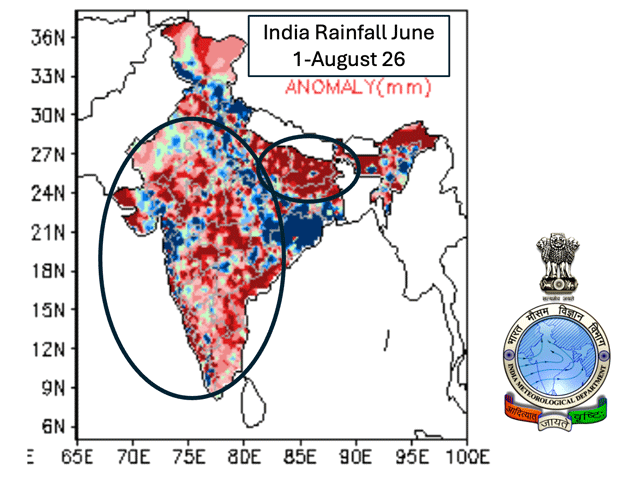
For the top kharif crop production states, monsoon rainfall from June 1 to Aug. 26, 2026, has been less than generous. For the top kharif crop production states, the India Meteorological Department shows these general trends on precipitation since June 1:
-- Andhra Pradesh (southeast): much below normal
-- Karnataka (southwest): below to much below normal
P[L1] D[0x0] M[300x250] OOP[F] ADUNIT[] T[]
-- Uttar Pradesh (north): much below normal
-- Maharashtra (west-central): above normal on the Arabian Sea coast and much-below normal inland
-- Madhya Pradesh (north-central): above normal to much below normal
-- Tamil Nadu (south): below normal
-- West Bengal (east): below normal
-- Gujarat (far west): above normal to much below normal
-- Rajasthan (northwest): mostly below normal
Those summaries do not offer much of an endorsement for this year's monsoon season. The USDA Weekly Weather and Crop Bulletin for Aug. 25 highlighted this variability well. The bulletin noted less than 1 inch of rain in northwest India and neighboring Pakistan, along with extreme heat, stressed grain, oilseed and cotton crops. Similar conditions were noted in the north-central and southern states. Of the major production states, only Madhya Pradesh had rainfall of 2-6 inches. Temperatures in the drier states ranged into the low 40s Celsius or more than 100 degrees Fahrenheit.
Factors suggested behind this erratic monsoon performance focus mainly on the strong El Nino event in the Pacific Ocean. When El Nino develops, it tends to weaken the flow of moist winds across India and contributes to variable and mostly below-normal rainfall. This pattern generally lasts for several months. Additionally, long-term rainfall patterns in India are showing a tendency to be more variable whether El Nino is in place or not. Climate scientists have catalogued differences in the way that rainfall arrives. Dry spells are longer and then are followed by short bursts of heavy rain that can cause flooding and landslides. This pattern of both extreme dryness and extreme precipitation can be unfavorable for rainfed crops such as the rice, grain and cotton crops in India.
As with crop seasons in the U.S., time is running short for India's monsoon rain pattern to visit the main kharif crop states. The typical harvest time frame for these crops is from the third week of September to October. Any rainfall now may not be in time to bring much benefit.
Bryce Anderson can be reached at bryce.anderson@dtn.com
(c) Copyright 2026 DTN, LLC. All rights reserved.
Comments
To comment, please Log In or Join our Community .