



Ag Weather Forum
Early Spring Central US Drought Coverage Exceeds Top DTN Weather Analog Years
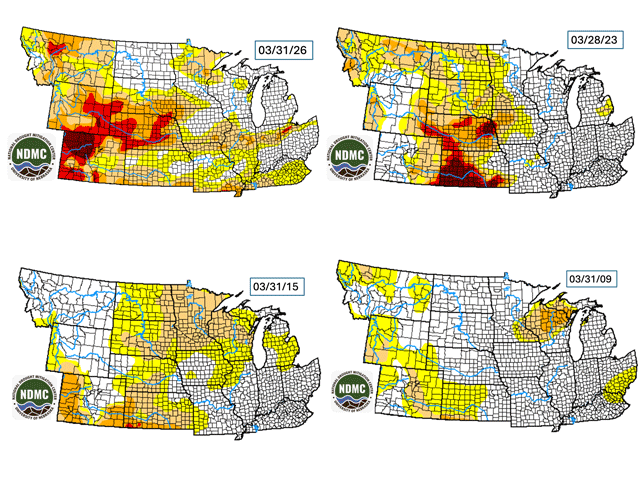
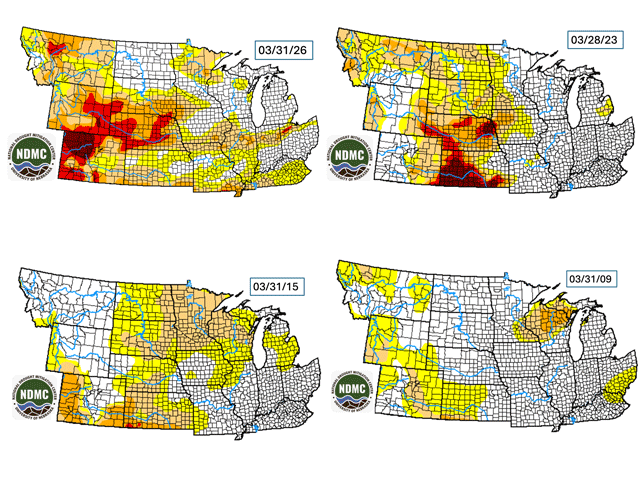
Early April finds fieldwork and row-crop planting beginning to get underway. With that activity starting, here's a look at dryness and drought conditions in the primary U.S. corn and soybean states compared to the top DTN weather analog years for 2026.
According to the U.S. Drought Monitor, the NOAA Central Region -- which contains the top corn and soybean producing states -- has a larger percentage of the region affected by dryness or drought going into April than the top three weather analog years identified by the DTN long-range weather forecast team. Those years are: 2023, 2015 and 2009. (All three were very good production years for row crops.)
P[L1] D[0x0] M[300x250] OOP[F] ADUNIT[] T[]
Drought Monitor assessments for the week endedg March 31, 2026, show that 69.81% -- almost 70% -- of the central U.S. had some phase of dryness or drought. The harshest drought categories -- Severe, Extreme or Exceptional -- covered 24.55% of the central U.S. at the end of March 2026. In contrast, the Central U.S. Drought Monitor at the end of March 2023 had 51.56% with some phase of dryness or drought; 2015, 52.57% with dryness or drought at the end of March; and 2009 saw just 30.88% with dryness or drought in effect at the end of March.
Drought is most notable, of course, in the western half of the central U.S., especially in Nebraska where extreme drought (D3) ballooned in areal coverage since the start of the year from 0.00% to 43%. But the Midwest also has more dryness or drought now than in the top three analog years. Midwest dryness or drought March 31, 2026, was noted in about 53% of the region compared with 16% at the same time in 2023; 46% in 2015; and 17% in 2009. (March and early-April precipitation has brought significant drought easing to the Midwest.)
The implications of drought in the western half of the central U.S. are worth considering for row-crop production even though much of the corn and soybean output in Nebraska, South Dakota and Kansas is produced on irrigated acreage. In Nebraska, row-crop acreage is approximately one-third rainfed according to University of Nebraska extension meteorologist Eric Hunt. In Kansas, approximately one-half the row crop acreage is rainfed, according to Kansas State University. Drought conditions point to soil moisture deficiencies at planting time.
A comparison of weather analog years is not a forecast. However, this Drought Monitor comparison points to some important differences between spring 2026 and the top analog years 2023, 2015 and 2009. Rainfall that amounts to a "just in time" event remains high on the list of crop needs if the 2026 corn and soybean harvest prospects in much of the region are to approach the performance of the analog years.
Bryce Anderson can be reached at bryce.anderson@dtn.com
(c) Copyright 2026 DTN, LLC. All rights reserved.
Comments
To comment, please Log In or Join our Community .