

Ag Weather Forum
All or Nothing in Central US March Precipitation
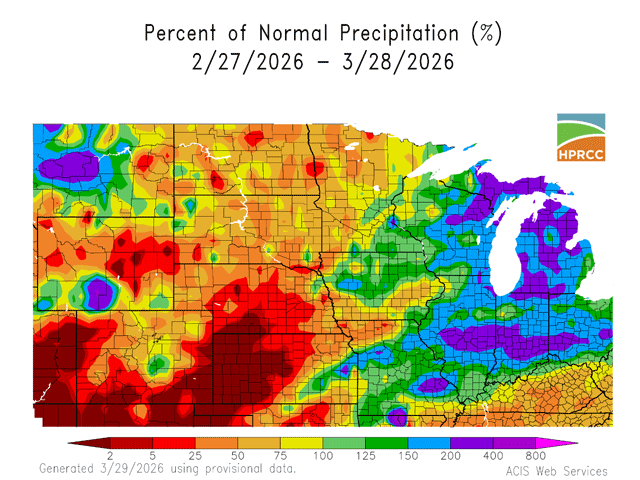
March of 2026 brought a wide contrast in either "have" or "have not" precipitation to the central United States. The Midwest -- especially east of the Mississippi River -- took in heavy amounts. In contrast, the Plains -- especially the western half of the region -- were very dry, as the numerous wildfire incidents during the last half of March illustrate.
The extent of well-above-normal precipitation in the eastern Midwest during the month is notable. Parts of Illinois, Indiana, Ohio and Michigan recorded amounts that were 200% of normal, and an area in southeast Missouri joined this heavy precipitation array as well.
Examples of this heavy precipitation since March 1 include Springfield, Illinois, with 6.92 inches, 270% of normal; Decatur, Illinois, with 6.69 inches, 290% of normal; Indianapolis, Indiana, with 7.63 inches, 223% of normal; Lafayette, Indiana, with 5.24 inches, 207% of normal; Lansing, Michigan, with 3.88 inches, 203% of normal; Grand Rapids, Michigan, with 4.51 inches, 205% of normal; and Toledo, Ohio, with 4.95 inches, 205% of normal.
P[L1] D[0x0] M[300x250] OOP[F] ADUNIT[] T[]
In sharp contrast, the western one-third of the Plains was left high and dry. Dodge City, Kansas, had zero inches in March versus 1.24 inches normal; Garden City, Kansas, had only a trace of March precipitation versus 0.98 inches normal; Goodland, Kansas, had zero inches in March versus 0.80 inches normal; McCook, Nebraska, had only a trace in March versus 0.82 inches normal; North Platte, Nebraska, March precipitation totals just 0.22 inches, 24% of normal; Valentine, Nebraska, totals 0.24 inches, 26% of normal; and Sidney, Nebraska, March precipitation totaled only 0.09 inches, just 17% of normal.
Winter wheat is showing the adverse impact. Kansas winter wheat rated good to excellent declined by 18 percentage points during March, from 58% good to excellent March 1 to 40% good to excellent March 29. The lack of moisture along with extreme warmth and strong winds spurred the drying out of wheat. In addition, wildfires in Nebraska have reached a record of more than 800,000 acres, far higher than the previous state record set in 2012.
The precipitation difference between the Midwest and Plains is a geographical and climatological fact. However, that disparity may have reached a new level in March 2026.
And forecast precipitation during the next week keeps that difference intact, with totals of around one-half inch indicated for the Western Plains, while the eastern Midwest is forecast to see totals exceeding 2 inches during the first five days of April. Factor in a forecast for above-normal temperatures for most areas, and the extreme moisture difference in the central U.S. shows only limited easing as April approaches.
See DTN Ag Meteorologist John Baranick's Ag Weather Forum blog about upcoming weather: "Daily Active Weather Includes Severe Storms, Ice, Snow Rest of This Week," : https://www.dtnpf.com/… .
Bryce Anderson can be reached at bryce.anderson@dtn.com
(c) Copyright 2026 DTN, LLC. All rights reserved.

Comments
To comment, please Log In or Join our Community .