


Ag Weather Forum
Forecast Cold Wave Has Variable Impact on Corn Diseases

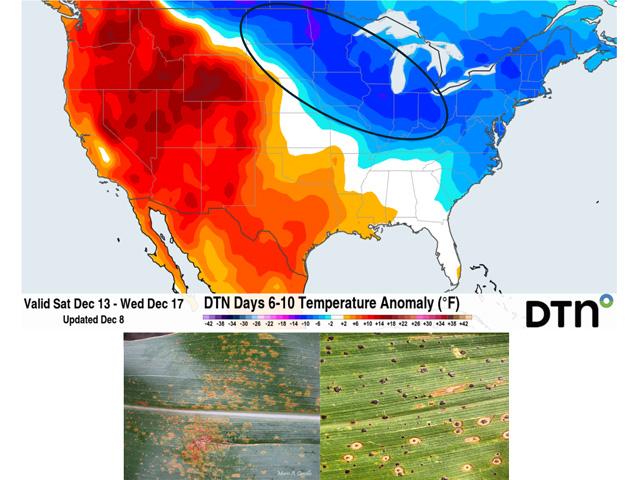
One of the effects of the oncoming series of cold waves in the central United States during the next five to seven days may be the effect on leftover remnants of corn diseases which likely caused some yield loss along with extra expense for control measures during the 2025 growing season.
These costs can be significant. Top-quality fungicides have an average cost of about $20 per acre. Application charges are about $10 per acre, so the total cost for corn fungus control is about $30/acre. These charges have shown little change during the past two to three years. (Details courtesy of Minnesota-based farm management analyst Kent Thiesse.)
P[L1] D[0x0] M[300x250] OOP[F] ADUNIT[] T[]
During this past season, the impact of disease, either in the cost of control or the effect on yield, were conversation topics across the U.S. Corn Belt. On a national level, disease impact may have been low; after all, U.S. corn production is estimated at a new record of 16.8 billion bushels. But on a local and area level, disease presence was a problem -- one with a price tag.
So, how will this cold period affect those microorganisms still out there following harvest? As with many issues in crop production, the impact varies depending on the particular disease. A look at two of the headline corn diseases of this past season, southern rust and tar spot, illustrates that variability.
In the case of southern rust, central and northern U.S. winters are detrimental to its spores and keep the disease as an annual threat. For example, "This pathogen does not overwinter in Nebraska. Disease occurrence in Nebraska is dependent upon wind dispersal of urediniospores from southern states in early to mid-July," noted a University of Nebraska-Lincoln extension bulletin by plant pathologists Jim Stock and Tamra Jackson-Ziems. So, for this disease, summertime temperature, humidity and south winds will be notable features for its re-occurrence.
Another major feature in this past season's corn disease spectrum, tar spot, shows a more resilient characteristic. Tar spot, which notably showed up in the Midwest about 10 years ago, is a disease which goes dormant during the winter and thus survives on crop residue in extreme cold. The tar spot pathogen has adapted to the point where viable spores have been noted all the way into Canadian corn fields along with the U.S. Corn Belt.
One of the main features of crop diseases repeatedly identified in research projects is the ability of some pathogens to cope with adverse conditions. That shows up again here; the arctic cold may bring some natural corn disease control, but the cold will not wipe the slate -- or the fields -- clean of the presence of every pathogen ahead of the 2026 growing season.
Bryce Anderson can be reached at bryce.anderson@dtn.com
(c) Copyright 2025 DTN, LLC. All rights reserved.
Comments
To comment, please Log In or Join our Community .