


Ag Weather Forum
One Last Arctic Blast This Weekend
A clipper system that moved through on Dec. 9-10 was a strong one, producing a band of heavy snow across the north and strong winds. Another pair of clippers are set to move through later this week and weekend. While they won't be nearly as strong or produce the same wind potential, the cold air that follows will be much more intense.
Clippers are fast-moving systems and the one that moved into the Northern Plains on Tuesday is already in the Northeast on Wednesday. A band of 4-8 inches of snow has fallen on the north side of its path from southeastern Saskatchewan through central Michigan and now accumulating in the eastern Great Lakes and Northeast. Winds behind that system were intense with gusts over 60 mph across the Dakotas, southwest Minnesota, eastern Nebraska and nearing that in Iowa. The winds have calmed down slightly as the system moved into the Midwest, but are still blowing at 30-40 mph on Wednesday.
P[L1] D[0x0] M[300x250] OOP[F] ADUNIT[] T[]
With that moving out of the way, the attention turns to two more clipper systems to end the week and start the weekend. One is moving from the Pacific Northwest into the Canadian Prairies and Montana on Dec. 10. The primary low will move southeast through the Dakotas and Nebraska on Dec. 11 and through Kentucky on Dec. 12. A band of moderate snow is forecast to develop on the northern side of the storm track from the Dakotas through the Ohio Valley. Forecast snowfall amounts in this band are in the 3- to 6-inch range. What is worse is that some warm air above ground in the Northern Plains may make for some freezing rain across the Dakotas, cutting into the snowfall totals, but leaving more issues with icy conditions.
Right behind that clipper, another is forecast to follow a similar path from Montana through Iowa and into the Ohio Valley for Dec. 12-13. This time, the precipitation is likely to be all snow, resulting in another band of 3-6 inches that may line up near the previous one. But the primary impact from both clippers will be the cold that follows.
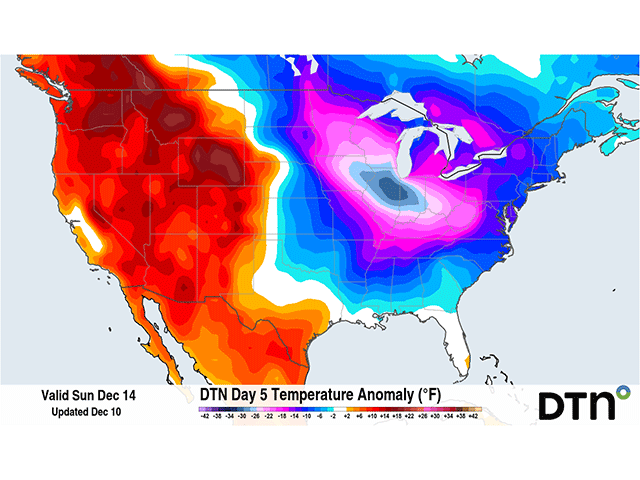
The first clipper will see some below-normal air seep through the Northern Plains and into the Midwest. That will turn on some lake-effect snow across the Great Lakes as well. But the second clipper will bring a stronger punch of cold air. Coming from northwestern Canada, where temperatures are currently 20-50 degrees below zero Fahrenheit, this will be an absolutely intense burst of cold air. Some moderation will occur, but during the weekend, temperatures are forecast to drop below zero across the eastern Dakotas and Upper Midwest on Dec. 13, then extend into northern Illinois and northern Indiana on Dec. 14. Peak cold of minus 25 degrees F is in the forecast for the Red River Valley of the North and temperatures may not break above the zero Fahrenheit mark there, across the rest of Minnesota, and northern Iowa on Saturday. Temperatures may break just above zero in the Upper Midwest on Sunday, but it will be close for those from Minnesota to northern Illinois.
Sub-freezing temperatures may make it to the Gulf of America for Dec. 15-16. But temperatures will rise next week. The burst of cold air should quickly be replaced by seasonably warmer air and the storm track should move north of the border into Canada. That will give much of the country a break from the harsh start of winter we have seen so far. But you can be sure it won't be the last of the season. The cold air will still lurk just across the border in Canada.
To find more weather conditions and your local forecast for free from DTN, head over to https://www.dtnpf.com/….
John Baranick can be reached at john.baranick@dtn.com
(c) Copyright 2025 DTN, LLC. All rights reserved.
Comments
To comment, please Log In or Join our Community .