



Ag Policy Blog
Reconciliation Bill Marks End of the Modern Farm Bill Era
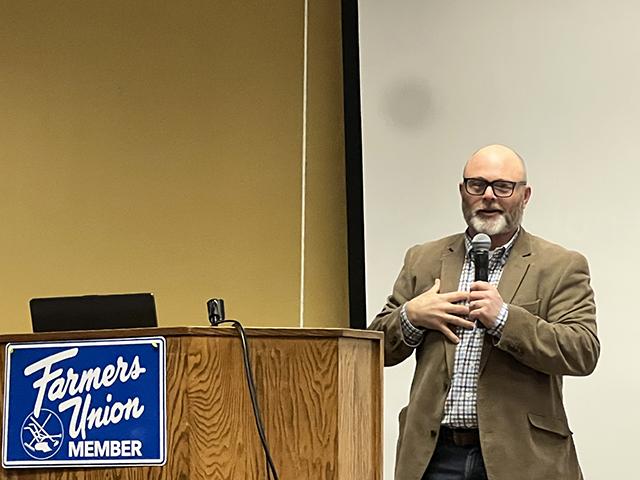
"Friends, farmers, countrymen, lend me your ears. I come to bury the farm bill, not to praise it."
That's how Jonathan Coppess opened up his talk to members of the Iowa Farmers Union this past weekend.
The former Farm Service Agency (FSA) director -- now associate professor of farm policy at the University of Illinois -- warned that Congress' policy changes in the One Big Beautiful Bill Act have permanently severed the political link between food assistance and farm programs.
The reconciliation package -- sometimes dubbed as "OB3" -- doubled spending on commodity subsidy programs while cutting food assistance to low-income households by more than $200 billion, a move he described as politically unprecedented.
"In effect, we cut spending on SNAP to double subsidies to farmers," Coppess said.
Highlighting how marrying food stamps to farm programs kept the farm bill going since the 1960s, that linkage has been broken.
"This is the end of the farm bill as we've known it," Coppess said. "For 50 years, the core deal has been food assistance paired with farm programs. That deal is now broken. OB3 is the fatal, final blow."
Diving into specific policies, Coppess said the farm policy changes in OB3, combined with a growing reliance on ad-hoc aid, are a bad mix of costly farm policies.
MAXIMUM ABSURDITY IN AD-HOC PAYMENTS
The traditional farm safety net has been overwhelmed by a flood of constant emergency spending that is now becoming routine rather than exceptional.
That was highlighted this week with the $12 billion in "bridge payments" to farmers.
This year, ad-hoc payments include $10 billion for last year under the Economic Crop Assistance Program, and another $21 billion in hurricane and disaster aid. The bridge payments will go out in February.
"If this isn't maximum absurdity in farm payments, I don't know what is," Coppess said, noting that many of these programs are directly tied to what farmers plant each season, distorting production decisions.
The constant ad-hoc payments create a cycle where farmers constantly need more payments because costs keep increasing, but so do planted acres. And then farmers receive more payments and then costs increase again and planted acres go up. All of that will drive farm acreage over a cliff, Coppess said.
"If we keep making these ad-hoc payments -- we keep throwing money at this problem attached to the acres you plant, the decisions you make in the spring, that's where we are headed."
ARC AND PLC MOVES FAVORING COTTON, RICE
Next fall, the 2025 Agricultural Risk Coverage and Price Loss Coverage payments are projected at $13.5 billion from the OB3.
P[L1] D[0x0] M[300x250] OOP[F] ADUNIT[] T[]
Coppess singled out increases in PLC reference prices as one of the most destabilizing changes in the reconciliation bill.
He said farmers with long-grain rice base acres are projected to receive an average of $286 per base acre on average in 2025, with some payment rates exceeding $300 per acre. Seed cotton and peanuts also receive sharply higher payments around $160 an acre.
"You do not have to plant the crop for which the payment is triggered," Coppess said. "So, a farmer with $286 and a long grain rice PLC payment can plant corn and soybeans on those base acres capture the same market that you do, and the extra federal cash benefit."
"These are massive, unbalanced payments," he said. "It's not about the total national dollars -- it's about how much cash is showing up per acre."
PAYMENT LIMITS LOOSENED FOR LARGER FARMERS
One of Coppess's strongest criticisms centered on new rules allowing "qualified pass-through entities," such as limited liability corporations (LLCs), to stack multiple, new $155,000 payment limits. This allows large farming operations to avoid payment caps and potentially collect millions of dollars.
"If I'm going to bump up against the payment limit, what I do is set up a series of embedded entities -- LLCs -- and then I get a new payment limit for everyone," Coppess said.
The higher payments are tied to base acres so it will lead larger farmers to look for more land that is already classified as base acres.
"This will rapidly accelerate consolidation in agriculture and decimate rural communities," Coppess said. "Why? If I have that much more additional federal cash in my bank account, what am I going to do with it? The first thing I'm going to do is go for cash rent. So, next thing you know, the landlord is going to hear about how much more I can pay for cash rent, but you can't. Or I can buy it, or I can pay more for fertilizer."
Coupled with that, USDA will be adding 30 million more base acres, of which the first 3 to 4 million acres are already designated to go to seed cotton.
CROP INSURANCE RISK SHIFTS TO TAXPAYERS
New crop-insurance policy changes could set up the insurance system for long-term failure, Coppess said.
The OB3 made several changes to crop insurance, including a new subsidy paid directly to crop insurance companies to encourage them to keep sell policies in high-risk regions where losses regularly exceed premiums. The new subsidy targets areas with frequent 1.2 loss ratios -- basically means indemnities paid out are 20% higher than the total premiums paid.
"We are effectively bribing insurance companies to continue selling policies in areas that have losses so far out of the realm that the insurance industry doesn't want to sell them," Coppess said.
Much of the area affected here is western Texas and the biggest crop influencing this decision is cotton, he said. "We're going to pay you to sell insurance where the losses are more than you want to have to carry."
In addition, Congress expanded the Supplemental Coverage Option (SCO) to 90% coverage at the county level while boosting the federal subsidy to 80% of premium costs.
"The bottom line of this is this over-insuring and heavily insuring high risk areas and crops," Coppess said. "You're going to see more and more of this insurance used in high risk areas and crops. This is going to drastically impact the integrity of the crop insurance program."
These policy changes favor states such as Texas over the Midwest. There will eventually be repercussions.
"I know I'm going to get yelled at, and I always do, because I always anger the South and I talk about this because I guess I'm not supposed to say these things," Coppess said. "I don't just try to pick on Texas, but when our farmers are paying into this and it's going down there, I think it's unfair, right? So, the concern isn't regional ... this is bad policy, and the integrity of the program will suffer, and all farmers then will suffer, because this cannot continue this way. You cannot expect this to work like this for very long."
CRP CHALLENGE
Coppess also raised concerns that Congress didn't reauthorize the Conservation Reserve Program (CRP) in the reconciliation bill. Instead, CRP is in the middle of another one-year extension.
CRP right now idles 25.8 million acres after an increase of 5 million acres during the Biden administration -- most of which was in the grasslands program. The CRP functions as a buffer to prevent overextending acres, as well as the environmental concerns on sensitive or problematic lands -- highly-erodible acres.
"There's going to be pressure for those acres to come out and as we've seen in history, when we have a market problem, we tend to push ourselves over the cliff. We over-produce and we just don't pull back," Coppess said.
With gaps in reauthorization, there continue to be these windows where CRP expires on Sept. 30, but then the program doesn't get an extension or reauthorization for weeks or months later, Coppess noted.
"During that window, if you're a landlord and there's this uncertainty, you're going to go out and look for a tenant to farm those acres, he said.
FULL FARM BILL PROBLEM
While Congress dealt with ARC, PLC and crop insurance in OB3, several key titles such as credit and rural development remain open questions. Congress extended those programs -- and CRP -- until next fall.
The problem is that after taking $200 billion out of SNAP, there is no money left anywhere else to make changes in other programs.
So, what does a farm bill begin to look like and who presses Congress to address those policy needs without a coalition of groups backing the bill?
"That is the question I still wrestle with is, what does this look like going forward?"
See, "Trump Administration Details Framework for $12 Billion Farmer Bridge Assistance Program," https://www.dtnpf.com/….
Chris Clayton can be reached at Chris.Clayton@dtn.com
Follow him on social platform X @ChrisClaytonDTN
(c) Copyright 2025 DTN, LLC. All rights reserved.
Comments
To comment, please Log In or Join our Community .