


Minding Ag's Business
Inside TEPAP: As Farm Profits Tighten, Financial Literacy Remains Essential
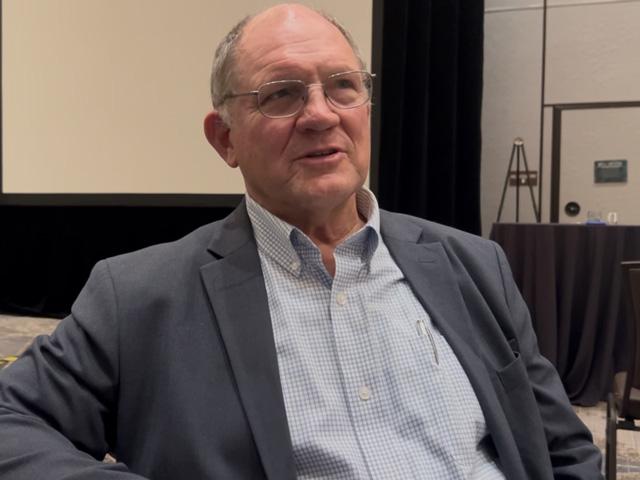
OMAHA (DTN) -- In his opening class last January to about 100 farmers from across North America, farm consultant Dick Wittman dove right into discussing different methods of accounting and the way farmers should look at their budgets and cash flows.
"I want you to think about financial management in two depths. There's the ending level where we're creating external financial reports, but we often use for looking at whole business financial performance," Wittman told the group. "You have the balance sheets, the income statements, the statement of change in financial position, projected cash flow and pro forma income statements. These are whole farm-based. They don't tell you anything about why you're successful, but they may give you an indication of what your overall success is. And then we want to drill deeper. We want to know why we're successful."
That gets into a whole other level of decision-making on the farm.
Wittman is one of the main faculty members for The Executive Program for Agricultural Producers (TEPAP), which is held at the beginning of the year in San Antonio. Registration has opened for the 2027 TEPAP class, which will be held Jan. 3-9. The application deadline for the program is Oct. 31.
Coming out of the farm crisis, Danny Klinefelter, a professor of agricultural finance at Texas A&M, saw a lot of farm operations after the 1980s struggling with economic conditions. He and others saw a need to help farmers improve their financial business practices to help survive when times were tough, but also capitalize on their positions when the agricultural economy was in better shape. Klinefelter started TEPAP in the early 1990s. He retired in 2017 and passed away in 2023, but the program he created carries on.
As Wittman told participants in last January's class, understanding financial principles helps optimize a farm's performance. That requires understanding how financial statements flow and how costs and expenses are reported. Best practices also require setting goals and strategic planning for the business.
Of the 100 farmers who participated in the last TEPAP class, there was diversity in size. Annual farm sales ranged from $275,000 to more than $490 million.
As farmers face repeated years of losses on commodity crops often exceeding $100 per acre, Wittman also raised concerns that state Extension specialists who focused on individual farm financial management challenges have retired without being replaced. The emphasis on financial accounting that came out of the 1980s farm crisis has declined.
"A lot of these top-level people who retired rarely had a successor with the same level of skillsets," Wittman said. "Along with that, a lot of these land grants were fighting for their lives with budget cuts as well as pressures to dilute and expand their missions. So, they lost some of their core missions on agricultural sciences, economics and finance."
Wittman added, "Farm business management programs used to be so robust throughout the country; but there are only a few left that continue to function."
P[L1] D[0x0] M[300x250] OOP[F] ADUNIT[] T[]
TEPAP is among the few programs around the country that offers an intensive executive-style program for farmers to not only learn more about financial accounting, but also employee management and topics such as defining roles and responsibilities for individual family members in a farm operation. TEPAP takes place over two years for producers who participate.
This also adds to generational challenges where Boomers and Generation X farmers are more likely to remember the financial hardships that Millennial and Generation Z farmers haven't experienced, Wittman said. Yet, younger farmers now oversee larger operations that require making million-dollar decisions on land, equipment and annual operations.
"We're asking younger and younger people to oversee bigger and bigger pots of responsibility and resources, and they get here and they realize they don't know where to start when it comes to financial literacy," Wittman said. "They have heard the idea in college, but they have rarely had a real-life case study where they have had to take real-life data and go and create a balance sheet and income statement, take data to create an accrual adjusted income statement, do a budget. These are things we learned in an MBA program and I fell into it backwards because in order to teach it I had to learn this stuff."
Kristjan Hebert of Hebert Group, a large grain farm in Moosomin, Saskatchewan, Canada, took what he learned at TEPAP in 2008 to help create an executive education program to implement the practices learned in the program. The number of Canadian producers participating in TEPAP has grown over the years, mainly driven by word-of-mouth, Hebert said.
"There is getting to be a large group of us who talk about TEPAP and what it did for our operations and the quality of speakers down here," he said. "You typically have the theme that commodity prices are low and margins are tight. Out of that uncertainty comes a lot of opportunity on how you work on your processes to become more efficient and tighten up costs."
A lot of people go into farming because they like producing things, whether it is crops or livestock. But at some point, they have to place more emphasis on financial management. That can require either learning those skills or hiring a chief financial officer to manage the books.
"It's changing your mindset on how important finance, cost of production and net present values are and really getting your culture around the importance of that," Hebert said. He added, "For those that don't enjoy doing it, it's a necessary evil that's very, very important. I think as farms grow, it's something we've seen."
Georgia Lucas is the business manager at Dusty Lane Farms, a 3,000-acre vegetable and grain farm in southern New Jersey. She enrolled in TEPAP because her boss had taken the program and encouraged her to enroll.
"I went to college for agriculture and I've been in it for more than 10 years, but TEPAP really challenges you to think about it differently," Lucas said. "We all get into doing the same old thing every single day. It kind of makes you step back and say, 'Well, I am doing this, but am I really doing this well?' and gives you some different ideas. You talk to so many different people. The networking alone -- hearing people who might have the same type of operation as you, and they are doing things in a completely different way."
Pointing to financial challenges in agriculture, Lucas added, "In the industry and the economy we're in right now, that is really important because we have to figure out how can we think out of the box ... If you don't know the numbers such as, 'how much am I spending to grow this crop?' How can you better yourself if you don't know the financial principles to make your business better?"
Mark Welch, a professor and Extension economist for grain marketing at Texas A&M, has been involved with the program over the past decade organizing TEPAP instruction and planning. He noted the cyclical nature of agriculture continues and TEPAP is preparing producers for those cycles.
"When you think back to 2015-2019, that was a pretty rough stretch of low grain prices. What we found with the TEPAP audience at that time is that the motivation to come to a program like this -- which takes a sizable commitment of time and financial resources -- is they recognize this is the time I need this program the most," Welch said.
Welch also has noticed TEPAP participants are younger now and more women are involved in the leadership and management of larger farm operations as well.
"The older producers in the room are wishing they had known about TEPAP 20 years ago and many of the producers coming now are also the second generation who are coming for TEPAP instruction," Welch said.
For producers who would like to learn more about TEPAP, Welch encourages them to contact the TEPAP office and they will connect farmers with someone either in their area or who grows similar commodities to talk about the program with them.
"I've never had a TEPAP alumni turn away that opportunity because they are anxious to talk to that next generation who is looking for what they learned to help their operation and share that with somebody else," Welch said.
The program also has scholarships available for producers who qualify.
In explaining one of the drivers behind TEPAP, Hebert also pointed to a familiar saying from Klinefelter, "Better is better before bigger is better."
Learn more about TEPAP and apply at https://tepap.tamu.edu/…
Chris Clayton can be reached at Chris.Clayton@dtn.com
Follow him on social platform X @ChrisClaytonDTN
(c) Copyright 2026 DTN, LLC. All rights reserved.
Comments
To comment, please Log In or Join our Community .