


Ag Weather Forum
5 Global Regions Hit Hard by a Super El Nino
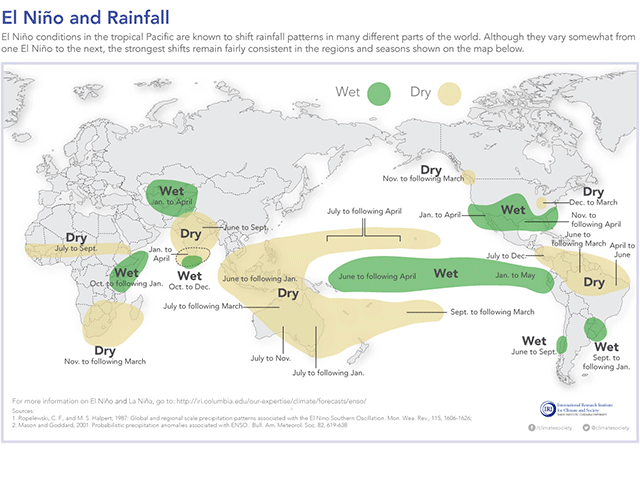
A "Super" El Nino is building in the tropical Pacific Ocean. You can read more about its development here: https://www.dtnpf.com/…. Impacts from changing temperatures in the Pacific Ocean are known to affect global weather patterns in specific ways. But why?
To understand the reason why El Nino -- or La Nina for that matter -- affects weather patterns in different parts of the globe, it is necessary to understand how water temperatures can affect the weather in the first place.
The warmer waters during El Nino do not just sit idly by, but are connected to the atmosphere. Where water temperatures are higher, surface air is warmer with higher moisture content than air over cooler water. Air that is warmer and more moist is prime for producing thunderstorms, bringing that warm air up into the higher reaches of the troposphere. That extra heat puts pressure on the jet stream and causes it to shift from its normal route from west to east across the tropics and subtropics, leading to changes in the weather pattern.
The stronger an El Nino is, and the higher the temperature difference in the tropical Pacific, the more pronounced the pattern changes become, sometimes locking in place for long periods of time. But because the Earth changes its location of the jet streams throughout the year, effects on global patterns are seasonal, and change during the El Nino's duration. Some effects happen in summer, as DTN's Bryce Anderson describes for U.S. agriculture here: https://www.dtnpf.com/…. Some effects happen during winter, on both sides of the equator.
Here are five different parts of the world that are likely to experience El Nino differently:
1. Wetter Southern U.S. in winter.
Anderson noted that U.S. agriculture generally benefits from El Nino during its summer, but that is not in all areas of the country. Indeed, some areas like the Pacific Northwest and Gulf Coast stay drier during that time. But during the winter, the effects tend to reverse. While the Pacific Northwest may remain drier, resulting in building drought, the southern tier of the country is usually much more active, resulting in wetter periods. Drought in these areas, which may continue through the summer and fall, may see a reversal of fortune come winter. Flooding and increased off-season severe weather are more pronounced during an El Nino.
P[L1] D[0x0] M[300x250] OOP[F] ADUNIT[] T[]
2. Drier Southeast Asia monsoon in summer.
When the word monsoon is brought up, most people think of the extreme rainfall in India and Southeast Asia. Under normal or even La Nina conditions, warm water in the Pacific pools up around Indonesia and the western Pacific. Thunderstorms there produce winds that form a sort of front-like wave of increased precipitation that spreads through Southeast Asia in the late spring and summer. The result is a massive amount of water that falls in the region. But during an El Nino, these effects shift. With the warmer water now displaced well to the east in the central and eastern Pacific, the western Pacific is generally cooler. Thunderstorm activity is reduced, and the rainfall in some of the wettest parts of the world becomes much drier. Drought can develop, and temperatures rise as a result. The monsoon rainfall doesn't completely end, but it can lead to major problems for water usage and agriculture. And that can last into the following winter, when these areas rely on that built-up water to supply them through the drier season.
3. Drier Australia in the Southern Hemisphere winter and spring.
The same sort of effects happen south of the equator in Australia. Though at the same time as farther north, the Southern Hemisphere is in its winter season, with effects lingering into its spring. With relatively cooler waters off the coast, both north and east, moisture is reduced and high pressure sinks into more of the country. This results in drier conditions that tend to be very harmful for agriculture and for water supplies. But the more frequent high pressure sometimes includes a higher risk of low temperatures and frosts during the winter. That effect is less certain than the dryness.
4. Reduced hurricane chances in the Atlantic in summer and fall.
Many of the hurricanes that move through the Atlantic Basin form from thunderstorms that build over western Africa and shift westward into the Atlantic Ocean. These disturbances occurring over warm waters can sometimes become a tropical storm or hurricane if the right conditions are met. But two different effects can happen during an El Nino. For one, drier conditions are favored in western Africa by a small degree. Fewer of these thunderstorm clusters push westward into the Atlantic, leading to lower opportunities to produce tropical storms and hurricanes. The second has to do with the jet stream. The increased jet stream over the Pacific also spreads into the Atlantic, increasing wind shear that dissipates heat, a detrimental impact to hurricane development. Tropical storms and hurricanes feed on more concentrated heat that results from consistent or slower wind speeds in the upper levels of the troposphere. The combination usually leads to lower totals for tropical storms and hurricanes in the Atlantic, though just one that escapes these conditions may still bring devastating impacts to the Caribbean, Central America, or the U.S.
5. Increased rainfall in Southeastern South America in the Southern Hemisphere summer.
One more important feature of an El Nino is increased summer precipitation in southeastern South America. Though it tends to be drier during the winter, the pattern reverses in summer for much of Argentina, Paraguay, Uruguay and sometimes far southern Brazil. While this is usually a good sign for agriculture, there are increased risks of flooding and severe weather. In Brazil, temperatures are usually higher. Wet season rainfall in central Brazil and the Amazon is usually reduced as well, leading to drought and problems with wildfires during the winter dry season.
Other effects that are noteworthy around the world include hot and dry conditions in South Africa in the summer, warmth in Western Canada and the U.S. in winter, an increased tropical season in the eastern Pacific, and wetter conditions in the Aral Sea area of Asia in spring. With El Niño expected to become extremely strong later this year, anticipate many of these impacts becoming evident over the next year.
You can read more about El Nino and its global impacts on temperature and precipitation here:
To stay up to date with weather conditions and your local forecast for free from DTN, head over to https://www.dtnpf.com/…
John Baranick can be reached at john.baranick@dtn.com
(c) Copyright 2026 DTN, LLC. All rights reserved.
Comments
To comment, please Log In or Join our Community .