


Ag Weather Forum
Heavy Early May Snow Brings Minimal Soil Moisture Benefit to Western Plains
The first week in May brought a brief serving of winter weather to the state of Colorado. A snowstorm on May 5-6 produced up to 2 feet of snow in some parts of the state. Locations such as Steamboat, Breckenridge and Vail in the Rocky Mountains had around 10 inches of snow. In Denver, the storm became one of the biggest in history. The U.S. Drought Monitor summary for the High Plains region, which includes Colorado, noted "Light-to-moderate precipitation overspread much of the High Plains, with the heaviest accumulations (0.5-1.5 inch) falling across central Colorado, including late-season snow across the higher elevations."
So, on the surface, this precipitation would bring some improvement in drought conditions. There certainly was some easing of drought. The Drought Monitor assessment noted some drought easing occurred in central Colorado. But the benefit was limited. "Across the rest of the Plains, however, the moisture was not sufficient to engender substantive improvements," the Drought Monitor assessment said.
Colorado State Climatologist Russ Schumacher told DTN soil moisture sensors indicated a sharp improvement following the May 5-6 storm. These quick improvements followed steady declines, or just consistently low, soil moisture until the early May precipitation. But that benefit may be short-lived. "The question is whether the moisture will percolate down to deeper layers, or whether it will just be a temporary blip considering we are looking at near-record high temperatures and no meaningful precipitation this week," Schumacher said in an email. "It was a much-needed storm for sure, but we'll need more of those kinds of storms before conditions can recover from the brutal winter and early spring."
P[L1] D[0x0] M[300x250] OOP[F] ADUNIT[] T[]
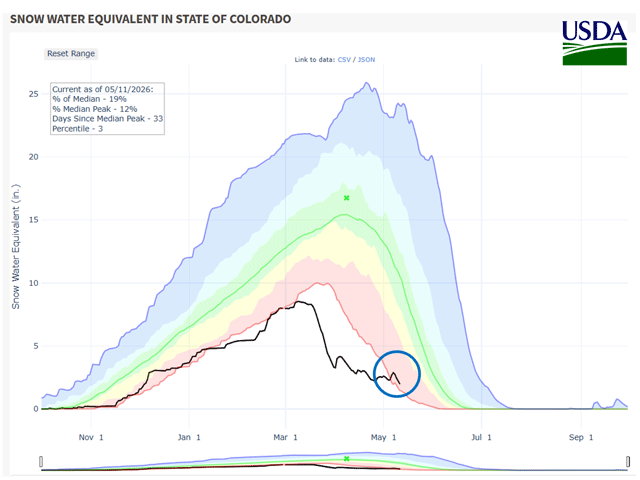
Schumacher also looks for little benefit to mountain snowpack moisture due to daylight length and a big dose of heat during this week. "I think we're going to lose any gains this week, again because of near-record warmth and because at this time in May the melt typically starts getting rapid anyway with the longer days and high sun angle," he said. "We can already see it in the snowpack charts where after the small increase from last week's storm, the melt out has commenced yet again."
Snow water equivalent assessments from USDA's Natural Resources Conservation Service show as of 12:00 a.m. on May 11, 2026, snow water equivalent in Colorado was just 19% of the median value.
Persistent and record-level warmth for months continues to dominate the Plains and western mountain regions of the U.S. Nebraska had its warmest and driest December-through-March stretch on record. The Colorado state climate report for April notes similar conditions, going back to fall 2025.
"Water year 2026 continues to be the warmest on record by a large margin. Statewide average temperature has been 7.4 (degrees Fahrenheit) higher than the 20th century average, 5.7 F above the 1991-2020 average, and 2.7 F warmer than any previous October-through-April period," the report noted. "It is the 7th driest start to a water year, 2.77-inches below average for precipitation statewide."
The balance of this week supports the prospect of more snow melting and soil profile drying. The high temperature in Denver may reach 90 F this week. If that happens, it will tie the current Denver daily temperature record set in 1915. Such warmth will make the moisture from early May just a brief interlude in a long dry period.
Bryce Anderson can be reached at bryce.anderson@dtn.com
(c) Copyright 2026 DTN, LLC. All rights reserved.
Comments
To comment, please Log In or Join our Community .