

Ag Weather Forum
Snow Drought Continues to Grip the Plains in Late Winter
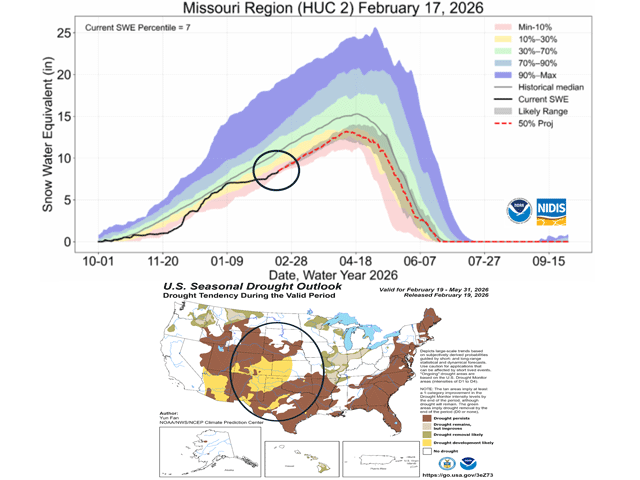
While the northeastern U.S. digs out from record-level snow, the Plains and Rocky Mountains continue in a dry pattern going into the last few days of the 2025-26 meteorological winter season. A drought status update for the Great Plains posted by NOAA and the U.S. National Integrated Drought Information Service (NIDIS) finds that, even with some snow in the region over the past week, moisture from winter snowpack is well below average and may reach record low levels.
"As of February 17, many SNOTEL stations across the mountains of Montana, Wyoming, and Colorado are experiencing the lowest or 2nd lowest snow water equivalent (SWE) on record," the update noted. "SWE, the amount of liquid water stored in snowpack, melts and provides the water many critical economic sectors rely on. SWE in the mountain snowpack across the Missouri River Basin is among the lowest 7% of values on record. Projections, based on historical data, show peak SWE may reach only 10-30% of normal."
P[L1] D[0x0] M[300x250] OOP[F] ADUNIT[] T[]
Wintertime precipitation has definitely been on the low side over the Plains region. Many states received less than half their normal precipitation. But temperatures were very warm. Temperature analysis from the High Plains Regional Climate Center at the University of Nebraska-Lincoln shows the past 60 days have seen widespread 4 to 8 degrees Fahrenheit above-normal temperatures in the Great Plains. That warmth is even greater in the Rocky Mountains, where average temperatures have been from 8 to 12 degrees F above normal during the past 60 days.
This warm and dry combination is not good just ahead of spring. Little to no moisture has been added, and the warmer conditions lead to moisture evaporation. "As a result of these conditions, high evaporative demand (the thirst of the atmosphere) led to unseasonable drying down of the landscape across large portions of the Plains from Montana, Wyoming, Colorado, and western Nebraska," the report noted. The result, of course, is either historic or near-historic lows of the snowpack in the Great Plains.
Drought assessment in the Plains is increasing in coverage and intensity. The Feb. 19, 2026, U.S. Drought Monitor shows 60% of the Drought Monitor High Plains Region in some phase of dryness or drought. That is a sharp departure from just 37% of the region assessed in dryness or drought back at the start of the current water year on Sept. 30, 2025. And the NOAA Climate Prediction Center (CPC) drought outlook for this upcoming spring calls for drought to either remain in place or develop over all but the northern fringe of the Great Plains.
There is some above-normal precipitation suggested as the calendar changes to early March. However, that possible moisture is also accompanied by above-normal temperatures. Such a combination "...would be welcome moisture for the region, but could further limit snowpack development," the NOAA/NIDIS report concluded.
To stay up to date with weather conditions and your local forecast for free from DTN, head over to https://www.dtnpf.com/…
Bryce Anderson can be reached at bryce.anderson@dtn.com
(c) Copyright 2026 DTN, LLC. All rights reserved.
Comments
To comment, please Log In or Join our Community .