


Ag Weather Forum
Dryness for Southern Argentina May Start to Affect Crops
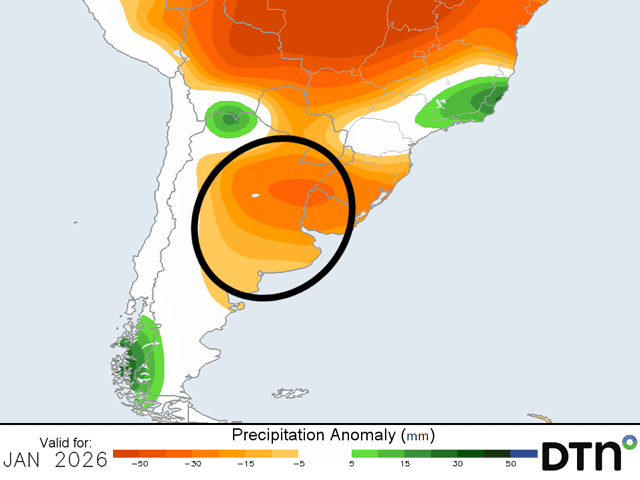
There aren't many reasons to worry about South American crops at this point in the year, but there may be some reasons to concern ourselves in January.
It hasn't been perfect, but soil moisture stands in a very good spot for most of Argentina, Paraguay and southern Brazil. And soil moisture has improved significantly across much of central and northern Brazil, though it is a bit tenuous in some areas.
But looking at Argentina in particular, the country has taken some good rainfall in the spring and so far has been able to endure a slower pace of showers this summer to leave most areas with near- or above-normal soil moisture at this point in the season. Fronts have been less frequent, but they have been potent, largely producing widespread precipitation.
During the week of Christmas, that rainfall has slowed down significantly. A front stalled across northern areas and continued to drop plenty of rain there, but central and southern areas have dried out.
P[L1] D[0x0] M[300x250] OOP[F] ADUNIT[] T[]
A cold front will push through this coming weekend, Dec. 26-27, but showers are forecast to be quite spotty or nonexistent, until that front gets up into northern zones, providing them with more beneficial rainfall into the new year.
We may be in the start of a much drier trend for the southern half of Argentina's growing areas. Long-range versions of both the American GFS and European ECMWF models have well-below-normal precipitation in these areas, prime corn and soybean growing areas. Models hint nearly the entire month of January will be in a drier pattern, though the GFS model is more forgiving with increased rainfall chances after the midpoint of the month.
If a period of dryness comes to Argentina, January is the most likely month for that to occur. And, during La Nina, those chances increase. So, this stretch of dryness is neither unexpected, nor unprecedented. But the period could be very important.
The first phase of corn planting completed as scheduled and the second phase is already half over, resulting in 77% of the total corn crop being planted already. Corn from the first phase should largely be in the pollinating to filling stages and the soil moisture so far is allowing that to occur as usual. However, the second phase of corn is seeing soil moisture reductions from the top of the soil column downward and young plants could be hit with stressful conditions for early growth.
Soybeans are mainly planted in November and December. Some of the early-planted soybeans are getting into the blooming stage and water availability will become more important with time while later-planted soybeans can endure a period of dryness in their early growth stages that can be improved by increased rainfall in about a month.
Moisture in late January and into February can help to reduce losses for both crops, but that will depend on the temperature forecast as well. If it is not raining, it is usually hotter and that is indeed the forecast for much of January for most of Argentina.
So far, weather conditions have been good enough to keep crop conditions at better-than-normal readings. But concerns could start to mount in January if the forecast holds true. It will certainly be a time to monitor conditions closely.
To find more international weather conditions and your local forecast from DTN, visit https://www.dtnpf.com/….
John Baranick can be reached at john.baranick@dtn.com
(c) Copyright 2025 DTN, LLC. All rights reserved.
Comments
To comment, please Log In or Join our Community .