


Ag Weather Forum
Early-Spring Precipitation Trends Bolster Drought Outlooks

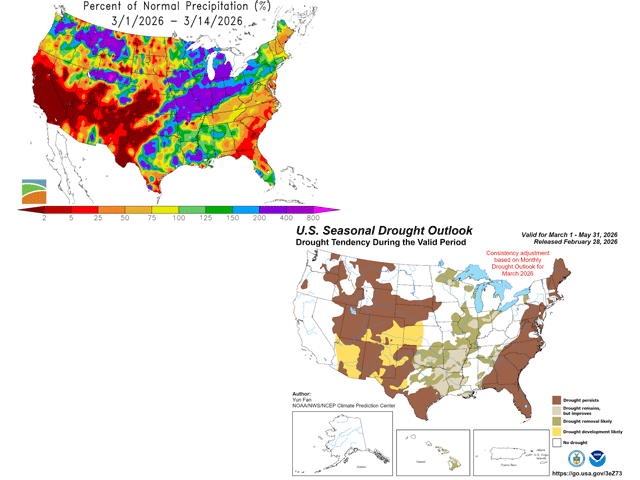
Rain and snow patterns during the first two weeks of March are validating the seasonal drought outlook by U.S. weather agencies quite noticeably. The seasonal drought outlook issued at the end of February by the NOAA Climate Prediction Center and the National Integrated Drought Information System called for drought easing or drought removal in the southeastern Plains, the Delta and the Midwest. At the same time, drought persistence or development was expected for the central and southwestern Plains, southern Texas, and the Rocky Mountains.
Now, after the first half of March, precipitation is practically mirroring that outlook. From south-central Texas northeast through the Delta and Midwest, precipitation has largely totaled from 200% to 400% of normal. And drought easing was noted. "A 1-category improvement was generally made to areas that ... included central to southern Indiana, Illinois, and Ohio along with east-central and southern Missouri," said the March 9, 2026, U.S. Drought Monitor assessment.
P[L1] D[0x0] M[300x250] OOP[F] ADUNIT[] T[]
On the other side of the equation, March moisture has been light to zero from the southwestern Plains through the southern Rockies and the Colorado Plateau, with precipitation mainly less than 5% of normal. "A majority of the South Region has received less than half their normal precipitation with a temperature departure of more than 6 degrees F above normal during the past 90 days. These three-month precipitation and temperature observations are consistent with a La Nina wintertime pattern," the Drought Monitor summary said. In higher elevation terrain, "As of March 10, snow water equivalent for the river basins of Colorado is running below 70% of the 1991-2020 average," noted the Drought Monitor summary. Plains dryness is also a key factor in the development of record-setting fires in Nebraska during the weekend of March 13-15.
This early-March pattern indeed suggests the Pacific Ocean is still showing La Nina conditions as evidenced by the values of the Southern Oscillation Index (SOI), the atmospheric component of the El Nino-Southern Oscillation (ENSO) feature in the Pacific. The March 16, 30-day SOI value was +13.30, and the 90-day SOI value stood at +10.25. (SOI values greater than +7.0 point to La Nina.)
La Nina-influenced storm tracks in the U.S. show a pronounced path from the Pacific Northwest and northern U.S. southeast to the Ohio Valley and then extending back northeast to New England. This storm track produces two notable precipitation patterns: below-normal in the Southern Plains and above-normal in the Midwest. Those two sustained patterns have certainly been in place during the first two weeks of March.
Long-range forecasts through the summer season indicate the Pacific Ocean will transition to El Nino, which increases the prospect for the "have-not" region of the Southern Plains to have cooler and wetter conditions. However, scientist Joel Lisonbee of the National Integrated Drought Information System offers a cautionary comment from a March 11 ENSO report: "The current six-year drought in the Southern Plains presents a challenge ... likely requiring exceptionally wet weather and more than one wet year to fully recover," Lisonbee wrote.
Bryce Anderson can be reached at bryce.anderson@dtn.com
(c) Copyright 2026 DTN, LLC. All rights reserved.
Comments
To comment, please Log In or Join our Community .