



Minding Ag's Business
Analysis Says Farm Safety Net Boosts Profits Beyond Bad Years
OMAHA (DTN) -- A new economic analysis from farm economists suggests the farm safety net doesn't just help farmers through downturns. It has become woven into the economics of modern agriculture, not only boosting farm profitability in the good years, but also benefiting landowners, input suppliers, lenders and insurers.
Over time, the farm safety net has shifted from primarily offsetting market losses to increasingly boosting profitability for major commodity crops since 2007, according to economists at Ohio State University and the University of Illinois.
Their analysis collectively examined the market returns for farmers who grow barley, corn, cotton, oats, peanuts, rice, soybeans and wheat -- nine crops for which USDA calculates the cost of production. The researchers then added overall farm safety net payments which included commodity programs, crop insurance, ad-hoc payments and emergency programs.
Farm economists Carl Zulauf, Henrique Monaco and Gary Schnitkey noted, "Market losses are more common than market profits in the U.S. field-crop sector."
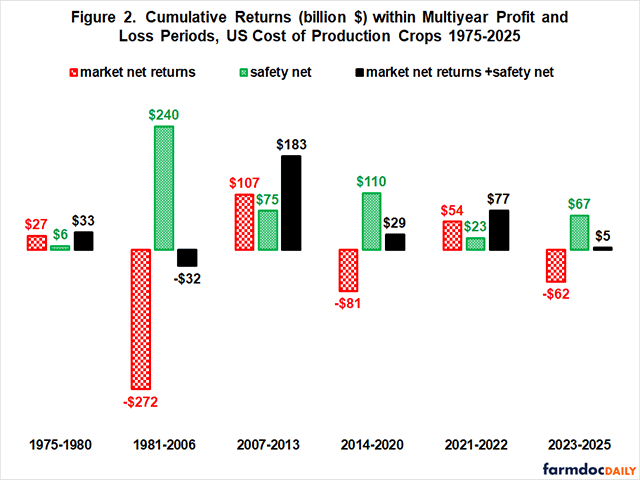
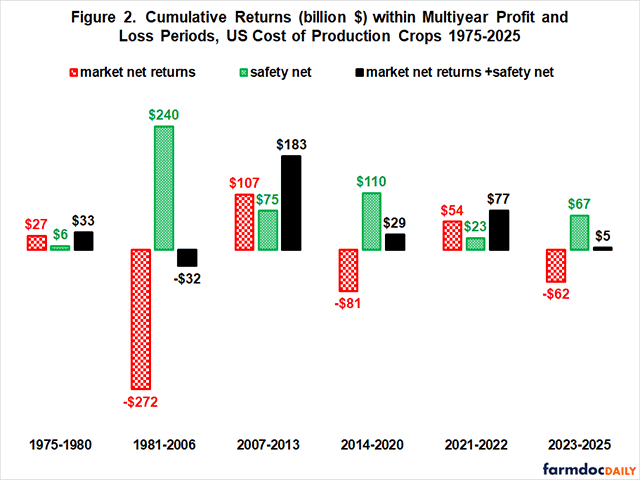
Prior to 2007, the safety net generally offset most -- but not all -- losses. Looking at the period from 1981-2006, the safety net covered about 88% of cumulative market losses. Since 2007, the analysis found government support more than offset cumulative market losses, providing sector-wide profits during those stretches of multi-year downturns from 2014-2020 and 2023-25.
P[L1] D[0x0] M[300x250] OOP[F] ADUNIT[] T[]
In stretches when farmers were profitable, the safety net increased cumulative returns by 70% in the period from 2007-2013 and 41% in 2021 and 2022. The authors argue this represents a fundamental shift in the role of the safety net, which they describe as "supercharging profits" rather than simply protecting against losses.
"This dramatic change prompts the policy question, 'What share of sector market losses should the safety net cover?'"
The analysis added, "Payments in years of sector profitability are particularly troubling both in terms of fairness and supercharging market profits. Crop insurance and ad hoc programs are largely responsible for these payments. Their role in years of prosperity should be carefully examined."
One of the paper's broader arguments is that government support has become embedded in agriculture's cost structure. The economists contend farmers are likely to spend at least part of those payments on production inputs, increasing demand for land, equipment, crop inputs and other assets. Over time, government support has become capitalized into production costs, benefiting input suppliers, landowners, lenders and insurers alongside farmers.
"This prompts another policy question, 'Is this the intended outcome of the U.S. crop safety net?'"
This kind of dynamic has been noted by farm groups, which pointed out production costs such as fertilizer began to rise when USDA announced the Farmer Bridge Assistance (FBA) payments -- even before the war with Iran began at the end of February.
Over the past three crop seasons, 2023-2025, market returns were in the red, -$62 billion, but the safety net totaled $67 billion to generate a $5 billion net return. Most of those payments, $33 billion, came in ad-hoc aid while $17 billion came from crop insurance and $16 billion came from the farm bill commodity programs, Agricultural Risk Coverage and Price Loss Coverage (ARC and PLC).
The report comes out as the Trump administration and Congress are again considering another ad-hoc aid proposal of at least $11 billion, following $9.6 billion in FBA payments earlier this year. In October, ARC and PLC are projected by the University of Illinois to pay out $13.3 billion for corn, long-grain rice, peanuts, sorghum and wheat growers.
The full report can be viewed at https://farmdocdaily.illinois.edu/….
Chris Clayton can be reached at Chris.Clayton@dtn.com
Follow him on social platform X @ChrisClaytonDTN
(c) Copyright 2026 DTN, LLC. All rights reserved.
Comments
To comment, please Log In or Join our Community .