



Canada Markets
Soybean Crush in World's Top 3 Setting Records
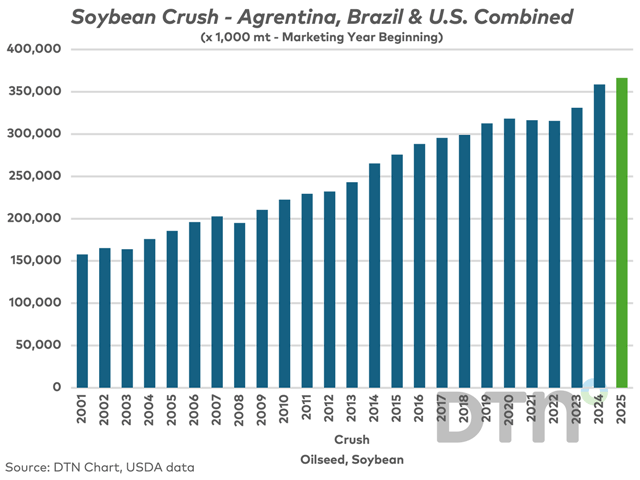
Expecting a new record high for soybean production in Brazil has become as normal an annual ritual as planting -- but the need for it gets little attention. Given how important soybean crush has become to providing the level of soybean oil supply required to satisfy the global demand for biofuel while leaving no shortage for food purposes, it deserves a closer look.
You will notice on the accompanying chart the 2025-26 marketing year (in green) will set another soybean crush record for the top three product exporting countries combined. At 366.4 million metric tons (mmt) processed between the three, it is up 16.1% from the 2022-23 level of 315.6 mmt, representing a 50.8-mmt increase in three short years. In the last two decades, soybean crush has almost doubled from the 2005-06 level of 185.7 mmt. You don't hear that often when another record for Brazilian soybean production is discussed.
And yet, world soybean oil ending stocks-to-use were pegged at roughly minimum pipeline levels of just 8.6% for 2025-26 in USDA's January World Agricultural Supply and Demand Estimate (WASDE) update.
What brings the point up now is Monday's Fats and Oils: Oilseed Crushing report from USDA. It pegged soybean crush in the U.S. at 230 million bushels (mb), up from 221 mb in November and 218 mb in December 2024. That keeps the crush pace on track to easily reach the USDA record estimate of 2.57 billion bushels (bb) of soybeans crushed in 2025-26 compared to last year's record setting 2.445 bb.
P[L1] D[0x0] M[300x250] OOP[F] ADUNIT[] T[]
It is worth noting that soybean oil yield improved slightly in Monday's report with 11.55 pounds of soybean oil produced per bushel of soybeans crushed. That was up from 11.46 pounds/bushel last month but still down sharply from 11.80 pounds/bushel in December 2024. It also backs USDA's decision to cut soybean oil production in the January WASDE even though soybean crush was increased by 15 mb. They lowered the annual average yield estimate to 11.60 pounds/bushel from 11.80 the previous month and 11.95 pounds/bushel last year. As a side note, on 2.57 bb -- .35 pounds/bushel lower yield equals 900 million pounds less soybean oil produced annually from the same total bushels crushed.
It's also worth taking note of the strong soybean oil export pace that will keep crushers incentivized. Thursday's U.S. weekly export sales report for the week ended Jan. 22 included another 49 million pounds of soybean oil being sold during the week, taking total export commitments to 740 million pounds in just the first 16 weeks of the marketing year. USDA already had to revise their annual total up from 900 million pounds to 1.2 billion pounds in the January WASDE, but it looks like it will be another year of upward revisions in future USDA estimates. As a reminder, last year USDA was estimating annual exports of 600 million pounds up until the December report. Final soybean oil exports hit 2.492 billion pounds.
With Monday's announcement from the White House of a trade deal with India, expectations are they will return to the U.S. as a major buyer of soybean oil. They had backed off when the president increased tariffs on them for buying Russian oil. As part of the deal, they have pledged to purchase $500 billion in U.S. products with soybean oil and crude oil being of particular interest here.
With reports suggesting the 2026 biofuel blending mandates will be finalized and released by early March, expectations are for demand from that sector to increase as well. The rumored level of blending requirements are 5.2 billion to 5.6 billion gallons compared to just 3.35 billion gallons last year and 3.04 billion gallons in 2024. Given the delay, USDA did cut their soybean oil biofuel use projection for 2025-26 from 15.5 billion pounds to 14.8 billion pounds. That was still far above the 11.758 billion pounds used the previous year.
With the low soybean oil yield and record-setting demand that lies ahead, soybean crush will remain strong in the U.S. for the foreseeable future and will also need continued growth in South America to help supply the world.
I welcome feedback along with any suggestions for future blogs. My daily comments can be found in Plains, Prairies Opening Comments and Plains, Prairies Quick Takes on DTN products.
Mitch Miller can be reached at mitchmiller.dtn@gmail.com
Follow him on social platform X @mgreymiller
(c) Copyright 2026 DTN, LLC. All rights reserved.
Comments
To comment, please Log In or Join our Community .