



An Urban's Rural View
The President and the Public Give the Economy Different Grades
Does the economy rate an A+++++, as President Donald Trump insists? Or does it deserve the C----- that much of the public has been giving it?
Judging by consumer sentiment, it might even be a D-----. The Conference Board's Consumer Confidence Index ended the year sharply below its January peak. (https://www.conference-board.org/…) The University of Michigan's index has inched up in December and January but is still nearly 25% lower than a year ago. (https://www.sca.isr.umich.edu/…)
The public's unhappiness with the economy also shows up in polls. In the NPR/Marist survey conducted last month, only 36% approved of the president's management of the economy, the lowest score in six years. More than half thought the economy was already in recession. Concern about inflation was much higher than it was six months ago, even among Republicans. (https://www.npr.org/…)
Is the public right? The stock market apparently thinks the economy is OK. The Dow was up 13% in 2025 while the S&P 500 was up 16% and the NASDAQ up 20%. (https://www.cnbc.com/…)
And for good reason. Profits of S&P 500 companies were up 13% and analysts are predicting another 15%-16% increase in 2026. (https://www.cnbc.com/…) Investments in AI and the data centers to power AI are surging.
Gross domestic product numbers have been strong. Adjusted for inflation and seasonal variation, GDP increased at a 4.3% annual rate in the third quarter, well above the historical average, and 3.8% in the second. (https://www.bea.gov/…)
Not bad, even if not worth five plus signs.
P[L1] D[0x0] M[300x250] OOP[F] ADUNIT[] T[]
So why all the public pessimism? In a big, complex economy like ours, booms don't benefit everyone; if you're struggling, you don't regard the economy as great even if government statistics do. Within the ag economy, some farmers can enjoy windfalls at the same time others are going broke.
Jobs are a big part of the problem. When GDP is this strong, they're usually plentiful. That's not the case today. New job creation has stalled.
The unemployment rate has only risen a few tenths of a percentage point over the last year and is still relatively low at 4.6%. But with the never-ending talk of AI replacing humans, even high-performing employees worry about losing their jobs.
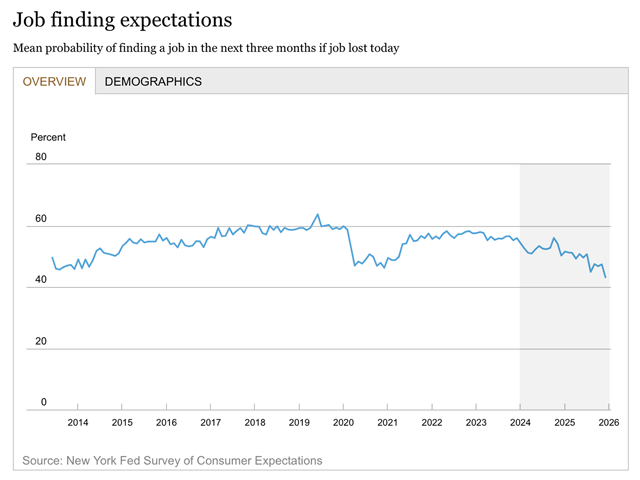
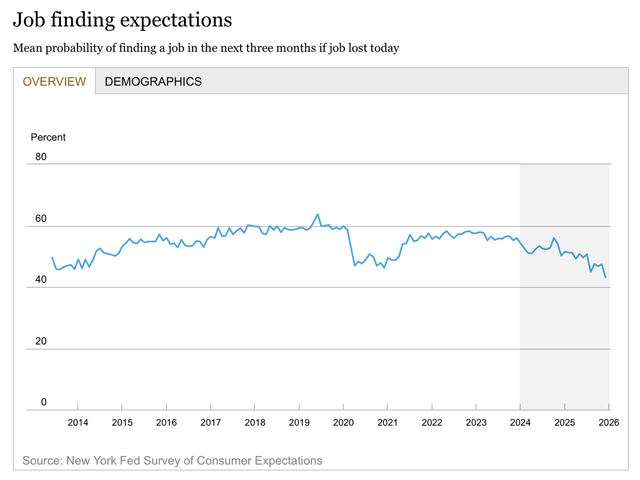
Word is out that people who've lost jobs are having trouble finding new ones.
In the Federal Reserve Bank of New York's December survey, expectations of finding a job if a current job were lost fell 4.2 percentage points to 43.1%, a new low. (https://www.newyorkfed.org/…)
The market for precious metals delivered another vote against economic optimism last year. The price of gold, the classic safe-haven metal, rose 64%. This wasn't about "physical demand" -- investment funds and central banks were among the big buyers. Apparently, they see inflation on the horizon.
Current inflation is another big reason for the public's unhappiness with the economy. The inflation rate has continued to hover uncomfortably around 3%, nearly a percentage point higher than the Federal Reserve's 2% target. Respondents to the New York Fed survey were expecting a 3.4% inflation rate a year from now.
What's upsetting many Americans, though, is more the level of prices than the rate of increase.
Supply-chain disruptions during the pandemic made prices soar 8% in 2022 to unusually high levels. They've remained high; Americans want them to come down. Trump promised during the 2024 campaign to bring them down on his first day as president. He hasn't been able to do that in his first year.
Yes, gasoline prices have fallen. But electricity prices have risen as have the prices of many other goods and services. Moreover, houses are unaffordable for many Americans. Mortgage interest rates have come down but the 30-year mortgage rate is still too high for many at around 6.2%.
Trump's tariffs haven't helped. They've driven prices higher, though not yet as much higher as many had feared. His attacks on the Federal Reserve's independence could yet rouse bond investors to drive long-term interest rates higher even if the Fed continues lowering short-term rates. That would be bad news for mortgage seekers.
The president has called affordability a hoax and some economists argue wage increases have generally kept up with inflation in recent years. Still, the affordability issue helped Democrats win election victories in New York City, New Jersey and Virginia.
It's a mistake for a politician to tell people the economy is great and inflation is under control when that's not what they're experiencing. President Joe Biden made that mistake.
So, until recently, did President Trump. Now, he's groping for quick fixes, promising, for example, to cap credit-card interest rates.
The jury is out on whether he can convince the public to give the economy a better grade.
Urban Lehner can be reached at urbanize@gmail.com
(c) Copyright 2026 DTN, LLC. All rights reserved.
Comments
To comment, please Log In or Join our Community .