



Ag Weather Forum
More Heavy Rain in Canadian Prairies Mean More Flooding, Severe Potential
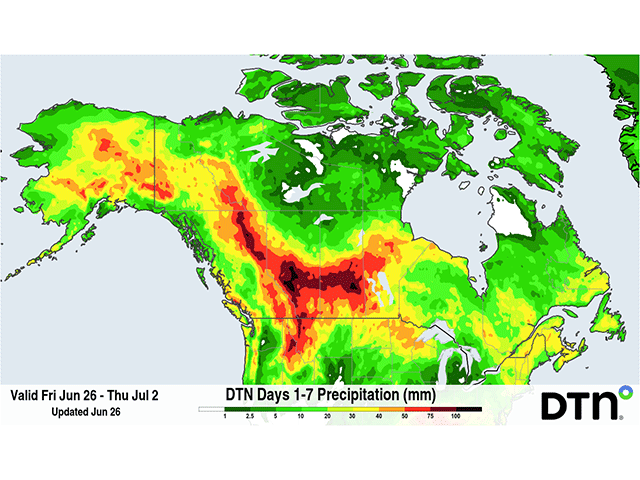
The Canadian Prairies has been wet during the spring and now early summer. That pattern continues with another big system moving in this weekend. Areas of heavy rain and severe weather, along with strong winds, are going to be possible with this system as it lingers into next week.
The system is currently in the Pacific Northwest. It will move into the Prairies on June 27. However, a building upper-level ridge across eastern North America will bottle up that system and keep it spinning in the region into next week.
Models have it finally getting a push eastward across central Canada on June 30 or possibly Canada Day on July 1. A four- to five-day event with a strong system in the region will mean continuous rainfall and pulses of stronger thunderstorms.
P[L1] D[0x0] M[300x250] OOP[F] ADUNIT[] T[]
Any severe storms capable of damaging wind gusts and hail look to be primarily focused across eastern Saskatchewan and Manitoba, and mostly through Monday, but some storms wrapping around the low center could produce some occasional hail farther west as well.
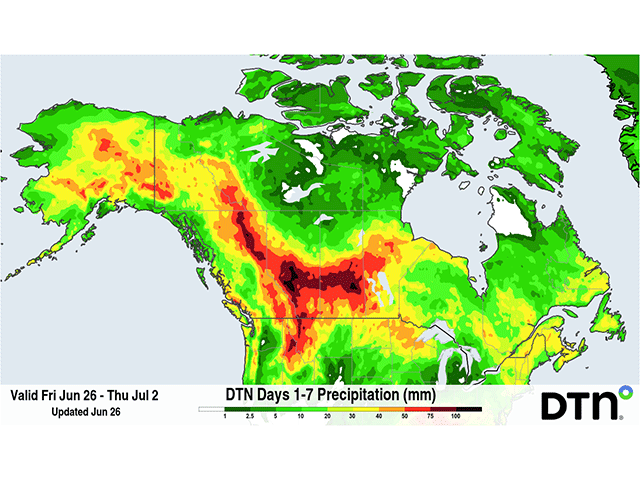
The low will produce a band of showers on its northern and western edges, with more periods of scattered showers to the south and east. When the entire event is considered, a band of 50-100 millimeters (2-4 inches) looks likely across northern Alberta and Saskatchewan, with more like 25-75 millimeters (1-3 inches) across the rest of Alberta and scattered across southern Saskatchewan and Manitoba. With thunderstorms though, higher amounts will be possible. Considering the high soil moisture across most of the region, flooding will be a concern in a lot of areas, especially in the north and west. Parts of Manitoba, which have been dealing with flooding of its own this spring, will be concerned about the rainfall as well.
Another consideration will be the background winds. Swirling around the low center, winds will be variable but frequently gust in the 50-70 kilometers per hour (30-40 miles per hour) range. Some wind gusts will be higher and lower throughout the event as well, which may cause some damage of their own.
The system will be leaving around the middle of next week, but the pattern will continue to support frequent bursts of showers moving through in early and mid-July.
On the positive side, with almost all of the spring seeding completed, this rainfall will be helpful for growth. But with temperatures staying below normal, growth continues to be slow. This week's crop report out of Saskatchewan noted that most of the crop was either at a normal stage of development or behind for this time of year. Almost none of the crop is ahead of schedule. Some heat would be preferred to get crops growing at a faster pace. With seeding behind schedule and slower growth, this puts more of this year's crop at risk for a late summer or early fall frost. Cuttings for hay may be lower if we don't see more heat as well. Temperatures should be rising either late next week or the week after, as the ridge shifts partially into the region. That could pick up the pace of growth.
To stay up to date with weather conditions and your local forecast for free from DTN, head over to https://www.dtnpf.com/…
John Baranick can be reached at john.baranick@dtn.com
(c) Copyright 2026 DTN, LLC. All rights reserved.
Comments
To comment, please Log In or Join our Community .