


Ag Weather Forum
Excessive Heat in the Forecast for Next Week, But Little Concern for US Agriculture?
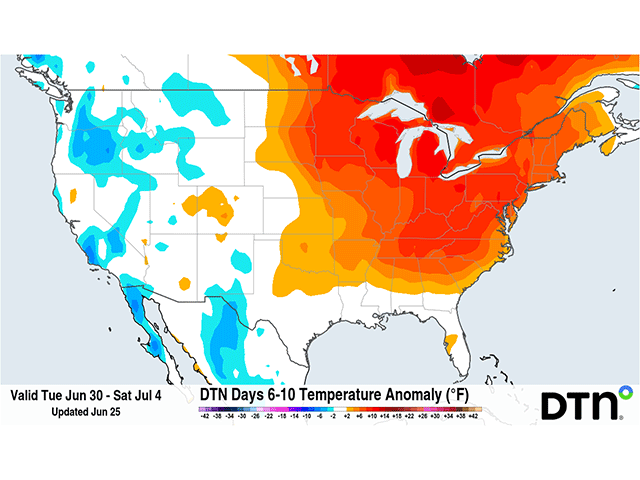
A big heatwave is forecast to develop this weekend and continue next week for the eastern half of the United States. Parts of the Plains will participate as well. A shifting upper-level pattern will produce a ridge from Hudson Bay down into the northern Gulf of America during the weekend and for much of next week. The result will be a shift in the storm track and a big burst of heat across the eastern half of North America.
For the U.S and parts of Canada, temperatures will soar into the 90s Fahrenheit while humidity will dramatically increase with dew point temperatures in the 70s F over vast areas of the continent. Heat indices will be in the 100-110 F range for multiple days over a lot of territory, stressing humans, livestock and crops.
A big June-July heatwave is usually a killer for U.S. agriculture, but corn and soybean markets don't seem to be reacting to the coming heat. That's because this particular heatwave may be just what some areas of the country need.
The weather pattern lately has been very wet across the southern end of the Corn Belt, Delta and Southeast. Flooding has been a frequent occurrence. Currently, flash flood watches are posted from the Central Plains into the Ohio Valley because of another system that is expected to bring through another round of intense rainfall to the southern end of the Corn Belt through early Saturday. The current flood watches are likely to be extended eastward through the Ohio Valley and maybe parts of the Mid-Atlantic as well.
In contrast, some areas across the northern Corn Belt have been drier. Though rain has been somewhat frequent, the intensity has not been enough to compensate for the normal amount of rainfall that usually develops during May and into June. And some areas in the region have been left behind by the fairly active pattern, resulting in some significant dryness. The recent update to the drought monitor continues to see areas from northeast Nebraska and southeast South Dakota through parts of Wisconsin in some form of dryness or drought. DTN's Bryce Anderson discussed this dryness in a blog here: https://www.dtnpf.com/…. This area of the country could use some rain.
P[L1] D[0x0] M[300x250] OOP[F] ADUNIT[] T[]
The weather pattern has also turned a bit cooler. Much of the Northern and Central Plains through the Corn Belt have been awfully mild and, in some cases, cold for the last two weeks. Growing degree days have fallen behind, particularly across the northern zones.
So, given these challenges, a change in the weather pattern would likely be favorable. What this change will accomplish will be three-fold -- increasing temperatures to boost growing degree days and crop growth, allow wet areas across the south a chance to dry out, and bring the storm track farther north to increase precipitation across areas in the Upper Midwest.
When talking about a heatwave, dryness usually coincides with it. Indeed, the upper-level ridge will deflect incoming energy from the West up into Canada. That will leave a lot of the southern end of the Corn Belt down to the Gulf in a much drier look while the ridge exists. For those that are too wet, particularly around Missouri and Illinois and adjacent areas in the southern Corn Belt, it will offer some relief. Without much rainfall and increasing heat, crops will use up some of the excess moisture that is drowning some fields.
This deflection of the storm track will bring more systems from the West into the Northern Plains and Canadian Prairies, increasing showers and thunderstorms. A significant storm will be moving into these areas during the weekend, with the low-pressure center swirling around the Canadian Prairies through a good portion of next week. That will induce constant rounds of showers and thunderstorms.
The front to this system will sit on the western edge of the heat dome from the eastern Dakotas down to the Texas Panhandle for a good portion of next week. East of the front will see the heat while west of it will be a bit cooler. Daytime highs in the 90s F will certainly develop in some areas of the Plains. However, overnight lows will have a chance to cool off, which will be important for cattle. This front will also be the focal point for periods of showers and thunderstorms. Though the exact placement and intensity of the precipitation for next week is questionable, it is reasonable to assume that the northern end of the front should be more active than the south, which means more showers for the Dakotas into the Upper Midwest, the same areas that could use some more rainfall that Anderson alluded to above.
But a heatwave is still a giant risk. For those areas that are not very wet, the heat will cause a reduction in soil moisture, leading to stress. The precipitation across the north may not be all that meaningful for some areas, or might miss more than models suggest, leading to further momentum toward building drought.
And for areas in the Plains that are already very dry and only recently wet, the coming warmer and drier conditions could turn the situation around as well.
The duration of the heatwave is also important. Models suggest the upper-level ridge will not be stagnant. By the end of next week, the system in the Canadian Prairies will move over the ridge through eastern Canada, while the ridge will shift westward to take its place. Depending on where this sets up, we could see some relief coming to the eastern half of the country while the temperatures rise in the West and/or the Plains.
The farther west the ridge moves, the more relief from the heat it will bring to the U.S. So, if this heatwave only lasts for a week, the result may not be all that damaging for those along and east of the Mississippi River, but the focus could then shift toward the western end of the Corn Belt and Plains for damage in mid-July. Tracking the movement of this ridge will be important during the next several weeks.
To stay up to date with weather conditions and your local forecast for free from DTN, head over to https://www.dtnpf.com/…
John Baranick can be reached at john.baranick@dtn.com
(c) Copyright 2026 DTN, LLC. All rights reserved.
Comments
To comment, please Log In or Join our Community .