


Ag Weather Forum
Three Big 'Spring' Storms Threaten US This Week
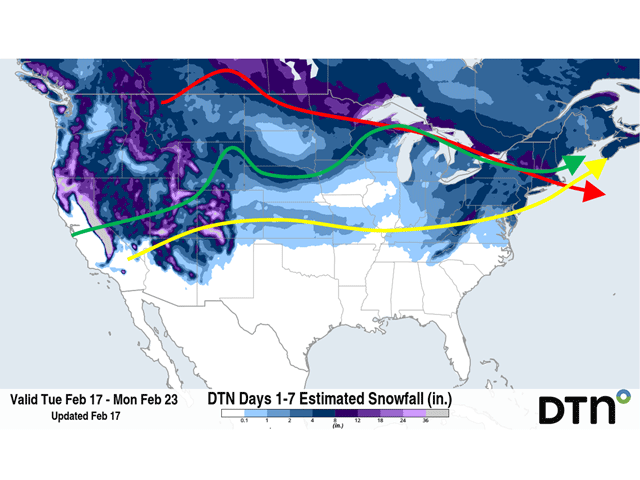
Warmer air spread through the country last week as the overall weather pattern started to change regimes. Over the weekend that process continued, which resulted in a big storm moving through the Western U.S. That storm, at least one more, and likely a third are in line to move through the country this week. With the big shift in temperature, there is ample energy out there to produce widespread impacts from gusty winds, heavy snow, potential blizzard conditions, and severe weather.
You could think of this scenario as three waves of the same storm, because they all come from the same upper-air trough. Or you could count these as three separate storms; but how they are categorized means very little. What will matter more are the impacts felt throughout the country as the system(s) move through.
The first wave is leaving the West and entering the Plains on Tuesday morning, Feb. 17. The precipitation impacts from this portion of the storm will move across the north with heavy snow already forming in Alberta, Canada. The main low-pressure center will move from northeast Wyoming through South Dakota and into Minnesota Tuesday, with the storm spreading out across the Great Lakes for Wednesday, Feb. 18. Heavy snow will continue to develop down to the low track and will be particularly heavy from Alberta through North Dakota and into northern Minnesota where more than six inches is appearing very likely across a widespread area and some areas may see close to a foot. With some lake-enhancement on the North Shore of Minnesota, totals could make it up to two feet of accumulation.
To go along with the snow, winds will be awfully strong across the Plains on Tuesday afternoon and gusts of more than 60 mph will be possible from Alberta down to west Texas. While southern areas will see very little precipitation, the winds could cause some damage on their own. Drier areas could see blowing dust as well as an increased wildfire risk. Where the snow and winds coincide, blizzard conditions will be possible. The National Weather Service has a blizzard warning posted for northeast Montana that may have to be extended into northern North Dakota and Minnesota as well.
P[L1] D[0x0] M[300x250] OOP[F] ADUNIT[] T[]
Part two of the storm is currently moving into California on Tuesday. After producing significant snowfall in the Sierras with peak accumulation in the highest passes at over six feet, the storm will continue through Utah and Colorado for Wednesday, where additional heavy snow of up to three feet is in the forecast. Western states are currently in a significant snow drought, with totals running less than 40% of normal in some areas due to somewhat lower precipitation, but mainly higher temperatures over the last few months. The current and coming storm will help considerably with easing that drought, though there is a long way to go.
The second wave will continue into the Central Plains on Wednesday night and especially Thursday, Feb. 18-19, moving across the Nebraska-Kansas border and then arcing northward into Wisconsin. A band of snow will form on the northern edge of the storm. Though models disagree greatly about snowfall intensity, there is potential for at least six inches to fall along the most preferred path from the Black Hills to Nebraska, northern Iowa, southern Minnesota, and western Wisconsin. The oddly shaped arc path will be interesting to watch and appear unusual for those who regularly watch the weather.
This storm may also produce stronger winds, but far below the 60-mph threshold, and blizzard conditions are currently not forecast for the snow. But the deepening low-pressure center over northern Illinois and Wisconsin could spark some stronger thunderstorms across the Ohio Valley on Thursday. Models are mixed on whether or not all the ingredients necessary for strong-to-severe thunderstorms will be present at the same time, leading to a lower-confidence forecast. But given that, there is still potential for the Storm Prediction Center, which currently has a slight risk of severe weather, to upgrade their outlook and risk potential. All forms of severe weather would be possible, including tornadoes, should all the factors manifest. That would be a rare and early severe weather outbreak this far north. Climatology favors the Gulf Coast states with severe weather potential in February.
The system will push through the Mid-Atlantic and Northeast for Friday, Feb. 20, with a mix of rain and snow. Some thunderstorms may be left over from Thursday, but severe weather would be unlikely. This could result in some heavier snow in the Northeast, however, extending the risks of more than six inches of accumulation to a wider area of the country.
The third and final piece to the system is much more uncertain than the first two. There will be another burst of energy that moves through the Southwest U.S. for Thursday and Friday. Additional snowfall to ease the snow drought is expected there and will occur farther south into Arizona and New Mexico as well. But as that system is forecast to move into the Plains on Saturday, it may not be in the best position to take hold of the lingering cold front from the second system to produce widespread precipitation. The DTN forecast does account for the potential for this third wave of the storm to be a big one, which would mean snow potential from California through Maine, but not all models agree. The very reliable ECMWF model shows very little precipitation east of the Rockies with a band of weak snow across Colorado and Kansas of less than an inch with scattered rain showers near the Gulf Coast over the weekend.
The American GFS solution, in stark contrast, develops a band of more than four inches of snow across Kansas and continues measurable snow through the southern end of the Midwest before significantly developing the system offshore and becoming a nor'easter type of storm for southern New England where heavy snow and strong winds could create a big hassle for a large population base. Reality will likely fall somewhere in between, which could still cause some significant impacts for a large portion of the country.
Another noticeable feature behind this system will be the massive drop in temperature. Temperatures east of the Rockies are extremely warm by February standards, with some areas of the Plains and western Midwest 20-30 degrees above average to start the week. Colder air pooling up in the West, and especially in western Canada, will fuel the storm systems as they move through. And as they do so, temperatures will drop significantly. Though the resulting temperatures will be only 5-10 degrees below average for most areas of the country, the stark change will lead to a 30-40 degree temperature drop behind the slow-moving cold front as it is progressively pushed along by the three systems throughout the week. The cold will not last long, however, as more warm air and another week of chaotic weather is in store for the last week of February.
To stay up to date with weather conditions and your local forecast for free from DTN, head over to https://www.dtnpf.com/…
John Baranick can be reached at john.baranick@dtn.com
(c) Copyright 2026 DTN, LLC. All rights reserved.
Comments
To comment, please Log In or Join our Community .