



Ag Weather Forum
Winter's First Half Dried Out Much of the Mississippi Basin
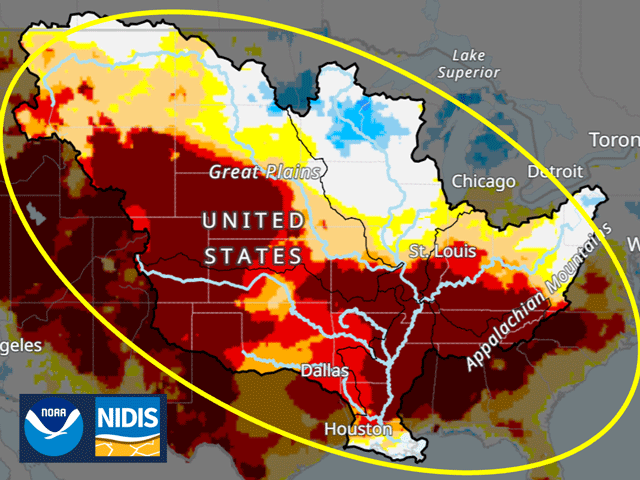
As we approach the midpoint of the 2025-26 meteorological winter season (December-January-February), the drying influence from a warm December is showing up in the greater Mississippi River basin. December 2025 ranked as the fifth-warmest December on record for the contiguous United States.
The greater Mississippi River basin was mostly near normal; however, temperatures in the Missouri River and Arkansas River tributary basins were from 3-12 degrees Fahrenheit above normal. Precipitation in the Mississippi basin varied from much above normal, including some record wettest, in the northern reaches of the basin, to much below normal and record-driest in the southern reaches. For the entire greater Mississippi Basin, December 2025 was the 12th driest December in the 131 years of record-keeping, according to the NOAA National Centers for Environmental Information (NCEI).
P[L1] D[0x0] M[300x250] OOP[F] ADUNIT[] T[]
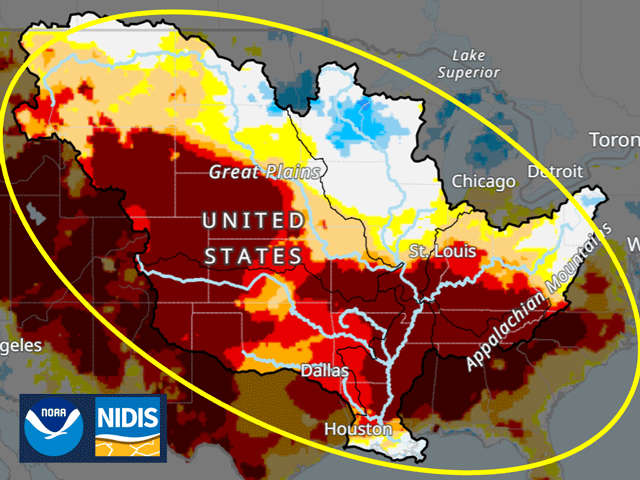
One result of that warm December over the greater Mississippi basin is large-scale atmospheric demand and drying. A new drying study by the NOAA National Integrated Drought Information System (NIDIS) called the Evaporative Demand Drought Index (EDDI) shows the impact of that drying. The EDDI description noted that "It examines how anomalous the atmospheric evaporative demand ... also known as 'the thirst of the atmosphere' is for a given location and across a time period of interest." EDDI is described as "a strong tool for preparedness for both flash droughts and ongoing droughts."
As of the end of the second full week of January, the four-week EDDI showed a sharp difference in atmospheric demand from north to south in the greater Mississippi basin. In the north, the Upper Mississippi River basin shows normal-to-wetter conditions. In most other areas of the basin, the evaporative demand is high, particularly in the tributaries that feed the Lower Mississippi River. That collection of tributaries includes the Ohio River, which typically supplies 50% of the Mississippi River's total stream flow.
Dryness is showing up in river levels as well. River gauge readings on Jan. 18 were on the low side of the median at Upper Mississippi stations in St. Paul, Minnesota, and Rock Island, Illinois. Every other gauge, from St. Louis, Missouri, to New Orleans, Louisiana, had either below median or well-below-median readings.
Forecasts for the balance of the meteorological winter and on into the start of spring in March do not offer much, if any, easing of this trend in the Mississippi Basin, especially in the Lower Mississippi. DTN's seasonal forecast for the January-through-March time frame points to below normal totals, along with average temperatures of at least 2-3 degrees F above normal. This combination suggests that high evaporative demand, and its influence on potential drought, will continue as a primary feature in the early 2026 fortunes of the primary U.S. agricultural transport corridor, the greater Mississippi River basin.
More details on the forecast for spring 2026 are available here: "El Nino Expected to Influence US 2026 Growing Season," https://www.dtnpf.com/….
Bryce Anderson can be reached at bryce.anderson@dtn.com
(c) Copyright 2026 DTN, LLC. All rights reserved.
Comments
To comment, please Log In or Join our Community .