



Ag Weather Forum
Small Changes in Upper Levels Flip Weather Pattern for US
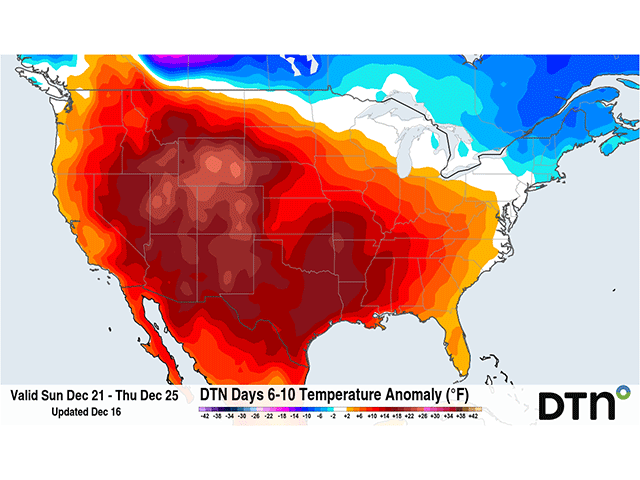
The U.S. -- and Canada too -- have been under an early burst of winter weather. Since the week of Thanksgiving, frequent bursts of arctic air of varying degrees of cold have pushed through much of North America. But the mechanism that has caused this cold intrusion has shifted. And while the weather pattern remains active, the cold air has retreated farther north. A warmer overall weather pattern is upon us and will likely last for the rest of the month. At least, that's what models are indicating.
Cold air can come from the Arctic in several ways. The most consistent way to do it is for an upper-level ridge to form over Alaska. That usually forces a trough to develop near Hudson Bay, and the flow from the ridge to the trough brings down cold air from the Arctic. Such was the case for most of the last three weeks.
An upper-level ridge has been a consistent feature since right before Thanksgiving, a week that saw winter temperatures arrive in a very significant way. Pushes of cold air have come down repeatedly since then. This has resulted in a rather active weather pattern, whereby multiple storm systems have moved through -- mainly in a clipper-like fashion -- to build up an early snowpack for the Northern Plains through much of the Midwest.
It has also been a rather cold period with temperatures significantly below normal. In fact, Minneapolis, Minnesota, has not seen a temperature above freezing since Nov. 25, a run of 20 straight days. Though temperatures usually are cold enough not to break the freezing mark during this time, three straight weeks of not accomplishing that feat is rather unusual.
P[L1] D[0x0] M[300x250] OOP[F] ADUNIT[] T[]
That streak is breaking Tuesday, Dec. 16, as a low-pressure system moves through Canada, causing gusty winds to warm coming down off the Rocky Mountains, flooding the Plains and Midwest. This air is sourced from the Pacific Ocean and not the Arctic, resulting in more widespread warmth returning to the country.
The reason for this shift in the source region for air is due to a change in the upper-level weather pattern. The ridge that has been a feature across Alaska has pushed westward into the Bering Sea and northeastern Russia. Instead of forcing a trough over central Canada, the trough is being forced over western Canada, which allows another ridge to develop over the rest of the U.S. This is the feature bringing the warmth, and the western trough is likely to keep the cold, arctic air locked up in the western half of Canada until that Bering Sea ridge shifts.
This is still an active pattern for the U.S. Storm systems will ride along the northern edge of the ridge through Christmas and possibly through the end of the month. The difference this time is that the track of the low-pressure systems will largely be through Canada instead of the U.S., meaning only cold fronts swing through the country.
Precipitation will still occur with these fronts, and a significant one is forecast to move across the country Wednesday through Friday, Dec. 17-19. But temperatures are rather warm ahead of this system. Most of this precipitation will be in the form of rain. Thunderstorms will be possible in the Midwest. And snow will be relegated to far northern areas.
In general, the rising temperatures will cause snow to melt rather than accumulate. Behind this front, temperatures are indeed forecast to drop quite significantly, tapping into some of the cold in western Canada. But that will only last a day or so before temps rise again.
Several other systems will move through near the Canadian border this weekend and next week, but the results will likely be limited precipitation and overall warmer temperatures. The northern tier of states may catch some of the cooler temperatures at times, but in general, this is a warmer pattern with limited cold disruptions rather than a cold pattern with limited warm disruptions, a basic flip to the temperature pattern across much of the U.S. east of the Rockies.
In fact, models have some extremely warm temperatures forecast for the week of Christmas. It is very early, and temperatures may change, but models are producing temperatures 20 to 30 degrees above normal for most of the U.S. outside of the Northeast in the few days leading up to the holiday. The forecasts are particularly high across the central and southern Rockies through the Southern Plains and into the Mid-South. If these forecasts hold, some records may be broken. Those of us with snow on the ground will likely see that area being reduced, and the chances for a white Christmas have fallen for much of the Northern Plains and Midwest.
But this warmth will not last forever. The ridge will eventually shift eastward again, and cold air will come rolling back through the middle of the country. Current model runs suggest the last couple of days of December -- or more likely early January -- for that to come back into the conversation.
To find more weather conditions and your local forecast for free from DTN, head over to https://www.dtnpf.com/….
John Baranick can be reached at john.baranick@dtn.com
(c) Copyright 2025 DTN, LLC. All rights reserved.
Comments
To comment, please Log In or Join our Community .