



Production Blog
Syngenta Showcases New Crop-Protection Tools for Weeds, Pests and Diseases
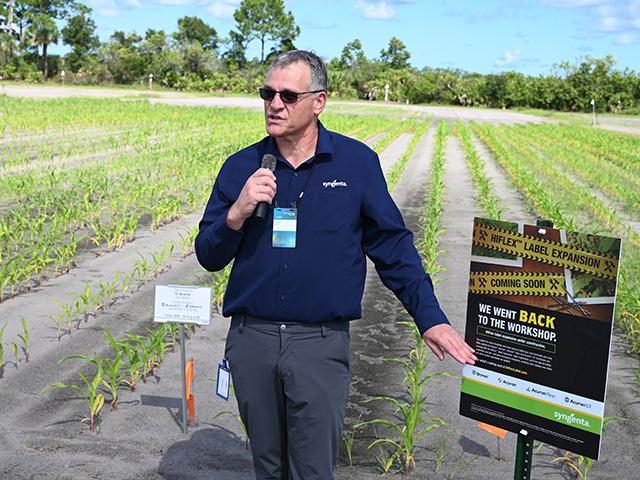
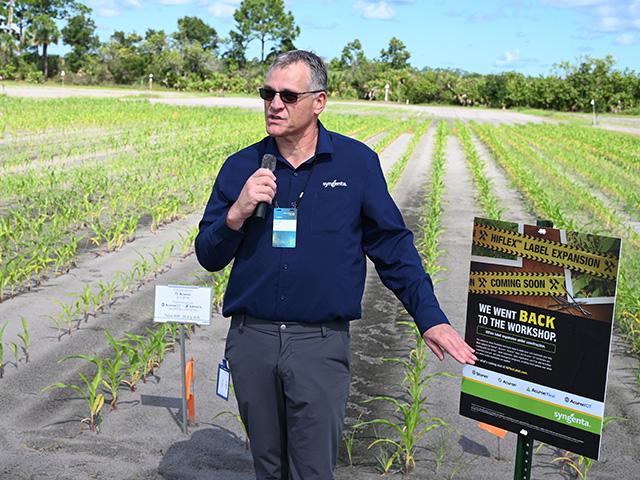
ORLANDO, Fla. (DTN) -- Syngenta showcased its latest research and innovations in crop protection to agricultural journalists last week in Orlando, Florida. This included a visit to the company's Vero Beach Research Center where future and existing products are evaluated and tested.
The biennial Syngenta Media Summit provided insights into research and development investments, regulatory hurdles slowing product development and how current crop-protection products can help farmers feed a growing world.
Jeff Cecil, recently promoted to president of North America crop protection with Syngenta, said the company is more committed than ever to bring new herbicides, fungicides and insecticides to market even though it's taking longer and costing more money to do it.
"Farmers are looking for new technology," Cecil said. "As (herbicide) resistance grows, we continue to have challenges that Mother Nature brings us that need answers. Farmers are looking for higher yields. So, new technology matters, but they are getting it later and later."
What used to take about 12 years to go from product concept to launch now takes 15 years or more due to a more laborious regulatory process, Cecil continued. He estimated it costs about $300 million to bring a new "molecule" to market.
Cecil also claimed Syngenta is the top investor in crop-protection research and development, spending $850 million in 2025, up more than $100 million from 2018. He said the company has 24 crop-protection products in the pipeline valued internally at nearly $17 billion.
"The FAO (Food and Agriculture Organization of the United Nations) predicts the world will need 50% more ag production by 2050," Cecil said. "We need to continue this investment."
The 240-acre Vero Beach Research Center plays a key role in developing and testing new products and technologies while also improving existing ones, Cecil said. It has laboratories, 12 greenhouses and test plots -- including 130 irrigated acres -- where crops can be grown and evaluated year-round.
"It's our backbone to developing products. It helps farmers solve problems to give them the yield potential they're looking for," Cecil continued.
Here's three recent Syngenta innovations highlighted at the media summit.
FLEXIBLE WEED CONTROL
Syngenta announced on Oct. 12 that the company has submitted a proposed HiFlex label expansion to the U.S. Environmental Protection Agency (EPA) that would expand weed management flexibility for growers using bicyclopryone-containing for herbicides, including Storen, Acuron, Acuron Flexi and Acuron GT.
P[L1] D[0x0] M[300x250] OOP[F] ADUNIT[] T[]
With approval anticipated for the 2027 growing season, the proposed HiFlex label expansion would double the maximum annual use rate of bicyclopyrone, giving growers greater flexibility to layer residual herbicides and improve season-long weed control.
"This really helps (weed) programs by giving farmers more flexibility and the full power of bicyclopyrone," said Mark Kitt, corn herbicides technical product lead with Syngenta, standing next to several containers with weeds in a greenhouse meant to show the effectiveness of the higher application rates.
Once the label expansion is approved, growers will have the option to use Storen, Acuron or Acuron Flexi preemergence followed by a postemergence application of Acuron GT, which is not permitted on current labels.
TARGETING SOYBEAN'S 'MOST WANTED'
Much like the FBI's Most Wanted list identifies the nation's most elusive criminals, Syngenta has zeroed in on three of the biggest threats to soybean yields: soybean cyst nematode (SCN), sudden death syndrome (SDS) and, the newest addition to the lineup, red crown rot.
Syngenta launched Victrato seed treatment this year, which provides broad-spectrum protection against nematodes and several soil- and root-borne diseases. The product contains the active ingredient (AI) cyclobutrifluram, a succinate dehydrogenase inhibitor (SDHI). This category of fungicides (FRAC Group 7) includes other products already on the market, including Saltro (Syngenta) and Ilevo (BASF). Syngenta branded this new molecule as Tymirium technology.
"SDHI chemistry is not new or unique, but what is new and unique about this molecule is the potency it brings and smart-site targeting," said Alex Russell, Syngenta soybean seed care product lead.
SCN is the No. 1 yield-robbing soybean pest, costing farmers an estimated $1.5 million annually, according to the SCN Coalition. SDS is one of the most well-known soybean diseases across much of the U.S., causing significant yield losses, according to the Crop Protection Network. Red crown rot is an emerging soybean disease in the Midwest, discovered for the first time this year in Iowa, which can cause yield losses up to 70% in bad areas of fields, said Darren Mueller, Iowa State University Extension and Outreach plant pathologist and professor. DTN recently published an article about red crown rot: https://www.dtnpf.com/….
Stine Seed Co., based in Adel, Iowa, offered Victrato to customers this year. According to the company, in replicated field trials conducted under nematode and SDS pressure, Victrato-treated soybeans demonstrated statistically significant yield advantages compared to standard treatment options.
"Seed treatments play an important role in protecting yield potential, especially in fields with known disease or pest pressure. Victrato gives growers a new option to address challenges that have been difficult to manage in the past," said Myron Stine, Stine Seed Co. president, in a blog post on the company's website. "Red crown rot continues to be a concern in many soybean-producing areas, and until now, there has not been a federally labeled seed treatment available. Victrato provides growers with a management tool they have not previously had access to."
As soybean harvest passes the halfway mark in the country, Russell said she's eager to get yield results from farmers that applied the seed treatment.
"Of the growers and retailers we reached out to so far, 80% of growers observed better plant stands and more uniformity, while 93% of retailers observed more robust plants," she said.
Learn more at https://www.syngenta-us.com/….
COMBAT CORN ROOTWORM
The EPA announced in June an initiative to delay corn rootworm resistance to Bt (Bacillus thuringiensis) corn traits. Soil-applied insecticide at planting is part of the framework. Learn more at https://www.epa.gov/….
"The traits aren't working as well as they used to," said Scott Johnson, insecticides product lead with Syngenta. "The need for corn soil-applied insecticides is a huge opportunity for us."
Syngenta introduced Opello this year, a soil-applied insecticide that provides what the company calls "revolutionary control of corn rootworm." Opello's formulation is highly tank-mix compatible, which minimizes clogs and slowdowns during planting.
The new active ingredient in Opello is isocycloseram, which is a Group 30 insecticide. The ingredient powers the company's Plinazolin technology, which Syngenta scientists say offers a new mode of action and protects against a broad spectrum of agricultural pests, including rootworm, mites, thrips, true bugs, beetles and certain Lepidopteran pest species.
Opello is one of five brand-name insecticides using Plinazolin technology, which was approved by the EPA in December 2025 after 12 years of research and development and more than 3,000 U.S. field trials.
"We tested Opello with over 100 starter fertilizers, and there was only one that we weren't compliant with. Growers can have confidence that they're getting the right amount of AI (active ingredient) per acre with their starter fertilizer while planting," Johnson said.
Syngenta and university trials in 2022 to 2024 showed corn treated with Opello averaged 27 bushels per acre (bpa) more than untreated corn, according to the company. Compared to corn treated with Capture LFR (FMC) and Nurizma (BASF), Opello yielded 13 bpa and 9 bpa more, respectively.
"We continue to see strong performance," Johnson concluded.
Learn more about Opello at https://www.syngenta-us.com/….
Read about the 2024 Syngenta Media Summit at https://www.dtnpf.com/….
Matthew Wilde can be reached at matt.wilde@dtn.com
Follow him on social media platform X @wildeagwriter
(c) Copyright 2026 DTN, LLC. All rights reserved.
Comments
To comment, please Log In or Join our Community .