



Market Matters Blog
Deep Freeze Overtakes Illinois River System, Impedes Barge Traffic
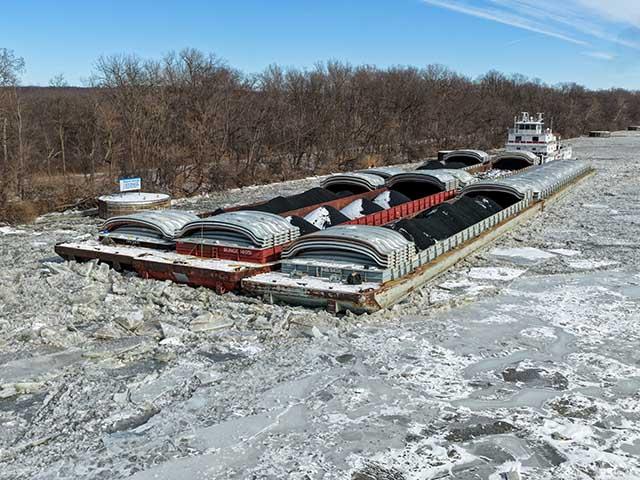
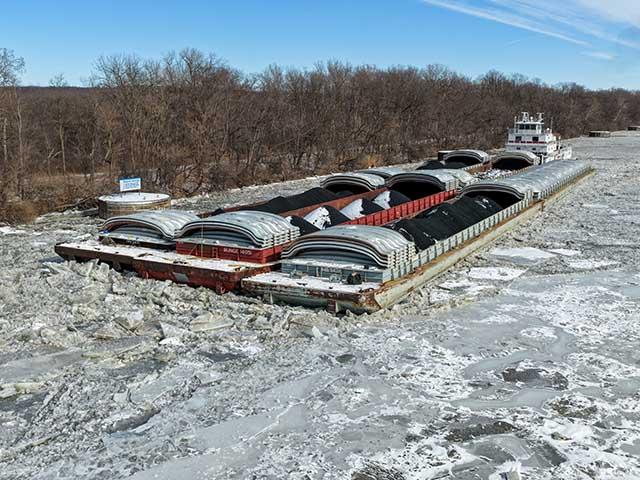
The Illinois River has been battling serious ice conditions. Reports of barges stuck in the ice, stoppage and/or slowdown of movement, and caution notices at locks have been going on for weeks.
In the Feb. 5 U.S. Army Corps of Engineers (USACE) Lock Performance Monitoring System and the Feb. 4 Inland Waterway report (IWW), updates were provided to tows pushing barges as to what was needed to pass through locks still having significant impacts due to ice.
1. Peoria Lock and Dam: 2/05/2026 at 0600: Ice Conditions: **Ice couplings required. Ice is approximately 3" thick, broken, cake ice covering 80% of the upper pool, extending about 1 mile upstream. The lower pool is 60% covered with broken cake up to 3" thick extending about 2 miles downriver. For Northbound DOUBLE lockages: an assist tug IS required to pull your first cut. ARTCO can be reached on marine channel 8 to arrange this. For Southbound DOUBLE lockages: Lock staff will notify you WHEN/IF NEEDED to have an assist tug pull you first cut. For Northbound tows with empty barges on the land wall side, ensure there is a ladder placed on the first cut for safe debarkation of your crew. Call us on marine band 14 to coordinate lockage, or by telephone for vessels without a marine radio.
2. Starved Rock Lock and Dam: 2/05/2026 at 06:00: Ice couplings required. 89' wide width restriction. Floaters are tied up. Helper boat required to pull cuts NB and case by case for SB. Lower right valve is out of service impacting emptying times. Due to extreme cold during night hours, lower bubbler is unable to run. An assist boat may be needed for southbound doubles. Call the lock ahead of time for any additional information or changes to locking procedures. Feb. 4 IWW report noted 100% ice coverage.
3. Marseilles Lock and Dam 2/05/2026 at 0600: Lower traditional stopping pin damaged, new "Red Top" stopping pin identified at lower 825' mark. Expect longer lockage times when lower wall is occupied. Ice conditions: Width Restriction of 89'; Unable to pull cuts; Ice Couplings Required; Floaters Tied Up; Mariners are not to enter Marseilles Canal unless locking through; Mariners are requested to not moor on Left Descending Cells in canal above the chamber. When locking through, utilize Right Descending Wall when possible. Upper/Canal Ice Conditions: Coverage -- 100%. Thickness -- 8-10". Lower Ice Conditions: Coverage -- 100%. Thickness -- 8-10".
P[L1] D[0x0] M[300x250] OOP[F] ADUNIT[] T[]
American Commercial Barge Line (ACBL) noted in their Feb. 5 update, that on the Illinois River at Beardstown, Dosh, Havana, Peoria, Pekin, Spring Valley, Hennepin, LaSalle, Ottawa, Morris, and Naples, "The following fleet operations have resumed; however, there are significant delays with tow work and dock spots are limited as of Feb. 5."
ACBL reported Channahon/Lemont Operations have resumed; however, there are significant delays, minimal tow work, and limited dock spots as of Feb. 5. Lemont will begin sweeping barges as of Feb. 5; TBD when washing will begin.
At SAG Canal/Chicago Harbor/Lake Michigan, ACBL said, "All operations have been suspended. Reassessing on Feb. 9."
"Please note that all plans are fluid and subject to change. We will continue to monitor conditions closely. If any critical updates arise over the weekend, they will be communicated as soon as possible," added ACBL.
As temperatures warm up, ice will melt and move south, but that can cause ice gorges at locks and dams depending on how fast the melt is. Temperatures that warm and then freeze at night are also not ideal.
**Ice couplings on barges, as discussed in the U.S. Army Corps of Engineers (USACE) Mississippi Valley Division report, are specialized, robust fastening systems used to securely attach barges together in winter, allowing them to remain connected despite ice accumulation on the outside of the hulls. They allow tows to maintain structural integrity in freezing conditions.
Here is a link to more information on the Illinois River locks status: https://ndc.ops.usace.army.mil/….
Here is a link to the IWW Lock & Dam Status 04-Feb-2026: https://www.irpt.net/….
Mary Kennedy can be reached at Mary.Kennedy@dtn.com
Follow her on social platform X @MaryCKenn
(c) Copyright 2026 DTN, LLC. All rights reserved.
Comments
To comment, please Log In or Join our Community .