



Canada Markets
This Week's Spike in Crude Oil Could Be Just The Beginning
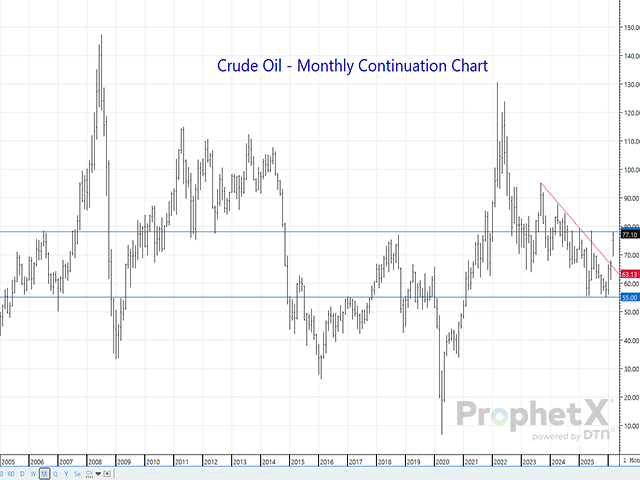
In a world where we all have grown to expect a quick resolution to any problem that arises, it's hard to imagine a silver bullet solution that will calm energy market anxiety anytime soon. The difficulties of the situation support the theory that breakaway gaps (as seen on the accompanying chart) may well be signaling the start of a major rally, not one close to the end.
With ultra-low sulfur diesel (ULSD, commonly known as heating oil) futures gaining as much as 33% from Friday's close to Wednesday's high, it would make perfect sense to see a pullback as leaders try to resolve the issues inspiring the price spike -- but it may be hard to get the genie back into the bottle. As such, it would likely be wise to use any pullback in price to try to manage fuel costs for the year ahead in any way possible.
Before diving deeper into the factors involved, I would like to put the recent move into perspective. It's worth noting that crude oil is only $19/barrel above the five-year low set in the middle of December. Not enough to cause panic. That still leaves the price at only 58% of the 2022 high level of $130/barrel. And only half of the 2008 high of $147.27/barrel. And that is not the inflation-adjusted price. Not trying to minimize the impact of this week's rally but simply pointing out if the breakaway gaps are truly a sign of things to come, it's best we keep an open mind to what the possibilities could be. Especially considering the challenges facing the market.
Most important at the moment is the virtual closure of the Strait of Hormuz. As DTN Basis Analyst Mary Kennedy pointed out in her blog at https://www.dtnpf.com/…, 20% of the world's crude oil trade passes through the strait, with its closure having dramatic impacts. Prices had increased ahead of the weekend as traders reacted to the potential loss of Iranian oil supply, for a while at least. But the potential loss of all supply from the region was not even close to being on the radar. With major production fields already being shut down due to a lack of remaining storage, pressure is intense on leaders to do something to get ships moving again, despite Iran's pledge to attack anyone who tries.
President Trump tried to come up with a solution Tuesday, suggesting he would have the U.S. Development Finance Corporation provide insurance covering the passage through the strait and naval escorts could be supplied if needed. There is already pushback on that plan given how clear it is that drones are difficult to fully defend against, both on land and at sea. Not to mention the political pushback against risking U.S. lives and assets helping to get Iranian oil to China (in some cases). Such a plan may inspire a profit-taking pullback in energy prices, but that could be temporary if Iran is successful in attacking any ship that tries to pass. And more likely a good opportunity to manage upside price risk.
The second obstacle that may be extremely difficult to overcome is associated with the elimination of Ayatollah Khamenei. It not only resulted in him being celebrated as a martyr by his Muslim followers, but it also cemented their resolve to avenge his death. That increases the risk of attacks worldwide in a disorganized and hard to defend against manner. His death also left a void in clear leadership, making it difficult to negotiate any sort of de-escalation. That has the U.S. in the awkward position of trying to promote some sort of successor with the lack of clear leadership leaving the situation volatile and unpredictable in the meantime. And most importantly to energy markets, leaves more questions than answers as to who is actually in charge of the oil supply or export decisions going forward (as it had been the reigning government).
P[L1] D[0x0] M[300x250] OOP[F] ADUNIT[] T[]
A third problem that arose in the early days (that appears to be settling down a bit now) is Iran's willingness to attack any neighbor that cooperated with the U.S. in any way. Attacks on neighboring production or storage facilities were a perfect example. Even the threats over the Strait of Hormuz passages suggest Iran is determined to take everyone around them down too if they are crushed.
All of the above does not guarantee a slow and painful resolution, but it's hard not to imagine a prolonged conflict with all of the discussion over regime change that will almost certainly require boots on the ground to accomplish. At the very least, the potential for extended risks to energy supplies needs to be considered.
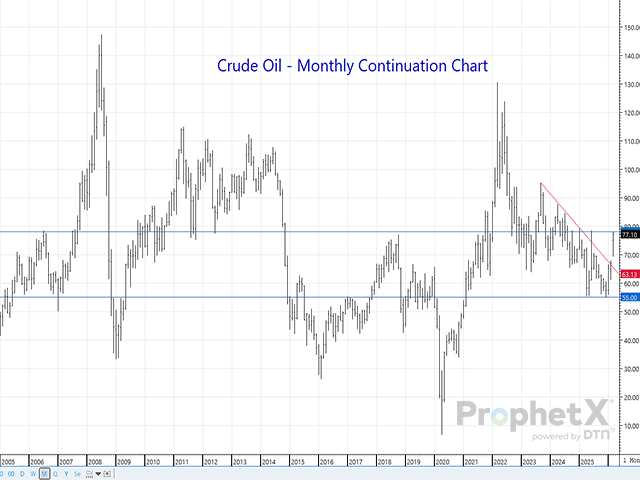
That leads into the technical picture. As mentioned with the accompanying chart, the fact the initial pre-emptive strike occurred over the weekend left very uncommon significant gaps higher on all of the daily, weekly and monthly charts. These should be considered breakaway gaps and are expected to mark the beginning of substantial moves, higher in this case. You may also notice the double bottom left throughout 2025 that would have a measured move to $101/barrel on a rally over resistance at $78/barrel. And considering how much more serious of a disruption this event could be to global crude oil supplies than the invasion of Ukraine by Russia, a test of the 2022 high at $130/barrel would certainly be reasonable to prepare for. Regardless, the one thing that stands out from the chart is how volatile prices have been over the past 20 years compared to this relatively insignificant bump up, and how reasonable it would be to assume it may have a long way to go yet.
A few final points should be mentioned. The weekly saucer bottom on the Bloomberg Commodity Index chart is playing out very well as expected given the rallies in energy markets and previously in metals. Such a saucer bottom would be considered a failure if it didn't take out the previous reaction high, which in this case was set early in 2022. Providing another clue as to the potential rally that may be ahead.
As far as market participants themselves go, managed money traders have so far just reversed their first-ever net-short position that was established at the end of 2025 and are now net-long 98,187 contracts (as of Feb. 24). That leaves them with plenty of buying power considering their record net-long was 496,111 contracts set in early 2018.
It's also worth recalling the Strategic Petroleum Reserve (SPR) has still not been replenished in case of a situation like this. It was set up as an emergency reserve following the price spike in the '70s with inventories hitting a high of 727 million barrels in February 2010. Following that, sales were made to help combat high pump prices with that accelerating sharply following Russia's invasion of Ukraine. It hit a low of 347 million barrels by July 2023 and has slowly been rebuilt since, but currently stands at only 415 million barrels. A relatively low reserve level considering the current situation.
And finally, OPEC+ announced on Sunday it will increase production quotas by 206,000 barrels per day (bpd) beginning in April. That is relatively low considering estimates were looking for the increase to be as high as 411,000 bpd. That said, none of it matters until the Strait of Hormuz is back to normal, considering Iraq had to shut down the world's second-largest oil field at Rumaila due to a lack of storage space (as a prime example). It produces about 1.5 million bpd normally.
So, as normal, hope for the best but plan for the worst.
For further information, see the blog, "Energy Price Break in December May Present Opportunity," from December at https://www.dtnpf.com/….
I welcome feedback along with any suggestions for future blogs. My daily comments can be found in Plains, Prairies Opening Comments and Plains, Prairies Quick Takes on DTN products.
Mitch Miller can be reached at mitchmiller.dtn@gmail.com
Follow him on social platform X @mgreymiller
(c) Copyright 2026 DTN, LLC. All rights reserved.
Comments
To comment, please Log In or Join our Community .