


Ag Weather Forum
Drought Conditions Bring Soil Moisture Concern Ahead of Southern Plains Wheat Seeding
U.S. wheat production went through a hard year in 2026. U.S. Wheat Associates noted that total U.S. wheat production is pegged by USDA at 1.53 billion bushels (bb), 23% below a year ago and the lowest in more than 50 years, going back to 1972. Recovery from that low mark starts with seeding the 2026-27 winter wheat crop. However, much of the Southern Plains -- the main hard red winter wheat production region -- labors in the grip of harsh drought.
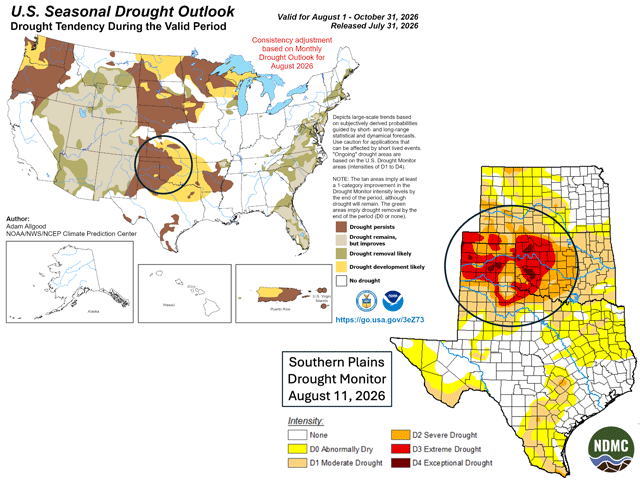
"Oklahoma has seen very little precipitation over the last 30 days, with most locations reporting less than 25 percent of the normal," stated the U.S. Drought Monitor commentary for Aug. 11, 2026. "Temperatures averaging 3 to 7 deg F above normal mid-summer values significantly exacerbated the drying conditions across much of Oklahoma and northern Texas, including the Panhandle." Indeed, the Aug. 11 Drought Monitor assessment for central and western Oklahoma and the Texas Panhandle is largely D3 (extreme drought) with some pockets of D4 (exceptional drought) indicated. (https://droughtmonitor.unl.edu/…)
P[L1] D[0x0] M[300x250] OOP[F] ADUNIT[] T[]
A review of precipitation in this section of the Southern Plains shows significant deficits since June 1. As of Aug. 12, precipitation totals included: (in Texas) Amarillo, 2.45 inches, 4.48 inches below the normal 6.93 inches; Borger, 2.74 inches, 3.52 inches below the normal 6.26 inches; Dalhart, 1.94 inches, 3.81 inches below the normal 5.75 inches; and Guymon, Oklahoma, it was 2.63 inches, 3.79 inches below the normal 6.42 inches. These totals are 50-70% below normal and illustrate the dryness now in place over this sector of the Southern Plains.
Weather headlines, of course, feature the strong El Nino event developing in the equatorial Pacific Ocean. One of the historical features of El Nino is its tendency to support increased precipitation in the southwestern Plains. But increased precipitation and associated drought easing are not indicated in the most recent U.S. Drought Outlook issued by the NOAA Climate Prediction Center (CPC). The southwestern Plains sector is projected to either see drought conditions remain, or to see drought conditions develop in the time frame through late October.
Drought prospects are concerning for their suggestion of limited soil moisture improvement for the start of winter wheat seeding in September. Drier conditions mean that the new stand of winter wheat may not be as robust as wheat growers and ranchers would like to see, especially following a low harvest. In addition to the grain crop prospect for 2027 harvest, the early pre-dormancy growth of winter wheat makes very good pasture for cattle. Reduced soil moisture would hinder this livestock production practice.
How these circumstances resolve will be a big step in understanding the potential for next year's winter wheat harvest in the U.S. to avoid further revisiting of historically low production benchmarks.
Bryce Anderson can be reached at bryce.anderson@dtn.com
(c) Copyright 2026 DTN, LLC. All rights reserved.
Comments
To comment, please Log In or Join our Community .