


Ag Weather Forum
One Last Push of Arctic Air, Possible Nor'easter This Weekend
Extremely cold air has been locked in across most of the United States east of the Rockies for almost a week now. It was the catalyst for a major winter storm across the southern and eastern U.S. this past weekend and the cold that has followed has caused the cleanup from that storm to be awfully slow. Ice and snow still cover the ground over northern Texas and the Lower Mississippi River Valley as this frozen precipitation has not been allowed to melt just yet.
A couple of clippers that have followed have reinforced that cold air this week and one last push of it could make for some more frozen impacts and the potential for a nor'easter this weekend.
The cold is reorganizing in southern Canada Wednesday morning, Jan. 28, where temperatures are well-below zero again. A seemingly weak clipper system is moving from the Pacific Northwest and will travel over the Rockies into the Canadian Prairies and Northern Plains tonight through Jan. 29.
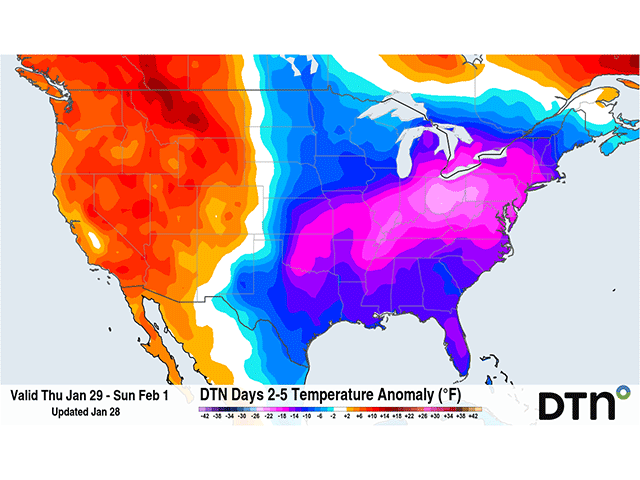
As the clipper continues southeast through the country, the cold air from Canada will be pulled south with it, spreading across the country east of the Rockies again. Temperatures will be falling back to where they were earlier this week, with many areas seeing temperatures 20-30 degrees Fahrenheit below normal again for a few days.
P[L1] D[0x0] M[300x250] OOP[F] ADUNIT[] T[]
For this weekend, temperatures are likely to be lower than they have been in the Southeast. Then entire Florida Peninsula, which was partially spared from the extreme cold this week, will probably see the coldest air of the year as temperatures fall below freezing all the way down to Miami and the Everglades on Feb. 1 and may continue again on the morning of Feb. 2. Significant impacts including increased heating demand, crop damage, livestock stress, and even falling iguanas are all on the table for Florida.
The clipper system may bring a streak of moderate snow -- about 3-6 inches -- to the northern High Plains for Jan. 29-30, but the system won't create much precipitation until it can interact with some slightly warmer air in the western Atlantic.
Pulling in some warmth and moisture over the top of the cold air, it is likely to cause a rapidly-deepening low-pressure system just off the Carolina coast on Jan. 31.
Models are unsure of the exact track of this storm, but it should move northeast on Feb. 1. If it is close enough to the coast, significant impacts will be felt from the Carolinas up through southern New England. But if the system remains just off the coast, many of those areas will be missed.
However, it appears that no matter the track, the Carolinas and southern Virginia are in line for a burst of heavy snow for late Friday and Saturday. Six-to-10 inches of snow is in the forecast on most models with some being heavier if the track is closer to the coast. That 6- to 10-inch swath could be extended northeast if that track indeed is closer to the coast, which would include east of the I-95 corridor from Richmond up to Boston. Winds from the storm near the coast may be in the 40-50 mph range and could cause some damage from falling trees and powerlines, especially if the snow does occur.
This burst of arctic air will be the last in the series and warmer weather building in the West this week will spread east of the Rockies first in the Northern Plains during the weekend, and then eastward next week. Deep snow will likely limit the warming from the Southern Plains through the Northeast and Mid-Atlantic, and even some areas in the Southeast will stay on the colder side of normal next week.
But this burst of warm air is also forecast to be short-lived. The weather pattern is setting up to bring back the arctic air first to the Eastern U.S. next weekend, in the roughly Feb. 6-9 time frame, and then eventually the Central U.S. the following week. We will be watching the potential for a big storm to do that as well, so winter isn't over just yet.
To stay up to date with weather conditions and your local forecast for free from DTN, head over to https://www.dtnpf.com/….
John Baranick can be reached at john.baranick@dtn.com
(c) Copyright 2026 DTN, LLC. All rights reserved.
Comments
To comment, please Log In or Join our Community .