

Ag Weather Forum
El Nino Expected to Influence US 2026 Growing Season
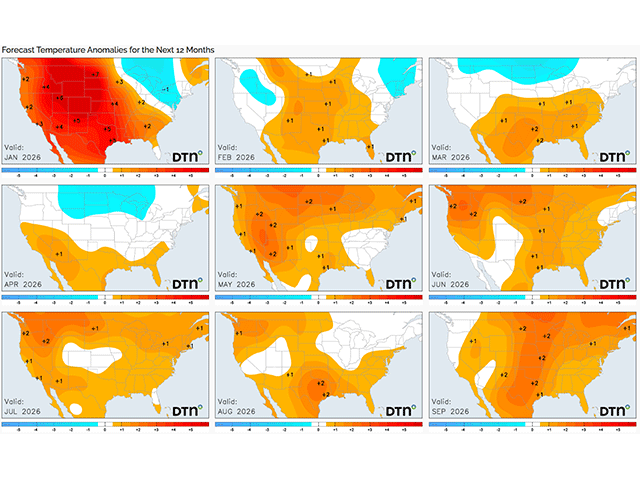
The death of yet another La Nina is on its way in early 2026 and forecasts have that changing to a possible El Nino this summer. The forecast uncertainty notwithstanding, 2026 is forecast to be one of those "normal" years, where weather patterns are shifting and not locked into place. But that doesn't mean it will be good for everyone. Lingering drought and a forecast for variable conditions could leave 2026 in a turbulent weather situation for many areas of the country. But that could also mean some significant benefits.
We saw that similar situation play out last year, though the climate situation was much different than the forecast for 2026. 2025 was a tricky forecast because of the uncertainties due to our primary climate driver -- the El Nino Southern Oscillation (ENSO) -- being in a neutral state for much of the growing season. That forced minor events in the climate system to have much more of an impact and resulted in fairly good weather conditions for most of the country. Even the return of La Nina conditions (the cold side of ENSO) in late summer and early fall didn't do enough to limit production, at least by the USDA metrics that were released in their World Agricultural Supply and Demand Estimates (WASDE) on Jan. 12. USDA estimated record-high yields for corn and soybeans, and near-record for wheat. That follows 2024, which was a favorable weather year for corn as well. Dryness late in summer that year robbed some of the corn and especially soybeans, but much of the year leading up to August was highly favorable. 2025 had similar issues and timing, but the good weather that preceded it allowed crops to finish well. Will the weather in 2026 turn out to provide yet another overall favorable year for crop development in the U.S.? Let's look at how that might unfold.
IT ALL STARTS WITH ENSO
Much of the global climate is driven by what is going on in the tropical Pacific Ocean. When waters at the surface are warmer than normal by at least 0.5 degrees Celsius, it is classified as El Nino. But when temperatures are more than 0.5 degrees C below normal, like they currently are here in January, it is La Nina. La Nina peaked in November and December and is currently rising toward neutral for the second half of winter. Warm waters below the surface have been spreading eastward for a couple of months now and will eventually erase the cold surface water during the next two months. ENSO-neutral conditions are forecast for spring.
However, the momentum toward rising temperatures may overshoot the neutral phase and become warm enough to be an El Nino sometime during the summer. That hasn't happened since 2023, a year that saw a Super El Nino -- at least 2 degrees C above normal -- develop by the end of that year. Models are mixed on the strength of this potential El Nino, but all of them show this rise up to or over the threshold at some point in the summer season.
The timing and strength will be important. If El Nino develops too early, we could see some stable patterns that produce significant winners and losers across the country. A gradual rise would likely mean more volatile weather as the event tries to lock into a specific mode, a more favorable pattern for widespread precipitation and frequent changes in temperature. DTN is favoring the more gradual rise and a lower peak than some models are suggesting, which would result in that more volatile pattern and fewer heatwaves, even if temperatures trend above normal. In fact, DTN's top analog year -- a year that is expected to be close to the situation for this year -- is 2023.
The weather pattern took some time to get going that year, but once it did, rain was frequent and rather widespread. If it wasn't so dry going through May and June, it would have been a very good year. And that is the factor that will be most watched this spring as well.
P[L1] D[0x0] M[300x250] OOP[F] ADUNIT[] T[]
LINGERING DROUGHT POSSIBLE IN THE SPRING
The La Nina that began late last summer and became official in the fall has led to some interesting weather heading into 2026.
The winter started off with a bang with some record-cold days at the end of November and the first half of December. That also produced widespread snow coverage across the Northern Plains and the Midwest. Temperatures at the end of December and through the first half of January have been almost the complete opposite and much of the snow has melted away, benefiting soil moisture, but leaving areas bare that are used to snow coverage.
Late-year dryness caused drought to become widespread through much of the country east of the Rockies while western areas enjoyed increased precipitation and drought reduction. Indeed, lingering drought this year may have an impact if it sticks around into planting season. As of Jan. 6, 32% of corn acres are in some form of drought. But that's 38% of soybeans acres and 42% of winter wheat acres as well. While dry soils are preferred by some for planting, these areas are going to need more moisture for early growth.
DTN's forecast at least brings some potential to reduce and possibly even eliminate areas of drought during the next couple of months. The weather patterns are shifting again at the end of January and eventually are forecast to have more of a traditional La Nina look with a colder north, warmer south, and active storm track from Texas up through the Northeast and Mid-Atlantic. Such a storm track would favor much of the drought areas and help moisten soils before planting. It also would have at least some potential for bringing rainfall into the winter wheat areas in the Central Plains, though that prospect is a little more uncertain.
But that may also be too much of a good thing. If the storm track is too consistent over the same areas, it may result in flooding and waterlogged soils that are slower to warm up and would result in delayed planting. The degree of which may be important for the 2026 growing season.
In contrast, cold air that lingers across the north may slow planting progress as well. Though the potential for cold air lingering into May is low, it is not out of the question to have some late frosts as the last vestiges of La Nina bring through some late cold air.
SUMMERTIME UNCERTAIN, BUT EXPECTED TO BE VARIABLE
As mentioned above, the timing and intensity of El Nino is going to matter significantly for the summer forecast. At this time of year, models have their lowest accuracy in forecasting ENSO conditions beyond about two months. Therefore, while all models are aiming for El Nino conditions to develop this summer, it's not a guarantee they will occur. However, when all the models are forecasting the event to take place, it is hard to ignore them just for that fact.
So DTN has chosen to go the slower route. In doing so, we are anticipating a much more active weather pattern as the atmosphere stays more chaotic for a longer period of time before locking in on an El Nino pattern that produces some areas of winners and leaves others behind. That means frequent storm systems, thunderstorm clusters and severe weather, variable temperatures with fewer long-lasting heatwaves, and widespread blankets of near-normal rainfall.
The specifics are going to matter though; just because an outlook looks favorable overall doesn't mean it will be favorable for all areas, or that significant issues will not build up over important areas for agriculture.
Such was the case in the Super El Nino year of 2023 when nationwide yields were respectable, but still below trendline. Yields were highly variable but seemed to benefit the I-states (Iowa, Illinois and Indiana) and Ohio more than the rest of the Corn Belt. Drought was a considerable factor that year, particularly in June before more frequent rains started to fall in July. So, while DTN is forecasting an overall good year, there are some risks if El Nino locks in too quickly, drought will develop in inopportune locations that could have significant implications for corn, soybeans, and both winter and spring wheat.
Though we hope the forecast turns out as described above, we know there will be some errors embedded in it. Even years that may look exactly like we have seen previously will turn out to be different because every year is different. Also, be aware that seasonal forecasts are not the same as a daily forecast. We cannot predict the exact day you will see rain, how many days you will have between rains, or the exact temperatures during the most critical time for your crops. Even a warm and dry month will have days where it is cooler with rain and vice versa. Another consideration is our confidence. While we are confident in El Nino developing this summer, we are not confident in its timing or strength, both of which could have big implications for this growing season.
DTN is offering a free webinar on Wednesday, Jan. 21 to discuss the late-winter and spring weather outlook. Signup is free! Visit https://www.dtn.com/… to register.
To find more weather conditions and your local forecast for free from DTN, head over to https://www.dtnpf.com/…
John Baranick can be reached at john.baranick@dtn.com
(c) Copyright 2026 DTN, LLC. All rights reserved.
Comments
To comment, please Log In or Join our Community .