


Ag Policy Blog
Democrat: Republicans Canceling REAP Grants Hurt GOP's Own Farmers
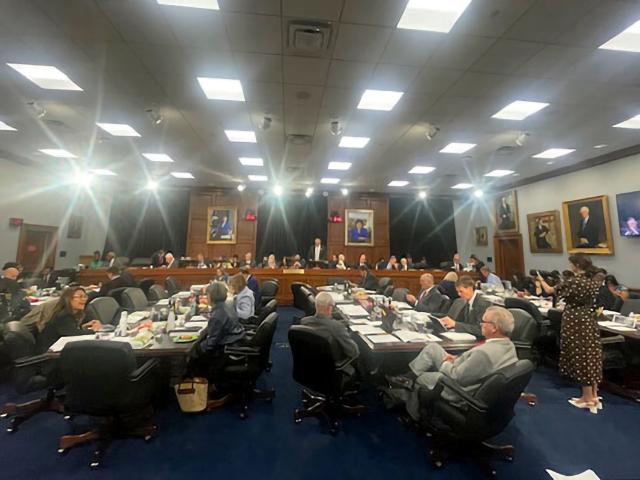
WASHINGTON (DTN) -- Republicans on the House Appropriations Committee effectively agreed to cutoff some funding opportunities for renewable energy that primarily benefit farmers in their districts, a top Democrat argued on Wednesday.
Rep. Rosa DeLauro, D-Conn., criticized GOP cuts to the Renewable Energy for America Program (REAP) in the fiscal 2027 budget for USDA that was approved by the committee.
USDA's overall discretionary budget took a small trim -- $380 million, or 1.4%, to $26.27 billion.
Still, some funding for programs such as REAP were overhauled to eliminate grants and scale back loans. REAP offers incentives to farmers and rural businesses to develop small energy projects such as rooftop solar on barns. REAP is a popular program that provides funding to farmers and rural businesses to improve energy efficiency and reduce their long-term energy costs.
USDA has frozen all grant applications for REAP to rewrite rules to comply with an order from President Trump on energy. USDA stated at the end of March there would not be any further REAP grants "until the new regulations are in effect." Once new rules are finalized, USDA stated the department would issue a new funding notice "and any applicants who previously submitted an application will have the opportunity to reapply."
The House version of the farm bill includes language that would allow USDA Rural Development funds for solar panels on five acres without any restrictions or allow solar on up to 50 acres if most of the power generated is used on the farm.
DeLauro, ranking member on the House Appropriations Committee, and Rep. Sanford Bishop, D-Ga., ranking member on the House Agriculture Appropriations Subcommittee, criticized the bill for cuts and listed Republican districts that would be affected.
The bill scales back loans under the Rural Energy for America program by 50%, while eliminating all grant funding. More than 25,000 projects have been funded through the program, helping people across all 50 states reduce their energy costs, and over two-thirds of grants have gone to Republican-led districts, DeLauro said.
"More than 25% of all REAP grant funding has gone to just 20 congressional districts. Eighteen of those districts are represented by Republicans, including all of the top five highest REAP grant recipients," she said.
P[L1] D[0x0] M[300x250] OOP[F] ADUNIT[] T[]
DeLauro called out fellow Ag Appropriations Subcommittee member, Rep. Ashley Hinson, R-Iowa, and a candidate for U.S. Senate.
DeLauro noted Hinson's district has received the most REAP funding of any congressional district, at more than $50 million. Minnesota's 7th District, represented by Rep. Michelle Fischbach, received the second-most funding at more than $47 million. Iowa's 4th District, represented by Rep. Randy Feenstra, has received the third-most funding with more than $40 million total.
"In 2025, out of 2,226 REAP awards, 1,752 for $372 million went to Republican districts, DeLauro said. "By contrast, only 465 went to Democratic districts for $169 million. Despite this, the Republican bill we are considering today decimates the program, raising energy costs for their own constituents all across the country."
House Agriculture Appropriations Subcommittee Chairman Andy Harris, R-Md., responded that REAP favored solar energy and that prime farmland is being converted to solar panels in his district in Maryland, but Democrats said REAP had not been used for that purpose.
CUTS TO WIC
Bishop noted the bill "provides $200 million less in new funds for the Women and Infant Children (WIC) program than the FY26 bill. That means 95,000 more women, infants, and children go hungry in Dr. Harris' home state of Maryland."
To House Appropriations Committee Chairman Tom Cole, R-Okla., Bishop said, "This means 56,000 women, infants, and children are going without fruit and vegetables in Oklahoma."
Bishop continued: "In Iowa, represented on this committee by Mrs. Hinson, that is another 48,000. Across the Chattahoochee River from me in Alabama, represented on this committee by Mr. (Dale) Strong, there are 85,000 women, infants, and children losing access to affordable healthy food.
"We have several members on this committee from Florida. Yet, if they support this bill today, that means 330,000 of the most vulnerable Floridians are going to go hungry.
"In my own state of Georgia -- and I am joined on this committee by my colleague, Mr. (Andrew) Clyde -- 185,000 women, infants, and children are left asking: How on earth does ending their access to healthy food help make America healthy again?
"And that is just a snapshot from a few states. Every state is going to see more women, infants, and children going without the fresh fruit and vegetables that Dr. Harris says he wants to promote. If WIC remains underfunded, as it is today in this bill, we will turn away eligible families for the first time in three decades."
Harris and Trump administration officials have said low-income people can use other nutrition programs to buy fruits and vegetables, although Health and Human Services Secretary Robert F. Kennedy Jr. has said he did not favor the administration's decision to cut WIC.
Also see, "USDA Halts REAP Grant Applications as Rising Energy Costs Squeeze Farmers,"
DTN Ag Policy Editor Chris Clayton contributed to this report.
Jerry Hagstrom can be reached at jhagstrom@nationaljournal.com
Follow him on social platform X @hagstromreport
(c) Copyright 2026 DTN, LLC. All rights reserved.
Comments
To comment, please Log In or Join our Community .