



Ag Weather Forum
Frost Potential, But Not Guaranteed; Three Ingredients Needed for Frost Formation
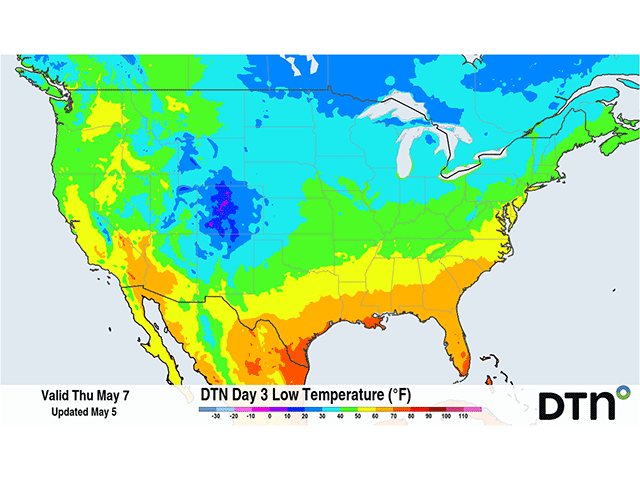
We have been in a colder pattern for the last couple of weeks. Frosts and freezes, when temperatures have fallen to lower than 36 degrees Fahrenheit and 32 degrees Fahrenheit, respectively, have been a regular occurrence in the Canadian Prairies and Northern Plains, which is not unusual for these areas at this time of the year. However, it has been cold enough at times to get frosts into the Central Plains and Midwest as well, a rarer feat for early May. Chances for frosts and some freezes continue this week with a cooler air mass in place and may be possible next week as well.
Three main factors are required to get frosts in early May, which are harder to accomplish as the days get longer. A cold, dry airmass, clear skies, and calm winds are usually required in combination to get temperatures to fall near and below freezing. But it all starts with the cold air sitting over an area.
FACTOR 1: COLD AIR MASS IN PLACE
It's hard to get frosty when temperatures are above normal, so the first and most obvious ingredient is cold air. This week, an upper-level trough of low pressure has settled over the eastern two-thirds of North America. The flow into this trough is from the northwest, or northwestern Canada, which is a supply of colder air for this time of year. Because the trough is sticky and refusing to move out of the region, the steady supply of colder air continues to move through southern Canada and into the U.S.
But just because the air is cold doesn't mean that it is ripe for frost formation. The moisture in the air is a key factor as well. It is counter-intuitive, but a drier air mass is more likely to produce frosts than one with more moisture, as drier air can cool more significantly than moist air. You may have heard of the dew point temperature, or the temperature at which the moisture in the air begins to condense. The air temperature will never fall below the dew point. As the air temperature cools, the moisture in the air condenses and releases heat into the air, keeping the temperature stable. If temperatures fall further, more moisture condenses and more heat is released. This results in dew or ice crystal formation at the surface but can also lead to fog. So, in general, cold, moist air, with dew points in the 40s F, are at a low risk of producing frosts. A lot of that water will have to be removed, and extra heat released, to achieve frosty temperatures.
FACTOR 2: CLEAR SKIES OVERHEAD
Temperatures cool overnight because heat is radiated away from the Earth's surface. The warm ground (and air near the ground) emit infrared radiation out into space, cooling the surface. As more of the Earth's surface cools, the air near the ground cools as well. This process continues until the sun rises the next morning, when the incoming solar radiation from the sun exceeds the amount of infrared radiation lost into space. The ground and surface air increase in temperature as a result.
But the sun isn't the only source of energy to the Earth's surface. All objects emit radiation, but some emit radiation better than others. Air is a poor emitter of radiation. It tends to hold its temperature over time. Concrete, asphalt, and metal, like in large cities, are excellent emitters of radiation, quickly absorbing and releasing that energy back efficiently. It is the main reason behind the "heat island" effect by which cities stay warmer overnight than the rural countryside.
P[L1] D[0x0] M[300x250] OOP[F] ADUNIT[] T[]
Another good emitter of heat is clouds, especially with regard to infrared radiation. Water readily absorbs and emits in the infrared spectrum. And water-laden clouds overhead can easily keep surface air temperatures from falling too quickly at night, the most important ingredient in the greenhouse effect that most of us learned about in school.
But even on a clear, cloudless night, one more factor can keep frost from forming -- winds.
FACTOR 3: CALM WINDS
As the Earth's surface cools, the air above the surface absorbs some of that radiation, keeping it warmer. It then emits that to air above it and then out to space. That means that the air closest to the surface gets cold faster than the air above it, and the air 100 feet above the surface is quite typically warmer than the air near the ground. If the air is still, this process becomes rather efficient and the air near the ground cools off quickly. However, when winds are elevated, the warmer air 100 feet high mixes with the cooler air near the surface. This mixing helps to even out the temperature, cooling off the air well above the surface, but warming the air near the surface. And in general, the faster the winds, the better the air mixes.
As a crude example, imagine that the air near the surface has cooled to 35 degrees F, but the air 100 feet in the air is still 41 degrees F. When winds are calm, this will continue to be the case. But if a gust of wind blows through, the resulting air will be mixed to an even 38 degrees F from surface to 100 feet, resulting in slightly higher temperatures near the surface, and slightly cooler temperatures at 100 feet.
When you think about it, this is rather intuitive. The most common mornings that you see dew or frost on the ground are when cold air has come in, the sun is shining brightly, and the winds are very still.
OTHER FACTORS THAT CAN AFFECT FROST FORMATION
Topography can also have a significant impact on frost formation. Cooler air is more dense than warmer air and thus tends to pool in lower elevations. Small divots and pockets in the landscape, and around lakes, streams, and rivers, tend to see the colder air pool up more than the tops of hills. This can lead to two scenarios.
One is that conditions are good for frost across the vast majority of a region, but the hilltops stay warm and frost-free. A second could be where frost formation is not favored, but small pockets of frost develop in small pits in the landscape where the colder air can drain in. Local features can play a significant role in frost formation.
So can soil moisture. Wetter soils, like clouds, radiate less heat into the atmosphere, instead radiating it back into the soil. While wetter soils are usually cooler during the day, they are almost always warmer at night. Drier soils, like those in a desert, radiate infrared radiation more efficiently, cooling the surface faster.
The presence of fog, either due to radiational cooling as mentioned above, or moving in from a different location due to light winds, can slow the cooling process further.
THE FROST FORECAST FOR THIS WEEK
This week, we have another surge of cold air pushing through the U.S. behind a strong cold front. Temperatures in the Northern Plains and Canadian Prairies were again below freezing on the morning of May 5. As that front pushes south through the rest of the country over the next couple of days, the cold air mass will settle in, giving the risk for widespread frosts across the Central Plains and Midwest. However, the other two factors, clear skies and calm winds, are less certain. With the upper-level trough spinning about, other disturbances are rotating around the U.S. and Canada as well. Those disturbances are bringing through occasional winds and patchy areas of clouds and rain. Both of those will be hindrances for frost formation this week.
The best chances for frost in the Midwest are on Thursday and Friday mornings, May 7-8. Though there will be clouds on both mornings, and perhaps some stronger winds on Friday, these days have the best chance for patchy frost and freeze conditions.
In areas of the central High Plains, the cold air is pushing up and into the Rocky Mountains. That additional push upward cools the air further, resulting in snow. Heavy snow accumulations are forecast from Cheyenne, Wyoming, down to Colorado Springs, Colorado. The snow will be less heavy across much of eastern Colorado, but accumulations may still occur in western Nebraska and Kansas for Tuesday night and Wednesday, May 5-6. Clouds may still be an issue for frost formation for Wednesday and Thursday, May 6-7, but the snow is another excellent emitter of infrared radiation. Surface air temperatures can be significantly colder where fresh snow cover occurs than surrounding areas that have none. The snow is not expected to stick around long, but the additional cooling in Colorado may keep temperatures down a few extra degrees in the surrounding areas as well.
Next week, the upper-level trough remains in Central and Eastern North America, but it is forecast to weaken as it gets pushed eastward. There may still be some frosty temperatures in the Midwest and Northeast at times next week between systems, but clouds and winds will be hindrances, too. Current forecasts have overnight low temperatures in the 40s and 50s, but they had this week's temperatures in that range as well. Changes to the forecast should be monitored for those with sensitive plants in the area.
To stay up to date with weather conditions and your local forecast for free from DTN, head over to https://www.dtnpf.com/…
John Baranick can be reached at john.baranick@dtn.com
(c) Copyright 2026 DTN, LLC. All rights reserved.
Comments
To comment, please Log In or Join our Community .