

Ag Weather Forum
Rain Chances Increasing for Drought-Stricken High Plains
Drought has become a major factor at the start of the 2026 growing season. As DTN Ag Meteorologist Emeritus Bryce Anderson noted here earlier this week, https://www.dtnpf.com/…, the dryness and drought have expanded to almost 70% of the Central United States.
That is before the update that will be released early on Thursday, April 9, which is likely to show a decrease after last week's rounds of heavy rain across the middle of the country.
But what is important is that drought covers most of the winter wheat acres, at more than 85% covered by some form of dryness or drought. Drought is always a lagging indicator, but has been increasing throughout the year, despite active weather that has caused drought to decrease across the Midwest this spring.
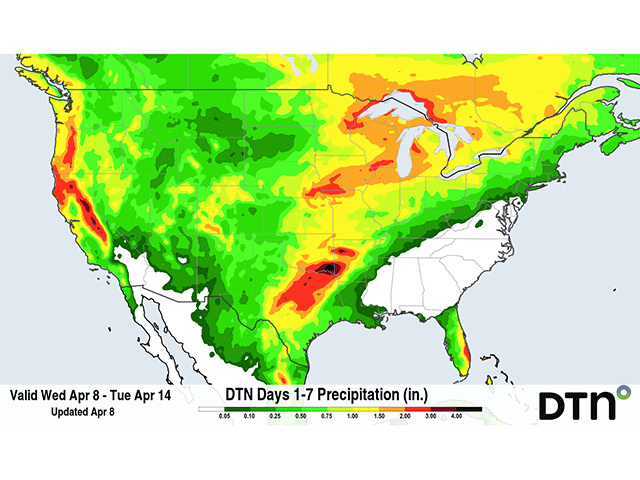
During the next seven days, precipitation chances will increase in the Plains and will include some of the areas that have been bypassed by the previously active pattern farther north and east.
Precipitation is needed in a bad way across the High Plains. From southern South Dakota through most of Nebraska, western Kansas, eastern Colorado, and the Oklahoma and Texas Panhandles, rainfall has been lacking this year. Drought has expanded quickly and with temperatures being very high this spring, with multiple days in the 90s Fahrenheit already, winter wheat conditions have fallen significantly. As reported here: https://www.dtnpf.com/…, winter wheat conditions are some of the worst at this point in the season in recent years. The poor-to-very-poor ratings sit at 31% for all winter wheat, 10 points worse than at the same time last year. But in the major hard red winter wheat areas of the Plains, the conditions are much worse.
P[L1] D[0x0] M[300x250] OOP[F] ADUNIT[] T[]
Nebraska is at 43% poor to very poor and Colorado is at 49%. Kansas is the best, but at 24%, while Oklahoma checks in at 54% and Texas at 51%. With heading already starting in the far south, we are entering a critical time to get moisture. Some discussions on social media suggest that some areas are already too late and rain will not help to save the crop. But the sooner we get rainfall, the sooner we can confirm that.
The next seven days offer multiple chances for getting precipitation into the region. A cold front will push through the region today, April 8. It will stall out across Nebraska and Kansas, producing scattered showers and thunderstorms through April 10. To go along with that, additional instability to the south will allow a few isolated thunderstorms to develop across West Texas and Oklahoma as well. Coverage will be quite spotty to the south, but these areas will take anything they can get.
The better chances start coming this weekend, though. The front will lift northward through Nebraska and South Dakota into the Midwest, with a return of moisture coming from the Gulf.
That will feed a disturbance moving through the Southwest U.S. which will create a storm system in the Plains. More widespread showers and thunderstorms are forecast for April 11-12 as the first impulse passes through. Models like the High Plains areas of West Texas and Oklahoma see best chances on Saturday, and central Texas to southern Kansas on Sunday. That may include some rounds of severe weather but also carries potential for some heavy rain. Coverage of those storms should be fairly widespread and will likely occur in other parts of the region as well.
Though this system will move through the Midwest early next week, it won't be the only system to come from the southwestern disturbance. Additional rounds of showers are going to be possible April 13-15 in the Plains. These chances may not be as great as the weekend, but will likely produce at least some batches of showers and thunderstorms for winter wheat areas in the Plains.
The coverage and amounts of the rainfall are the most important factors to watch for winter wheat producers in the Plains. Unfortunately, while this is a more favorable pattern for producing showers in the High Plains, it comes at the cost of being only scattered showers. There will undoubtedly be places that see very little or even no rainfall out of this pattern during the next week. Meanwhile, other areas will be blessed by multiple rounds of showers and thunderstorms that may dole out a couple inches of liquid. Models are usually poor at describing this, but favor areas of central Texas to eastern Kansas and Nebraska, on the eastern edges of the winter wheat belt, with the heaviest amounts.
However, that does not mean that all areas on the western end will be unlucky. Models still have up to a half inch of rain across western Nebraska, eastern Colorado, western Kansas, and the Oklahoma and Texas Panhandles. Experience suggests that thunderstorms will overperform the forecast in some areas and underperform it in others.
And these will not be the only chances that High Plains wheat areas have for rain, though they are the most pertinent. The weather pattern will feature a somewhat frequent disturbance in the Southwest for the second half of April. That will aid moisture returns from the Gulf, and thunderstorm production in the Plains. The degree to which this affects those in the High Plains is uncertain, but the chances will remain around for a while.
To stay up to date with weather conditions and your local forecast for free from DTN, head over to https://www.dtnpf.com/…
John Baranick can be reached at john.baranick@dtn.com
(c) Copyright 2026 DTN, LLC. All rights reserved.
Comments
To comment, please Log In or Join our Community .