



Ag Weather Forum
La Nina and Climate Change Pair Up to Swamp Hawaii
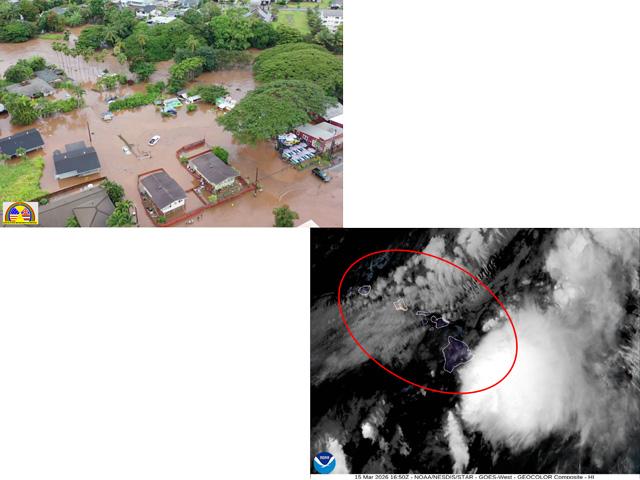
The worst flooding in more than 20 years has ravaged Hawaii -- widely thought of as America's island paradise. Consistent rounds of heavy rain occurred between March 11-15. And the rainfall that these storms produced was very large. Seven-day rainfall totals of 20 inches to almost 50 inches were recorded on the primary islands. In addition, high winds were measured with a maximum of almost 120 miles per hour. The heavy rain and strong winds swept homes off their foundations, floated cars out of driveways and left floors, walls and counters covered in thick, reddish volcanic mud. Hawaii Gov. Josh Green said the cost of the storm could top $1 billion, including damage to airports, schools, roads, homes and a hospital.
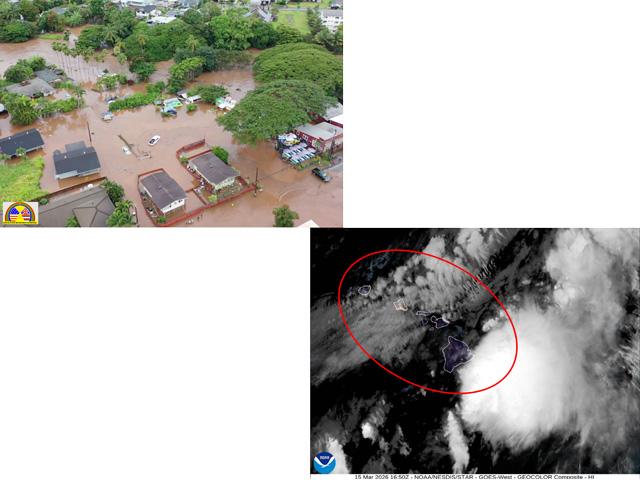
The initial cause of storms that brought the heavy rain and flooding is a feature known as a Kona Low. Kona is the Hawaiian word for leeward, and these cyclones often form on the west or northwest of the Hawaiian Islands -- considered the leeward side of the islands. The leeward side typically is sheltered from the trade winds and heavy rains. Kona Lows are winter-season features in the Pacific Ocean, but do not always strike Hawaii.
P[L1] D[0x0] M[300x250] OOP[F] ADUNIT[] T[]
The atmospheric setup with La Nina also is more favorable to Kona Low formation. "During a typical La Nina, the contraction of the Pacific jet stream creates an environment more favorable for Kona Lows, other upper-level low pressure systems, and cold fronts from the mid-latitudes to reach the Hawaiian Islands. That leads to an elevated likelihood of a wet winter during La Nina," wrote Nat Johnson in a NOAA Climate.gov article dated May 2022.
But the Kona Low circulation is only part of the scene of immense rain and flooding in Hawaii. The tendency of storms to produce extreme amounts of precipitation as warming continues across the globe is another component of this heavy rain. The Honolulu Times noted, "The intense flooding in Hawaii highlights the growing threat of extreme weather events driven by climate change. The frequency and intensity of heavy rainfall have increased in the islands, leading to devastating impacts on infrastructure, homes, and communities." Warming is indeed occurring in Hawaii. The NOAA National Centers for Environmental Information (NCEI) noted Honolulu temperatures have increased by 2.6 degrees Fahrenheit since 1950 and have consistently been above the 1951-1980 average since 1975.
The first quarter of 2026 has definitely had its share of weather extremes -- bitter cold, very heavy snow, outrageous heat, drought and fires. We can now add the Hawaii floods to that list -- even in America's Paradise.
Bryce Anderson can be reached at bryce.anderson@dtn.com
(c) Copyright 2026 DTN, LLC. All rights reserved.
Comments
To comment, please Log In or Join our Community .