

Ag Weather Forum
Winter Featured Warmth and Drought Expansion in Many US Crop Areas
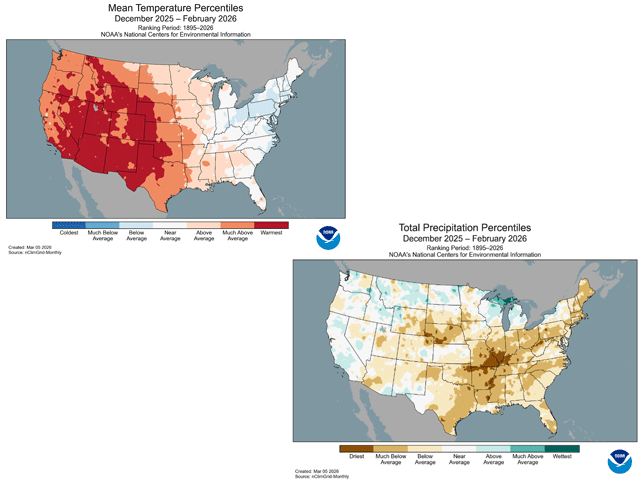
Details of temperature and precipitation for the United States in the month of February and for the 2025-26 meteorological winter season (December-January-February) have been compiled; and they show, overall, the winter just passed was mainly very warm and very dry.
The NOAA National Centers for Environmental Information (NCEI) found the average meteorological winter-season temperature was 37.1 degrees Fahrenheit, 4.9 degrees above the 20th-century average, ranking as the second-warmest winter in the 131-year record in the contiguous U.S. The December-January-February meteorological winter was also notably deficient on precipitation; it was the driest in 45 years, going back to the 1980-81 winter season.
States in the western and southwestern U.S. spiked the most in their winter temperatures. The NOAA/NCEI U.S. climate assessment noted Arizona, New Mexico and Utah each broke their previous record for warmest winter seasons by more than 2 degrees Fahrenheit. Looking at the NOAA climate regions, the West and Southwest each experienced their warmest winter on record, and the Northwest, Northern Rockies and Plains as well as the South each ranked second warmest. (The period of record dates to 1895, a span of 131 years.) The Northeast climate region provided a contrast, with its temperatures ranking in the lowest third of its historical record.
P[L1] D[0x0] M[300x250] OOP[F] ADUNIT[] T[]
A key feature of this warm winter season was the daytime high temperature. The contiguous U.S. winter season daytime high temperature averaged 48.3 degrees F -- 5.6 degrees above average. This marks the warmest winter for daytime highs on record. It is also the first time the seasonal average exceeded 48 degrees F. A prime example of this exceptional warmth was a 16-day stretch of maximum temperatures that reached at least 80 degrees F at Dallas/Fort Worth, Texas International Airport. It was the highest seasonal total on record.
On the precipitation side, the contiguous U.S. averaged 4.95 inches of precipitation during winter, 1.84 inches (27%) below the 20th-century average, which is fifth-driest winter in the 131-year record. Large portions of the central and eastern U.S. experienced much-below-average precipitation -- 18 states recorded one of their 10 driest winters on record -- while much of the western U.S. had near-average totals. The Upper Peninsula of Michigan was a notable exception, with much-above-average to record winter precipitation.
Winter dryness in the central U.S. has some notable examples. According to the March 5, 2026, U.S. Drought Monitor: "90-day precipitation averaging less than half of normal across western Kentucky, southeastern Missouri, and much of Indiana and Illinois. Paducah, Kentucky, and Carbondale, Illinois, had their driest meteorological winter (Dec. 1, 2025, to Feb. 28, 2026) on record."
Major crop areas also had winter dryness impacts. A review of USDA's March 3 Ag in Drought report found these changes during the winter season: Corn-area drought grew from 30% to 51%; Soybean-area drought grew from 30% to 53%; Winter wheat drought grew from 35% to 56%.
The combination of warmth and dryness in primary U.S. crop areas sharpens the emphasis on the importance of spring moisture. Soil profiles in many areas certainly need some recharge before the growing season sets in.
Bryce Anderson can be reached at bryce.anderson@dtn.com
(c) Copyright 2026 DTN, LLC. All rights reserved.
Comments
To comment, please Log In or Join our Community .