



Ag Policy Blog
Trump Administration Plans a Roadshow for New Dietary Guidelines
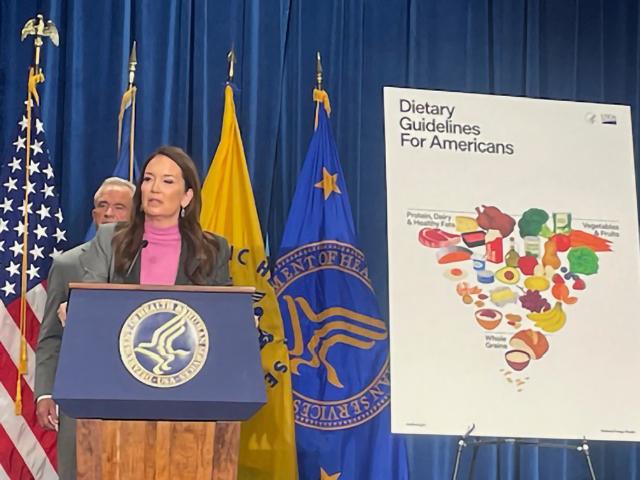
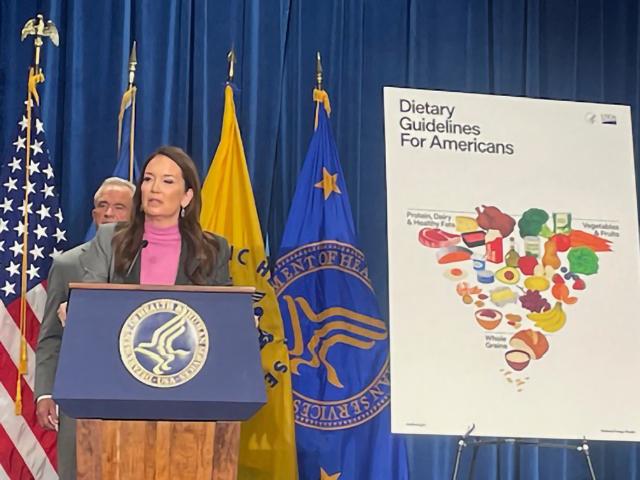
WASHINGTON (DTN) -- Trump administration officials on Thursday celebrated the release of the 2025-2026 Dietary Guidelines for Americans a day earlier with an event at the Health and Human Services Department at which a roadshow to promote the guidelines was announced.
A series of administration officials delivered variations on the remarks they made at the White House on Tuesday, but at the end of the event Kyle Diamantis, the Food and Drug Administration deputy commissioner for human foods, announced that the Dietary Guidelines for America Roadshow will begin next week with an appearance by Agriculture Secretary Brooke Rollins in Pennsylvania.
The Trump administration officials will be promoting a diet heavy on protein including red meat and dairy products and fruits and vegetables and urging people to eat "whole" foods without added sugars and stay away from ultraprocessed foods.
Food and Drug Administration Commissioner Marty Makary said that junk food had become the core of the American diet and that the Trump administration is "reclaiming" the food pyramid, the graphic used for many years to advise Americans on what to eat until it was replaced in the Obama administration with the "My Plate" graphic, which divided the plate into four areas for different types of food.
The old pyramid discouraged the consumption of fat while the new upside-down pyramid encourages the consumption of protein, including meats and dairy products with saturated fat.
"Eat real food," Health and Human Services Secretary Robert F. Kennedy Jr. said.
"If it comes wrapped in a package, the whole thing is a package. Don't eat it," he added.
Kennedy, who cooked a turkey in beef tallow for Thanksgiving, singled out the American Heart Association for criticism, saying it had campaigned against the consumption of saturated fat while taking money from companies that make ultraprocessed food.
The AHA said in an email to DTN, "We are aware of the secretary's comments, and we stand by our public statement welcoming the new Dietary Guidelines and commending the inclusion of several important science-based recommendations -- notably the emphasis on increasing intake of vegetables, fruits and whole grains while limiting consumption of added sugars, refined grains, highly processed foods, saturated fats and sugary drinks -- that align closely with the longstanding dietary guidance of the American Heart Association and other public health authorities."
"We were especially pleased to see the administration take on the issue of added sugars, which was excluded from the 2020 guidelines -- a decision we deeply criticized then.," AHA said.
"The ability of any private corporation to extend inappropriate influence over the work of the American Heart Association is neither practical nor possible. The lion's share of the Heart Association's revenue -- nearly 85% -- comes from non-corporate sources, including individual donors, foundations and estates, as well as investment earnings and revenue from the sale of our educational materials.
P[L1] D[0x0] M[300x250] OOP[F] ADUNIT[] T[]
"The remainder comes from a broad cross-section of businesses nationwide -- from community banks to national consumer brands -- led by people dedicated to the fight against heart disease.
"The Heart Association has scientific peer-review processes and corporate policy protections to ensure undue influence from any individual or organization cannot occur. For more than 100 years, the Heart Association has remained true to scientific discovery and evidence, and we are honored to serve patients, families and communities nationwide in support of longer, healthier lives for everyone, everywhere," the AHA said.
Kennedy noted that the dietary guidelines had been well received in the past 24 hours. He pointed out that the American Medical Association, which criticized his changes to the childhood vaccine schedule, praised the dietary guidelines.
The AMA did issue a statement applauding the administration for spotlighting "the highly processed foods, sugar-sweetened beverages, and excess sodium that fuel heart disease, diabetes, obesity, and other chronic illnesses," but it did not comment on the guidelines' provisions urging consumption of more protein including saturated fats.
Rollins, who worked with Kennedy on the guidelines, called on the crowd to give Kennedy a standing ovation.
"I don't think it can be overstated what a difference maker he is," Rollins said. "We are in an administration of difference makers."
Rollins introduced beef, dairy and hog farmers from the stage and said she is happy "to put the farmers and ranchers of this country back in the middle of what we will do to save America's health."
Grain farmers, who produce the ingredients for ultraprocessed foods, were not mentioned during the event.
Speaking of making sure that all Americans should have access to healthy foods, Rollins emphasized that the Trump administration will "double" the "stocking" requirements for healthy foods in the nation's 250,000 retail establishments that are eligible to accept Supplemental Nutrition Assistance Program (SNAP) benefit payments.
It's possible to buy the foods recommended by the guidelines for $3 per meal, Rollins said, adding that businesses that participate in SNAP must provide those foods "if they take a tax dollar from those who [have] the least among us."
In ending the program, FDA's Diamantis said, "Today is not the end of the mission. Today is just the beginning of a new approach to nutrition."
"This begins a year-long push," he said, that will begin with Rollins traveling to Pennsylvania. A Rollins spokesperson said she would attend the Pennsylvania Farm Show next week.
Critics say that, while the Trump administration can change federal purchasing policies, Americans generally have not followed previous versions of the dietary guidelines, and convincing them to follow them will be difficult.
Darius Mozaffarian, director of the Food is Medicine Institute at Tufts University, who attended the event, said in an interview he was generally pleased with the guidelines.
Mozaffarian said he was particularly pleased by the unprecedented criticism of ultraprocessed foods, but thinks the promotion of protein goes too far.
In the past, federal agencies outside USDA and HHS have not followed the guidelines or have taken a long time to implement them, he said.
If Rollins and Kennedy want to accomplish these changes in 2026, "that will be lightning speed," Mozaffarian said.
Mollie Van Lieu, the vice president of nutrition and health at the International Fresh Produce Association, said in an interview that the real issue is whether the new dietary guidelines change Americans' eating habits. Americans eat fewer fruits and vegetables than nutritionists recommend.
"Saying what should happen and people doing it are two different things," Van Lieu said. "The challenge has always been that people don't follow the pyramid. How will this be received by the consumer?"
But Van Lieu pointed that the strength of the Make America Healthy Again movement, which Kennedy leads, is "their communication to their base."
Jerry Hagstrom can be reached at jhagstrom@nationaljournal.com
Follow him on social platform X @hagstromreport
(c) Copyright 2026 DTN, LLC. All rights reserved.
Comments
To comment, please Log In or Join our Community .