

South America Calling
Soil Moisture Not Where It Needs to Be for Brazil's Coming Safrinha Corn Crop
Much of the weather focus in South America recently has been on Argentina and its overall lack of rainfall during the last several weeks. That is still an important factor to consider when looking at South American corn and soybean production for the 2025-26 crop year. But things are changing in Brazil and some of the focus needs to be shifted there as the first crop soybeans are harvested and the second-season (safrinha) corn crop gets planted.
Precipitation patterns in Brazil so far this season have not been all that great. Waves of showers started in late September, but then went absent for early October and were only sporadic throughout November and December. The daily scattered showers and thunderstorms that are being seen across most of the country have been erratic and inconsistent. Periods of dryness have occurred, and that has induced some heat stress at times.
However, the rain has been more consistent during January, and while many areas are still lacking in overall rainfall amounts when compared to normal, the soybean crop has largely done well. Very few areas have reported damage due to dryness.
P[L1] D[0x0] M[300x250] OOP[F] ADUNIT[] T[]
That is not to say that there are none -- some areas around the southern end of the country, particularly in Rio Grande do Sul, have not seen the consistent showers in January. But the conditions reported by most agencies suggest a fairly good soybean crop in Brazil. Most are calling for record production. But just because soybeans had enough rainfall does not mean that the safrinha corn crop will reap the same benefits.
As the calendar turns to February, soybean harvest will speed up. There are estimates that about 5-10% of the total soybean crop has been harvested already, including more than 15% in the country's largest production state of Mato Grosso. Corn is immediately planted after the soybeans are harvested, with some large producers opting to follow their giant combines with a large planter to make good use of some dry time between rains.
During the next three weeks, the country should reach about 60% completed on corn planting, and Mato Grosso should lead the way at about 80%. If these benchmarks are not met, a significant portion of the corn crop risks running into the dry season at the end of April before pollination, a potentially disastrous result. That would be made worse if the soil moisture situation doesn't improve either.
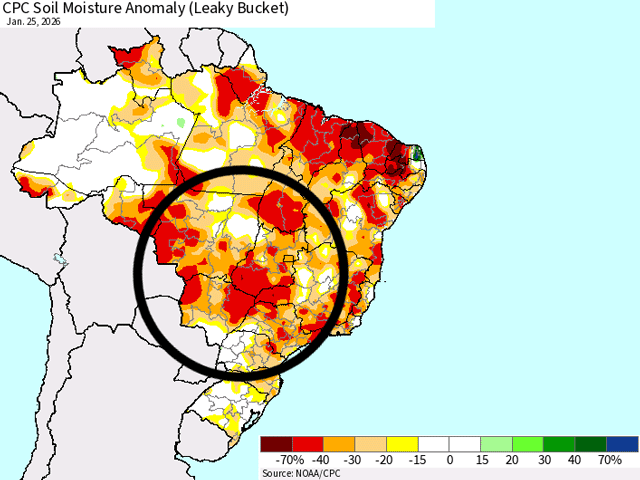
When looking at various satellite estimates, the heavier rains lately have not improved soil moisture dramatically. Many areas are still below normal with soil moisture, with only a few dotted areas with near- or above-normal amounts scattered from Mato Grosso to Minas Gerais.
Large sections of the country's primary safrinha corn areas are labelled as having 50% or less of the normal soil moisture, including Mato Grosso do Sul and Parana. If the wet season rainfall ends early, or even if it shuts down on time, the lower soil moisture situation could be a problem for either pollinating or, more likely, filling corn kernels. This situation will need to be monitored closely, even if planting is on schedule and rains are frequent.
Most of the country needs to see above-normal rainfall during the next two months to see improvements in the outlook, and long-range forecasts are not calling for that to be on the table. DTN is forecasting overall below-normal rainfall through March, even if a couple of weeks here or there produce above-normal rainfall.
To find more international weather conditions and your local forecast from DTN, visit https://www.dtnpf.com/….
John Baranick can be reached at john.baranick@dtn.com
(c) Copyright 2026 DTN, LLC. All rights reserved.
Comments
To comment, please Log In or Join our Community .