

South America Calling
Argentina Dryness Continues to Expand
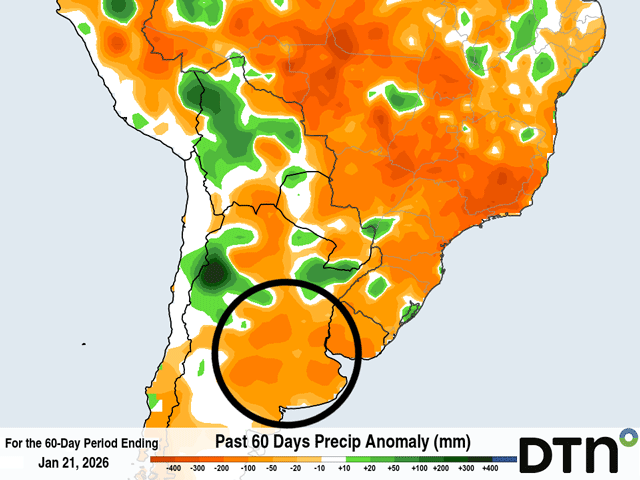
Recent dryness in Argentina has been a major story in an otherwise unusual growing season in South America. Whether it was early dryness in central Brazil, unexpected heavy and consistent rain in southern Brazil and northern Argentina, or a lack of sustained heat, this season has not gone the way most forecasts were suggesting back in September at the start of the growing season. But the long-expected run of dry weather has finally caught up to Argentina and that is having an impact on crop conditions in the country.
Northern areas of Argentina have done better than southern areas during the last two months, but rainfall during the last couple of weeks was less than 20% of normal for just about all of Argentina's primary growing areas in the central and south -- the primary growing areas for corn and soybeans. Rainfall has been less than 30% of normal for these southern areas since the beginning of December -- a long dry stretch.
Two weeks ago, the Buenos Aires Grain Exchange (BAGE) noted a decrease in both soil moisture and crop conditions for corn and soybeans on its weekly report. With dry conditions in the forecast going forward, that trend looked like it would increase and maybe even accelerate. That indeed happened as reports from both last week and this one have noted an increasing drier trend. As of Jan. 22, BAGE noted that good-to-excellent ratings fell to just 53% on soybeans and 52% on corn. That is a drop of eight points for both.
Meanwhile, poor-to-very poor conditions rose into double-digits with 13% of soybeans and 11% of corn in the category. Soil moisture has been falling even more rapidly, especially for areas that grow corn with almost half of the crop in some form of drought.
Conditions are not as bad as last year, where only 32% of the soybean and 40% of the corn crops were in good-to-excellent condition, but the momentum is to continue downward without a major change in the weather pattern.
P[L1] D[0x0] M[300x250] OOP[F] ADUNIT[] T[]
Some showers are forecast for the far southern end of the growing region this weekend. And models have been insistent on at least some spotty rainfall farther north throughout the country next week. The country will take all the rain it can get. But amounts are likely to be under 10 millimeters (0.4 inches) for most areas and those that see more than that would be lucky and very limited.
The pattern suggests something like spotty pop-up thunderstorm development that occurs in the U.S. Southeast during the summer. These little storms could pack a punch, but usually for only small areas. Therefore, without very good coverage for at least another week, crop conditions are likely to fall yet again in BAGE's report next week on Jan. 29.
Producers in Argentina are used to January being a drier month and plan for it. It is variable, but dryness is common throughout the month. For corn, producers plant in two phases, the first is planted in September and early October, to get the crop through pollination in December. The second phase is planted in December into January, to ensure that if dryness occurs in January, the rains return in February before that portion of the crop is planted.
Likewise, soybeans are typically planted in November and December to ensure that a dry January does not come during the critical pod-fill stage.
But even if the dryness isn't arriving during the most critical periods of growth for either crop, the poor weather can still have a negative impact on crop yields.
The only real missing factor has been heat. If long stretches of dryness occur, it is usually accompanied by well-above-normal temperatures that can further stress crops. Outside of a few short stretches of heat, temperatures have been mild and were a major factor in the crop conditions holding higher through the end of December, when the showers started to shut down. But now that both soil moisture and crop conditions are falling, the only thing that will save the crop is the return of rain.
After the spotty showers move through next week, long-range models return the country to relative dryness for February, especially the first half. And while substantial heat is not in the forecast, above-normal temperatures are in the forecast for the next three weeks.
If this indeed pans out as forecast, crop conditions will continue to fall and production numbers will have to be adjusted lower. Though not critical currently, the forecast is not a favorable one for the country.
To find more international weather conditions and your local forecast from DTN, visit https://www.dtnpf.com/….
John Baranick can be reached at john.baranick@dtn.com
(c) Copyright 2026 DTN, LLC. All rights reserved.
Comments
To comment, please Log In or Join our Community .