

South America Calling
Downward Trends Starting for Argentina's Corn and Soybeans
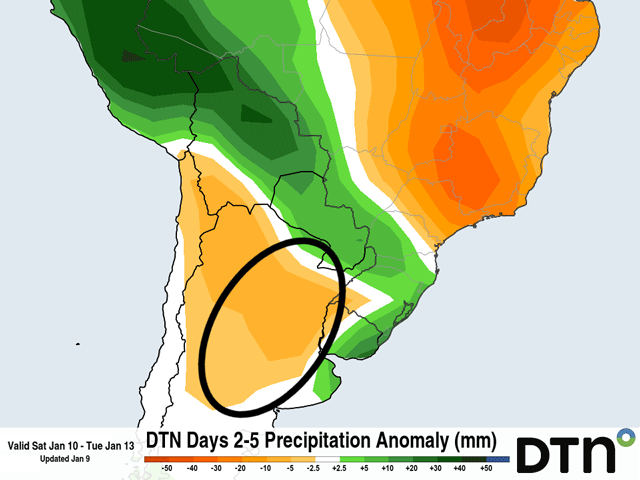
This year has not gone the way DTN has predicted for South America, at least not yet. Conditions during La Nina have been more volatile than expected, resulting in overall good crop conditions for both Argentina and Brazil for much of the season so far. Typically during La Nina events, Argentina trends hotter and drier. That hasn't happened nearly to the degree as forecast a few months ago. But there are some indications that the weather is trending in a downward path and could continue for the rest of January.
A report from the Buenos Aires Grain Exchange on Jan. 8 noted that crop conditions and soil moisture are both higher than at the same point last year. However, the same report showed a decrease in both compared to last week. Drier conditions have been more consistent over southern and central Argentina, the country's primary corn and soybean areas, leading to the decline. Concerns were very minimal in the report, but it does showcase the direction the country may be headed.
The weather pattern has been more favorable to areas in northern Argentina and southern Brazil, and to a lesser extent across some lucky areas around the state of Buenos Aires where heavier rain showers fell in the drier pattern at the end of December. But some areas of the states Cordoba and La Pampa have not had nearly the rainfall some other areas have and are largely responsible for the declines in this week's report. When combined with the last week of dryness in Buenos Aires, many of these areas are either seeing a decline or are about to if the weather doesn't cooperate and bring in some more rain.
P[L1] D[0x0] M[300x250] OOP[F] ADUNIT[] T[]
Both the short-range and long-range outlooks are not favorable, however. Fronts that have been moving through these areas of the country have only brought spotty showers before exploding with more potent and widespread rain farther north into Paraguay and southern Brazil. That trend looks to continue next week as there may be some showers early Jan. 13, and again on Wednesday night into Thursday, Jan. 14-15, but not nearly the amounts needed to reverse the recent trend toward dryness. Long-range outlooks from both the American GFS and European ECMWF models continue a below-normal rainfall look, though with varying degrees of showers. Still, this is not a favorable outlook for developing corn and soybeans in the country.
So far, the heat has not been much of a story. Near or below-normal temperatures have been much more frequent than above-normal, keeping stresses on the lower side for now. If higher temperatures lock in for a longer period, additional stress and crop condition declines should be expected. Models do hint at a longer hot stretch later this month.
Argentina is used to January being a drier month. It's not always dry, but has a tendency for precipitation to become more scarce for several weeks in the middle of summer. Typically, the push of the storm track northward can lead to hotter and drier conditions. Producers plan for this fact, splitting corn planting into two phases to avoid this dry weather coming during pollination, and to ensure that few soybeans are setting pods when conditions could be stressful to fill.
But the dryness can still have negative impacts on both corn and soybean production in Argentina, especially if it lasts outside of January. December started the drier trend. We will have to see if this extends into February as well. For now, the threats are somewhat minor to production, but certainly something to track closely.
To find more international weather conditions and your local forecast from DTN, visit https://www.dtnpf.com/….
John Baranick can be reached at john.baranick@dtn.com
(c) Copyright 2026 DTN, LLC. All rights reserved.
Comments
To comment, please Log In or Join our Community .