

Fundamentally Speaking
Mid-September Soybean Ratings Not Far Off From Year Ago Ratings
The soybean market has moved close to three-year highs with the November contract popping up over $1.50 per bushel just over the past six weeks.
There has been a lot of fund buying linked to expectations of large Chinese purchases this season and excellent demand for the co-products, both soybean meal and soybean oil.
Add to that uncertainty as to how this year's hot and generally dry central U.S. weather impacted this year's U.S. yield, and trepidation about how what has been termed one of the strongest El Nino events will influence the 2027 South American soybean crop.
This past week we did take note that the September WASDE report this year showed ending bean stocks at 310 million bushels (mb) with a stocks-to-use ratio of 6.8% are higher than the year ago September 2025 figures of 290 mb and 6.7% stocks-to-use ratio, yet the average farm price this season is forecast $1.50 per bushel higher than seen a year ago.
Certainly, there is a lot of optimism about this week's Trump-Xi meetings, though the market appears to have dialed in the Sino commitment to purchase 25 million tonnes of U.S. soybeans.
P[L1] D[0x0] M[300x250] OOP[F] ADUNIT[] T[]
Also, this year's estimated yield at 52.8 bushels per acre (bpa) is just a hair under the year ago record of 53.0 bpa.
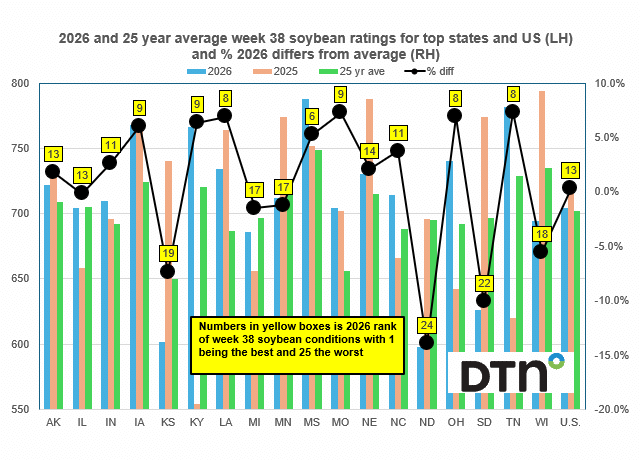
Along these lines, this chart shows the 2026, 2025 and 25-year average for the week 38 soybean condition report for the top soybean states and the U.S. on the left-hand axis while reported on the right hand axis is the percent that this year's week 38 rating differs from the 25 year average.
For this we use our usual ratings system where we weigh the percent of the crop excellent 10 points, that in good condition 8 points, fair 6 points, poor 4 and very poor 2 and sum the results.
Also, the number in the yellow boxes is the 2026 rank of week 38 top state and U.S. soybean conditions with 1 being the best and 25 the worst.
The states with the best week 38 or mid-September ratings are more southerly such as KY at 766 which has the largest advance year to year of any state vs the year ago 554, MS at 788 (the highest rated state), and TN at 782 is also well above the week 38 2025 figure.
On the other hand, the Plains states of KS at 602, ND at 598, and SD at 626 are the worst and far lower than last year's much better results, which helped boost the national yield to a record.
We should note that two northern states, MN and especially WI, have soybean conditions well off year ago levels.
We will examine the relation between week 38 ratings and what this means for yields in a later blog but conditions now are not that far off from last year.
Half of the 18 states have ratings above year ago numbers and 11 actually have above average condition figures.
The U.S. as a whole is quite neutral with ratings down 12 from last year, but the current 704 rating is just above 25-year average of 702 as it ranks number 13, right in middle of the study period.
(c) Copyright 2026 DTN, LLC. All rights reserved.
Comments
To comment, please Log In or Join our Community .