



An Urban's Rural View
US Soybean Farmers Need To Be Less Dependent on China
In 2017, President Donald J. Trump's National Security Strategy declared China a competitor, an adversary and a "revisionist power" determined to supplant the United States in Asia. (https://trumpwhitehouse.archives.gov/…)
In his 2025 National Security Strategy, the confrontational epithets were dropped, replaced by anodyne references. The document pledges to "rebalance" the U.S.-China trade relationship and says deterring a conflict over Taiwan is a priority. But the tone of these pledges is neutral. (https://www.whitehouse.gov/…)
Even a section of the document that aims fire at China doesn't use the words "China" or "Chinese." The section vows to deny "non-hemispheric competitors" access to vital assets in the Western Hemisphere and "to make every effort to push out foreign companies that build infrastructure in the region." Those "competitors" and "companies" are Chinese. (https://www.dtnpf.com/…)
Could the Donald Trump who was once so tough on China have turned soft? His rhetoric is certainly softer. Applying the "look at what they do, not what they say" test also reveals softening. The administration is still pushing China on several fronts, but it has eased up on tariffs and allowed more sales of high-tech U.S. semiconductors to China.
The chips sales worry China hawks like Matt Pottinger, who helped shape the first Trump administration's tough approach to China as deputy national security advisor. In Congressional testimony in January, Pottinger criticized the sales, saying they would, among other things, "help China supercharge its military modernization." (https://docs.house.gov/…)
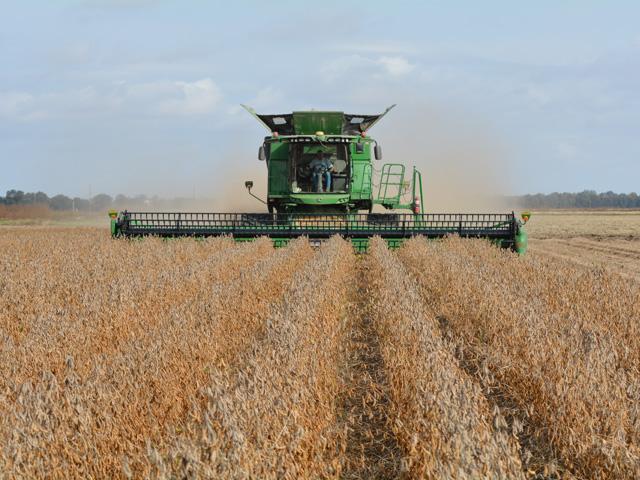
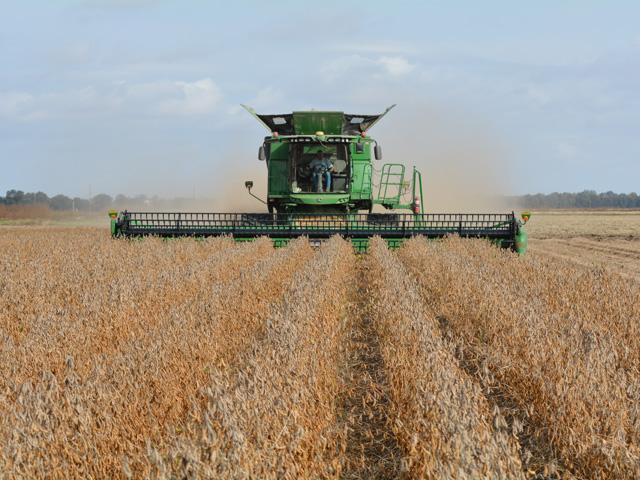
American farmers and ranchers suffered through the U.S.-China trade wars in both Trump administrations. In last year's trade war, China stopped buying American soybeans altogether for several months after Trump imposed 100% tariffs on Chinese imports.
P[L1] D[0x0] M[300x250] OOP[F] ADUNIT[] T[]
A recent analysis by the Economist concluded that "agriculture was hit harder by retaliatory tariffs than any other American industry." (https://www.economist.com/…)
The Chinese agreed last fall to resume purchases and the president agreed to slash the tariffs. This was more like a truce than a peace treaty, however. (https://www.dtnpf.com/…) Neither side can feel confident that the other will continue to abide by the agreement.
President Trump and President Xi Xinping are scheduled to meet in Beijing on May 14 and 15. Soybeans are on the agenda. It's of course not the only issue the two leaders will discuss. The Chinese want their still-high tariffs further reduced and the Hormuz Strait opened, among other things. The U.S. wish list includes rare-earths materials security and fentanyl-precursor control.
Still, Trump would love to come back with good news for U.S. soybean growers. There's a reasonable chance Xi will let him claim victory. The Chinese, he'll crow, will keep buying U.S. beans.
Make no mistake, though. Even if the summit is cordial and ends on a high note, there's no guarantee of permanent peace. Each side has demonstrated it has the power to inflict pain on the other. Both have indicated a willingness to use that power to make a point.
With the summit just weeks away, China did that -- twice. It ordered Meta, the U.S. owner of Facebook, to unwind its $2 billion acquisition of the Chinese AI startup Manus.
And when the U.S. Treasury sanctioned five small Chinese refiners for buying Iranian crude oil, China retaliated by saying the refineries could bring suit in Chinese courts against any bank, insurance company or other party complying with the U.S. sanctions. It was the first time China had activated its anti-sanctions "blocking rules."
The Wall Street Journal's Lingling Wei, perhaps the best-sourced U.S. journalist covering China, said she's hearing from people around the leadership that Xi thinks he's figured out how to "manage" Trump: "The U.S. president can be exhausted and outwaited, and calibrated escalation resets the bargaining floor instead of blowing up the relationship." (https://www.wsj.com/…)
Is Xi overplaying his hand? Though Trump wants this summit to go well, he doesn't want to look like he can be "managed." It wouldn't be surprising if at some point after the summit he reminds Xi he can inflict pain, too.
It's a truce, not a permanent end to hostilities. With luck, it will be a long truce. Trade, including soybean sales, will continue.
The Chinese, though, are preparing for the worst. They're striving to end their reliance on U.S. soybeans. They're buying Brazilian beans and building infrastructure to help Brazil get product to market. (https://www.dtnpf.com/…) They're working to reduce soybean consumption by developing fermented feeds for their pigs. (https://www.reuters.com/…)
U.S. soybean farmers must prepare for the worst, too. They may still sell some of what they grow to China, but they need greatly increased sales to other markets, both foreign and domestic, in case the truce collapses.
Just as China wants to stop depending on them, they need to stop depending on China.
Urban Lehner can be reached at urbanize@gmail.com
(c) Copyright 2026 DTN, LLC. All rights reserved.
Comments
To comment, please Log In or Join our Community .