

Ag Weather Forum
Early March Forecast Favors Major Drought Reduction for Central US
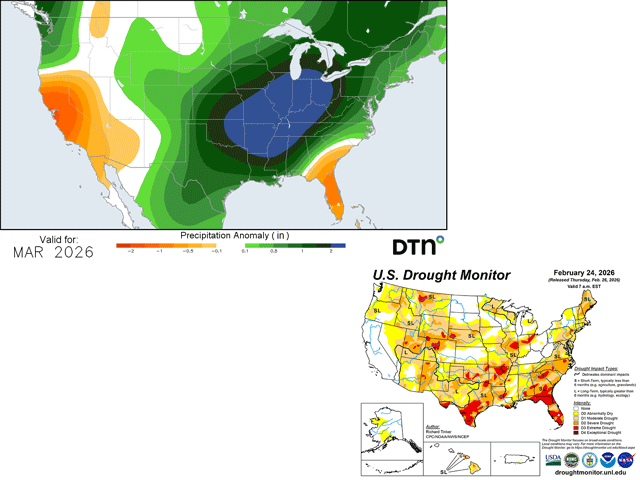
Drought is a major problem for much of the U.S. heading into spring. Though the weather pattern usually becomes more active as the seasons change, extremely large deficits have built up over the winter season that will take a lot of precipitation to undo. The next two-week period should feature some heavy precipitation for a lot of the middle of the country, and major reductions are looking rather likely for some of the areas in the deepest drought.
When looking at the U.S. Drought Monitor map released Feb. 26, large areas of the country are under some form of long-standing drought. From the Pacific Northwest to the Four Corners region, across the Southern Plains and Southeast and up through the Northeast, precipitation has not kept up to normal despite some rather big winter systems as of late. That includes the widespread ice and snowstorm across the South in late January, the record-breaking snow in the Carolinas a couple of days later, and the massive nor'easter that just hit the Northeast this past weekend.
Some of these areas have seen some drought improvement, particularly in the Northwest and around Arizona, as well as across small parts of Louisiana, Mississippi, and Alabama over the winter season. Areas around Nebraska and across the Midwest from Missouri up through northwest Ohio have been in drought as well, leaving mostly pockets of non-drought conditions across California, North Dakota, and the Upper Ohio River Basin as the only areas without true drought. Even the drought-free region across Kansas may be underplayed as recent dryness, strong winds, and high temperatures have robbed moisture out of the topsoil. That leaves drought as a major concern heading into the spring planting season.
P[L1] D[0x0] M[300x250] OOP[F] ADUNIT[] T[]
The weather pattern has been more active in the month of February, but it hasn't led to much in terms of widespread heavy precipitation that would reduce drought. Drought has instead increased for many areas of the country throughout the month. But the flip in the pattern that is coming up in early March is primed to bring through some wild weather that will include heavy rain and early rounds of severe weather that will make it feel like spring.
At least for the first two weeks of the month, the pattern is shaping up to bring an upper-level trough into the West. With a ridge largely stuck in the East, that leaves a storm track right through the middle of the country. Continuous reinforcements of the trough before its eventual push eastward should mean multiple rounds of storm systems, fronts, disturbances and all kinds of potential to create widespread and heavy precipitation out of moisture that will stream northward from the Gulf of America. The storm track favors a pattern from eastern Texas and Oklahoma to Ohio with the heaviest and most consistent precipitation, but it should be rather widespread through a lot of the middle of the country. DTN favors well-above normal precipitation over the first two weeks of the month in these areas. Near-daily precipitation may even be possible in this general area for 7 to 10 straight days, quickly eating away at precipitation deficits. Drought reduction looks like an almost certainty here, but toward the northwest across Nebraska into the Pacific Northwest and across the far Southeast into Florida, the precipitation is not expected to be as generous. Drought in these areas may not have significant reduction under the coming pattern and will need more throughout the rest of spring.
Other hazards will come with the precipitation as well. For starters, northern areas may still be cold enough for snow. Though the pattern is favoring above-normal temperatures for the first half of March, that doesn't mean it can't snow. For certain there will be some areas on the northern edges of the precipitation that will see heavier amounts, which could result in issues for removal. Depending on the circumstances, freezing rain may also be a possibility at times as well. But the biggest hazards are likely to be due to the rain. Producing multiple days of consistent and heavy rainfall may bring about flooding for areas that are currently in some form of drought. Area rivers will swell and could prolong the flooding well beyond the rainfall. And then there is the issue of severe weather. Increased temperatures along with multiple days of rain could bring torrential downpours, damaging winds, hail, and even some tornadoes for the first half of March. Areas from eastern Texas and Oklahoma up through the Lower Ohio Valley would be most at risk as of the current forecast, but that could change depending on the conditions.
And while the first half of the month certainly looks wet, the second half of the month could feature dryness. DTN also forecasts potential for a burst of arctic cold to come into the country late in the month into early April. It is not certain, but a distinct possibility. Where drought persists after the coming deluge, it likely will hold over into April, the start of the planting season for the middle of the country. Though some wet spots could remain, wetter conditions are needed to ease drought before summer heat turns on, and there could be some issues that will need to be monitored.
To stay up to date with weather conditions and your local forecast for free from DTN, head over to https://www.dtnpf.com/…
John Baranick can be reached at john.baranick@dtn.com
(c) Copyright 2026 DTN, LLC. All rights reserved.
Comments
To comment, please Log In or Join our Community .